- Home
- ServicesCrafted for Growth
Our development solutions are designed to transform your vision into a thriving success story.
- TechnologiesTech Solutions
We leverage cutting-edge technology to drive efficiency, scalability, and excellence in every project we undertake.
- Contact Us
The Growth of Vibe Coding: How AI Is Changing Software Development
Posted By
naxtre
Published Date
12-02-2026
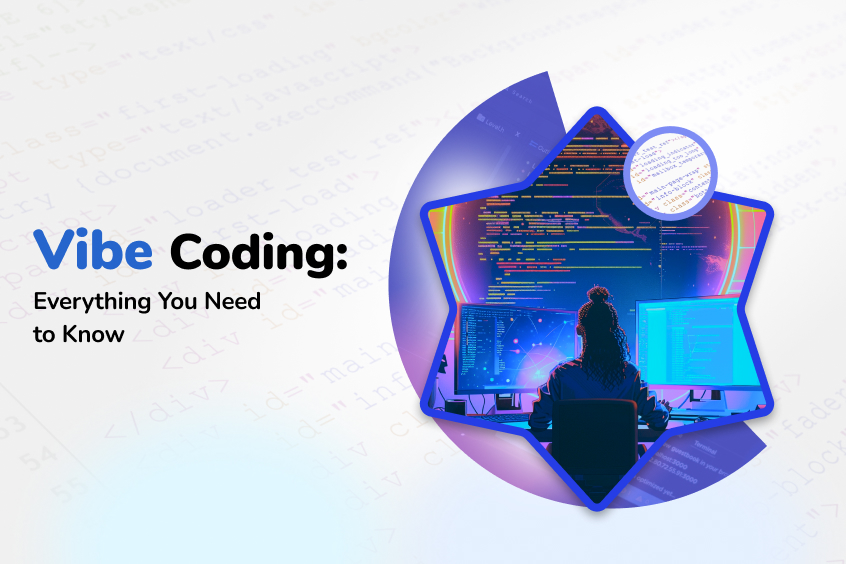
Vibe coding
is the newest trend in software development where both developers and people
who aren't developers can describe what they want in a software using everyday
language, and then use Artificial Intelligence to create real working code. As
more companies start using vibe coding in software development, they need to
carefully consider both the advantages and the potential issues that come with
it. In this blog, we guide you in telling the truth from the excitement and
show you how to use this new technology in a safe and smart way.
We live in
a world where 'vibes' are really important.
Everything
is decided by vibes. Which cafe to go to? The one with a better vibe. Which
song becomes popular? The one with a better vibe. With whom do we build
connections and develop personal relationships? Someone who matches our vibe.
Now, we are
also making apps and software with a certain feel or style.
Unless
you've been completely cut off from the world, you've probably come across
people talking about vibe coding, where they build complete apps without
writing any actual code.
People are
talking a lot on social media and developer forums about vibe coding. Some
coding tools such as Lovable, Base44, Replit, Bolt, and Emergent have become
really popular and are now even raising money for their projects.
But what
exactly is vibe coding? How vibe coding works? What are the benefits of vibe
coding? Are there any risks of vibe coding? And most importantly, is it really
something that enterprises should care about, or is it just something non-technical
people can have fun with?
In this
blog, we cover all these questions and many others. Plus, here's a simple
checklist to help you figure out if you need vibe coding in your workflow or
not.
What Is Vibe Coding?
One of the
biggest trends in software engineering right now is vibe coding.
It's
basically using big language models to create app code by talking through
instructions. You explain to the AI what your app should do and how it should
appear. Then it creates that app for you.
You don't
look at the code, don't care about it, and don't make any changes to it. If the
app works, congratulations! You are now a successful vibe coder. If not, let
the tool know and have it fix the problem. Repeat until you have a functioning
app.
This new
way of coding uses natural language design, quick changes, and AI to create
code. It focuses more on the purpose rather than the exact structure, on
getting things done quickly instead of doing it by hand, and on the results
rather than the carefully made design.
A Brief History and Why It’s Trending
The term
was first used in February 2025 by AI leader Andrej Karpathy, who used “vibe
coding” to describe the emerging natural-language-first development workflow.
By the
middle of 2025, the phrase had quickly spread through social media, groups of
developers, and regular news outlets. Collins Dictionary has officially named
"vibe coding" as the 2025 Word of the Year, showing how much it's
part of the culture now.
Besides all
the social talk, the growing popularity of vibe coding shows a big change in
how people are approaching software development. As more vibe coding AI tools
develop, both non-technical people and developers along with companies are
trying them out. New ways of coding are combining creativity, automation, and
real engineering across different groups in organizations.
Why is Vibe Coding important in 2026 and in the future?
Although the name sounds fun, vibe coding is much more than just a joke or a trend. It shows a real change in how software and apps will be made in the coming years. Here are some vibe coding stats to give you a better idea.
- 63% of people who use vibe coding are not developers, and they use it to build user interfaces, full-stack applications, and their own personal software.
- The Asia-Pacific (APAC) region is leading in using vibe coding, with 40.7% of all vibe coding happening there. About 13.9% of people who use vibe coding are from North America.
- Developers who have been coding for more than 10 years say that using AI to help with vibe coding has made them 81% more productive.
- Organizations in regulated sectors such as healthcare (28%) and financial services (34%) are also using vibe coding for developing non-critical and internal tools.
- The coding market for vibes is currently worth about $4.7 billion and is growing at a rate of around 38% each year. It's expected to reach a value of $12.3 billion by 2027.
The quick
growth of vibe coding software development is because of three strong industry
factors:
1. The AI Boom & Better LLMs
Nearly all
top companies have put money into AI. Newer AI systems like GPT-5 models,
Claude-Opus models, and other special AI coding tools now have a better understanding
of context, design patterns, and detailed instructions. This evolution shows
how vibe coding works in a practical and dependable way better than ever
before.
2. Democratization & Lower Barriers to Entry
Non-developers,
subject matter experts, and product managers can now take part in coding
directly using the vibe coding platform. Instead of waiting for the engineering
team to free up bandwidth, they can start creating a prototype quickly. This
makes it easier for more people and different fields to use vibe coding in
their work.
3. Faster Prototyping & Innovation Velocity
Today,
time-to-market pressures are sharper than ever. Enterprises aim to try out new
ideas quickly, check if their concepts work, and cut down on the initial work
needed for engineering. That's where the benefits of vibe coding become most
clearly measurable.
But What About Enterprises?
Should
companies stop relying on developers and development teams and move to using AI
for coding based only on vibes?
Absolutely
not.
- Vibe coding is good for personal projects that you work on locally and use just for yourself, especially when the main goal is fun and not for sharing or using by others. If you want to create an app that runs on the Internet, is used by people besides the vibe coder, and needs to work with other apps, you need expert help.
- We haven’t gotten to that stage in this evolution where you can really begin comparing vibe coding with traditional coding for enterprise needs.
- Vibe coding can definitely help speed up the creation of MVPs, automation scripts, and the development of small internal tools and proof of concepts. You still need traditional engineering to support important systems that must always work, have strong security, and follow strict rules.
- For enterprises, vibe coding is not a replacement for traditional coding. It's a smart approach to overcome old obstacles and use the best of the technology we have. Before we get into that, let's first figure out what the opportunities and risks of vibe coding are.
What are the Benefits of Vibe Coding?
Beyond the
excitement of letting everyone become a 'developer,' vibe coding has become one
of the most popular uses of AI. Here are the actual, noticeable advantages of
vibe coding that are influencing the future of how software is developed.
1. Rapid Prototyping at Scale
Using
coding tools that create a vibe and AI to build the structure, you can make
early versions of a project in just a few hours—sometimes even just
minutes—instead of taking weeks. This speed allows teams to test their ideas
more quickly and cuts down on unnecessary work in engineering.
2. Anyone Can Contribute
Domain
experts, analysts, and business teams can take part in vibe coding, where they
write requirements using everyday language. This allows people without
programming skills to get involved and share in the creation of new ideas.
3. Innovation & Experimentation
When code
generation takes just a few minutes, experimenting becomes much cheaper. Teams
can look at more examples of vibe coding, work on their UI/UX concepts, and try
out different versions. All without heavy resource investment. This benefit
also helps developers working with vibe coding, allowing them to try out their
ideas more quickly.
4. Cost-Efficiency
AI helps
cut down on the extra work needed for making MVPs, prototypes, and internal
tools. This is especially helpful in early projects, where AI coding tools let
you work faster without needing to go through the whole engineering process.
In many
different fields, these advantages have created several situations where vibe
coding is used, making it an important part of how coding will develop with AI.
What are the Risks and Challenges of Vibe Coding?
Although it
has potential, there are a number of issues with vibe coding that must be solved
before it can be considered for use in professional settings. Some of the
biggest challenges in vibe coding include:
1. Quality, Security & Maintainability
AI-created
code can have secret weaknesses, old methods, unstable parts, or problems with
growing too fast. These coding risks make it not safe for use in real projects
unless someone checks it manually.
2. The Need for Human Oversight
Even with
smart AI tools that help with coding, people still need to check the work by
hand, watch over the design, plan for security risks, and test how well the
system runs. Enterprises need to follow good coding practices, like doing
regular checks and using automatic tools to scan for issues.
3. Suitability & Use-Case Matching
Vibe coding
and traditional coding aren't either-or options. Vibe coding might be good for
creating prototypes, building internal tools, and working on applications where
the risk is low. Traditional engineering is essential for industries like
banking, healthcare, supply-chain, and other critical products, especially when
they are used by the public.
In short,
the best results happen when companies use AI for vibe coding in a responsible
way, and when they handle the risks and challenges with good governance, clear
rules, and careful attention at the enterprise level.
How Enterprises Can Use Vibe Coding in a Smart and Responsible Way?
Recently,
at Naxtre, we've been working with many clients who have come to us with
incomplete or poorly developed apps. All vibe coded. All good looking. Some
even working on the frontend. But beneath the top layer, everything was a real
mess.
Security? Non-existent
Code
clarity? Barely there.
Documentation?
Just vibes, no pages.
Scalability?
The moment you moved past the demo environment, things began to go wrong.
And
maintainability? Unless you were the original "vibe coder" who wrote
it at 2 AM with lo-fi playing in the background, it's going to be really hard
to figure out how anything works.
The truth
is: Vibe coding can lead to fast progress, but without proper controls, it
creates hidden technical debt that looks like real innovation.
That's why
the answer to getting these vibe-coded apps to work properly is to combine AI
expertise, strong cloud capabilities, and solid engineering practices. This
allows companies to use vibe-coding software development in a safe and efficient
way.
Naxtre’s Strengths That Support Vibe Coding Adoption
At Naxtre,
we have the right tools, knowledge, and experience to help you turn your vibe
coded apps into real working apps for production use. Here are the main advantages
that make it possible:
1. Generative AI & AI-Agent Development
Adding tools like vibe coding, copilots, and AI-powered workflows to the company's existing processes.
2. Cloud Support & Data Engineering
Creating
safe, flexible, and rule-following spaces for building AI systems.
Creating
strong automation and quality control systems for the vibe-coding workflow
models.
4. Enterprise-Grade Software Engineering
Organizations
absolutely need to include the architecture, governance, and “responsible
innovation” layer.
With that,
we can help with quick testing of ideas, easy automation, creating internal
tools, building a basic version of a product, and developing small to
medium-sized applications. Our teams focus on quality, keep things easy to
maintain, and make sure everything is secure, so we can move quickly while
still building something that lasts.
The Future of Software Development: Vision & Vibes
As we think
about the future of vibe coding, it’s clear that using AI in software
development will change things a lot. Vibe coding is not a complete substitute
for engineering. It's a strong, imaginative tool that helps push the future of
coding with AI forward.
Naxtre follows current coding trends but still keeps the important principles of safe,
dependable, and cloud-based development. We combine fast action with careful
responsibility, helping teams create new ideas with confidence and in a way
that lasts.
Let's Talk
About Your Idea!