- Home
- ServicesCrafted for Growth
Our development solutions are designed to transform your vision into a thriving success story.
- TechnologiesTech Solutions
We leverage cutting-edge technology to drive efficiency, scalability, and excellence in every project we undertake.
- Contact Us
AI-Driven Data Engineering: How Machine Learning Models are Shaping the Future of Healthcare Data Pipelines
Posted By
naxtre
Published Date
04-12-2025
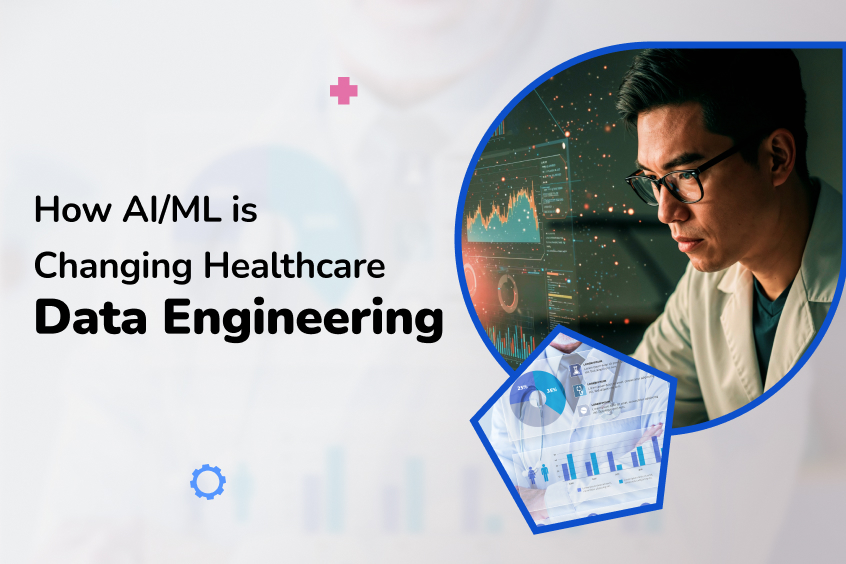
This blog provides a summary of the impact of machine learning on healthcare data engineering as a result of AI's increased involvement in data engineering within healthcare. The blog also provides real-world examples of how machine learning models have enhanced data workflows, as well as Case Studies from the author's Experience, and Highlights best practices developed from experience in the field and offers Practical Steps for preparing your organization/enterprise for AI.
Historically,
healthcare and Health Providers have had little say in how their data is
utilized. In fact, a large percentage of the electronic health records, Diagnostic
Imaging, Device Data and Clinical Notes generated from these facilities are
considered as Unstructured Data and therefore, only 3 percent are utilized.
Approximately
50 Petabytes of electronic health records are generated annually through 1
hospital. Of this data, approximately 97 percent will either be trashed or
require manual processing, which is inefficient and a waste of resources.
The reason
for this was not that organizations did not want to utilize the data available,
but rather it is more of the limitations of the systems employed by them.
The
traditional ETL method was designed to manage only a small number of structured
sources with very limited complexity.
The
existence of stringent restrictions regarding Privacy on the transfer of PJI has
also limited the extent to which Healthcare Organizations can share
"sensitive" or private information within the organization. Also,
analytics tools have found it difficult to work with unstructured
clinical/medical texts during this time.
These
difficulties in obtaining the , and evaluating Healthcare Data, have existed
from 2010 through to 2018. In some
respects this extended into February of 2020.
Advances
in artificial intelligence and machine learning (AI and ML) technologies have
begun to change this ability. AI and ML technologies have allowed for the
creation of simple yet powerful Data Pipelines that are able to read, classify,
anonymize, and connect data from hundreds, if not thousands, to millions, of
operational and clinical Data Sources in almost entirely real-time.
As the
sole focus of our Healthcare Digital Solutions bent on improving productivity
through the use of AI, we have closely followed how AI and MOUSE-Powered Data
Pipelines have been changing the Healthcare Digital Landscape, which includes
Natural Language Processing (NLP), automated removal of identifiable health
information, Machine Learning methods used for Patient Matching, and
AI-assisted FHIR Mapping to create Fully Interoperable and Ready for Actionable
Insights, none of which is Feasible without the ability provided through
MOUSE-Powered Data Pipelines.
The Purpose of This Blog and Why You Should Read
It
For this
blog, we reached out to our senior data engineers who’ve specifically worked
with hospitals and MedTech firms. Their perspective and the information we
gained shaped much of what you’ll read here.
The
consensus is this – AI is transforming the healthcare industry at an unusually
brisk pace. And you can see the momentum in the way modern data pipelines are
being designed around MLOps practices. Waiting too long to modernize will make
that gap almost impossible to close later, once AI-driven interoperability and
automation become industry standards, after the boom turns into a baseline
expectation.
On this
point, Pratik Mistry, who leads Technology Consulting at Naxtre, makes an
important observation:
“Healthcare
has probably gained the most from AI so far. Those are the foundations that
make every advanced use case possible. The challenge now is speed. The ones who
start early will build smarter systems. The rest will just play catch-up.”
If you
have not started exploring how AI/ML improves healthcare data workflows yet,
this is the moment to begin.
The Goal Of This Blog And Why You Should Read It
This blog
was created after talking to the senior engineers at Naxtre who have extensive
experience working with hospitals and MedTech organizations.
Based on
their suggestions along with our collected data, this blog will focus on the
impact artificial intelligence (AI) on the healthcare industry.
What this
Blog’s Goal Is - AI is rapidly
revolutionizing healthcare, as evidenced by the emergence of modern data
systems utilizing MLOps practices. If you wait until you need to migrate or
modernize your systems, it will be even more challenging in the future when
AI-based interoperability and automation become the predominant methods for
managing electronic health records (EHR).
Manisha
Kumari, the Marketing Analyst at Naxtre explained it this way:
“Healthcare
has gained the greatest advantages from AI thus far, and these foundational
elements create the foundation for future advanced applications. However, the
major challenge now is how quickly companies can develop their systems since
there is now a time gap. Companies who start today will have a better equipped
to develop newer systems, while those who wait will find themselves in a
significant disadvantage in the coming years.”
If you
haven't already started to investigate how AI and machine learning technologies
might change the way data is managed within your organization, now is the right
time!
How AI/ML Models Enhance Data Engineering in
Healthcare and Optimize Each Pipeline Stage
The
incorporation of Artificial Intelligence (AI) and Machine Learning (ML) into
healthcare data pipelines has resulted in automating all steps of the pipeline
processes that previously required manual configuration through the use of
intelligent ML algorithms that apply the knowledge obtained from previously
entered data into a system and how that system operates on that data.
Now, let’s
take a look at each segment of the data pipeline where AI creates the most
value.
1. Data Collection and Structuring
The
various types of healthcare data are collected by various organizations, and
each collection organization uses its own form of data; e.g., HL7, DICOM,
Medical Devices, and handwriting.
AI can
determine which data sets are similar to each other and then analyze and
combine them even if they don't share the same layout, format, etc.
After AI
identifies the various types of data and determines which fields will be
included, there is no longer a need for human intervention to identify the data
fields that require mapping to each other. Instead, machine learning models and
embeddings are used to identify standard fields, allowing for the easy addition
of additional data sources and for them to be converted to FHIR. Similarly,
these models eliminate the need for users to create custom tools to connect
with each unique data source, thereby eliminating the redundancy of tasks
previously required.
2) Extracting Practical Applications from
Clinical Narrative Documents
Due to
having multiple systems that have different terminologies (e.g., unit of
measure, a medical device, etc.) and/or formatting of the same information,
medical information is often not cleanly captured.
Machine
Learning Frameworks have historically developed using past correction activity,
and subsequently, Machine Learning Frameworks will take future correction
action by adding additional terms to the standard terminologies (i.e., LOINC,
SNOMED and RxNorm) based on previously corrected data.
There has
been an increase in the use of Natural Language Processing (NLP) tools to
perform these functions.
The NLP
tools are being increasingly used for extracting selected data elements from
Clinical Narrative documents (e.g., Physician’s Notes, Discharge Summaries, and
Laboratory Reports) and converting them into coded data formats.
As a
result, the AI tools that assist with the standardization of medical data are
increasingly being used in the healthcare space (e.g., IMO Health).
Thus the
written records can be used to create aggregate data as well as used in the
analysis of the patient population without requiring a large number of
personnel to manually label the data.
3) Patient Record Matching and Patient Identity
Resolution
Historically,
matching the same patient inside of multiple systems is one of the major
challenges faced in healthcare.
This is a
widely recognized issue, and currently there are many successful Machine
Learning Frameworks that utilize both probability and grading scales to
generate patient record matches, even with inconsistent or missing identifiers.
These
models evaluate similarity across demographic, temporal, and clinical variables
to determine whether records belong to the same individual. Advanced solutions
extend this logic with embedding-based matching that captures subtle
correlations beyond simple field comparison. Healthcare service providers get
more reliable longitudinal patient records, which is essential for analytics
and research.
4. Automated De-Identification and Privacy
Controls
Another
application of AI in healthcare data engineering is automated de-id systems.
Data must retain analytical value and protect patient privacy. AI tools
automate this process by detecting and masking protected health information
across structured fields and free-text documents.
NLP once
again works as the core mechanism here. It locates names, addresses, or
identifiers, computer vision solutions scan image metadata, and context-based
models decide when to replace data with realistic synthetic equivalents. There
are now reports of large real-world NLP systems that processed and
de-identified hundreds of millions or more clinical notes with independent
certification for production use.
5. Continuous Quality and Observability
AI
supports continuous data quality oversight. It performs exceptionally well in
learning baseline distributions and identifying deviations. ML systems flag
distributional shifts, sudden drops in completeness, inconsistent coding, or
schema changes that might break downstream analytics.
Anomaly
detection models classify data quality incidents and rank them by business
impact. As a result, medical teams can prioritize remediation efficiently
without any surprise failures in production analytics and clinical decision
support.
6. Feature Engineering and Serving
Once data
is standardized, ML contributes to generating higher-level attributes that feed
predictive models or population studies. Algorithms can derive patterns such as
medication adherence rates, episode timelines, or lab trend indicators from raw
data.
Automated
feature engineering platforms evaluate feature stability and correlation to
prevent drift and redundancy. Data scientists can focus on hypothesis design,
not mechanical variable preparation. Outcomes here are practical – shorter
model development cycles and fewer feature-related production incidents when
teams adopt feature stores and automated feature-stability checks.
7. Pipeline Optimization
Brute-force
scaling used to be the target state for healthcare data pipeline optimization.
Now, it’s about intelligence and timing. Predictive scheduling and adaptive
resource allocation are at the core of how teams run their workloads.
In
practice, models forecast upcoming demand, adjust cluster capacity on the fly,
and even reorder processing tasks to keep throughput steady. Cost-optimization
agents quietly watch historical pipeline metrics and spot where performance can
be maintained without over-provisioning. Such reliable, real-time performance
doesn’t burn unnecessary compute or cloud spend.
8. Governance and Metadata
AI-assisted
cataloging has become one of the most practical upgrades in automated
healthcare data systems. These tools automatically classify incoming datasets,
tag sensitive attributes, and maintain an ongoing record of data lineage.
Behind the
scenes, metadata extraction models read schema definitions and pipeline logs to
build a full lineage graph, something that once took teams weeks to document
manually. The outcome is a governance layer that makes data far easier for
analysts and clinicians to find, trust, and reuse.
Top Benefits and Industry Use Cases of AI in
Healthcare Data Engineering
Looking at
the recent trajectory of AI adoption in healthcare, the last few years have
been a turning point. The pace of innovation has been remarkable and deeply
integrated into everyday workflows. New use cases appear constantly, sometimes
in places no one expected.
Here are
some of the most relevant use cases of AI/ML optimized data pipelines where the
impact feels most visible right now:
Use Case 1: Clinical Operations
AI-powered
data pipelines are the key enabler here. These pipelines manage real-time data
ingestion from multiple hospital units and feed validated data to operational
models. This is an innovative example of using AI to automate data validation
in healthcare systems.
•
Predictive scheduling models integrated within
streaming ETL frameworks forecast admission surges.
•
NLP modules extract key operational terms from
physician notes during data ingestion.
•
Real-time data validation layers flag anomalies
before they propagate to downstream dashboards.
Use Case 2: Population Health Management
Data engineering
for medical and population health used to be a cycle of periodic data
aggregation. But AI has shifted it to dynamically updated streaming pipelines.
AI models now harmonize unstructured datasets to automatically link patient
records with payers, providers, and social health sources.
•
Graph-based record linkage resolves fragmented
patient identities across multiple EHR systems.
•
ML classifiers tag social determinants of health
attributes during data ingestion.
•
Predictive pipelines score population risk
dynamically and feed directly into care coordination platforms.
Use Case 3: Medical Imaging and Radiology
Imaging
pipelines have grown from static repositories into intelligent, self-optimizing
data systems. AI integrates directly into the data flow for each scan to be
properly indexed, classified, and retrievable across systems.
•
ML-based DICOM parsers auto-extract metadata and
normalize formats for unified access.
•
Vision models generate pre-screening scores that
feed triage queues in PACS.
•
Federated data pipelines support multi-hospital
model training without sharing raw images.
Use Case 4: Clinical Research and Trials
Research
pipelines now heavily rely on ML to automate eligibility screening, data
curation, and compliance. AI supports end-to-end traceability from data
ingestion through analysis. The end results are improved speed and audit
readiness.
•
NLP pipelines extract trial-relevant variables
from EHRs and map them to protocol fields.
•
De-identification models scrub PHI and preserve
semantic structure for analytics.
•
ML-integrated ETL provides consistent variable
definitions in multi-site research environments.
Use Case 5: Genomics and Precision Medicine
AI models
are deployed to handle the massive data loads and complexity that come with
genomics. ML algorithms help standardize formats, extract important patterns,
and interpret variations while fitting neatly into cloud data systems.
•
Deep sequence models classify genomic variants
during ingestion to reduce manual review.
•
ML-assisted ETL automates alignment and
annotation workflows using unified schema templates.
•
Features enginerring pipelines merge genetic and
clinical phenotypes for model training.
Use Case 6: Healthcare Analytics and Reporting
AI-optimized
data pipelines are smarter and more self-adjusting than traditional pipelines.
Instead of waiting for manual updates, AI keeps data fresh, flags drift
automatically, and fine-tunes outputs. Teams get analytical reports that stay
consistent with source data.
•
ML-based data quality scoring gates defective
datasets before they reach BI tools.
•
Generative models compose executive summaries
from structured metrics and contextual metadata.
•
Predictive pipelines monitor ingestion latency to
maintain timely reporting cycles.
Use Case 7: Digital Health and Remote Monitoring
AI-powered
data pipelines are making some of their biggest strides in digital healthcare
right now. Streaming pipelines now process millions of sensor readings per
patient daily. AI and ML maintain these flows with minimal noise and automate
classification/synchronization in device ecosystems.
•
Online learning models distinguish valid clinical
events from device artifacts.
•
Predictive resource allocation adjusts compute
for varying telemetry loads.
•
Drift detection models track device accuracy
degradation and trigger recalibration alerts.
Use Case 8: Regulatory and Compliance Management
Talk to
anyone managing patient data today, and they’ll tell you about the role of AI
in healthcare data compliance and security. Governance data pipelines now
feature automated compliance monitoring, lineage tracking, and PHI detection
powered by AI. ML models. Data transformations stay documented and
policy-aligned, which is essential for HIPAA, GDPR, and GxP frameworks.
•
ML classifiers tag sensitive attributes during
data ingestion and transformation.
•
NLP models analyze regulatory updates to identify
impacted datasets.
•
AI-based risk scoring models flag unusual access
or data-sharing patterns.
Challenges of Integrating AI with Healthcare Data
Pipelines
The problem
areas mentioned below came from our own experiments, as well as from
conversations with teams across hospitals, research institutes, and healthtech
companies around the world.
The
challenges of using modern AI models in healthcare data are surprisingly consistent
– data quality issues, compliance hurdles, model drift, and data
inconsistencies:
Fragmented
Data – Healthcare data still sits in disparate systems with different formats
and coding standards. This issue is so prevalent that even firms with FHIR-enabled
vendors struggle with partial data adoption and inconsistency.
Unstructured
Clinical Text – More than 70% of clinical information is buried in free-text
notes, scanned PDFs, radiology narratives, and discharge summaries. Without
strong NLP pipelines, most ML models are starved of context. Converting
unorganized text into structured, usable inputs becomes a major barrier.
Challenges in Healthcare AI/ML Workflows
• Data
Quality is Still Highly Variable
Incomplete
histories, duplicated records, inconsistent timestamps, missing vitals, and
unreliable device readings create considerable friction. ML models amplify
these inconsistencies.
•
Regulatory Needs Keep Changing
Most
healthcare companies don’t yet have dedicated policy specialists, so every time
there’s some change in regulations, model review results in a lengthy and
repetitive cycle of iterations, paperwork, and approvals.
• Model
Drift
As
clinical data gets frequently updated with new medications, disease patterns,
guidelines, etc., model drifts happen faster than you would expect. Healthcare
teams don’t have any option but to continuously retrain ML models. This mostly
happens in population health and early-warning systems.
Best Practices for Implementing AI/ML Models in
Healthcare Data Workflows
Now, to
address those challenges, here’s a set of practices that we now see as
non-negotiable when building scalable healthcare data pipelines using AI and ML
models:• Start with a Clean, Structured Data Foundation
AI-powered
data pipelines are only as reliable as the input. Establishing unified schemas,
consistent identifiers, and strict data validation early should be your
priority to avoid compounding quality issues downstream.
•
Prioritize Privacy by Design
Build
de-identification, consent tracking, PHI masking, and data access governance
into the pipeline itself. Do not layer them later. Compliance has to stay
automatic, not reactive.
• Use
Modular Pipelines for Model Integration
The
modular design approach is relevant here as well. Keep model training,
inference, and monitoring as modular components. This design allows iterative
updates and quick model swaps without disrupting upstream or downstream
processes.
• Deploy
Real-Time Quality Monitors
Set up
automated drift detection, missing data alerts, lineage tracking, and outlier
monitoring. Continuous feedback keeps AI predictions stable even as clinical or
operational data changes.
• Design
for Cross-System Compatibility
AI
pipelines work best when data flows without any friction across EHRs, research
systems, and analytics tools. This is the very reason teams following FHIR and
HL7 standards for interoperability are ahead in realizing the benefits of
AI-driven data engineering in hospitals.
• Scale
Infrastructure Responsively
Since
elastic scaling keeps pipelines cost-efficient without having any impact on
inference speed or data throughput, it’s best to use adaptive resource
allocation and containerized workloads.
The Next Phase of AI in Healthcare Data
Engineering
AI’s
growth curve has been exponential recently. It’s rare to see a field reinvent
itself this fast, and so, the next 5–10 years will shape the long game.
As of now,
the future trends in AI-based healthcare data engineering will be around
self-learning systems. Our data engineering team follows the latest shifts
through workshops and industry conferences led by major cloud vendors. They are
already working with early prototypes of AI-optimized pipelines that are
intelligent enough to adapt, heal, and optimize themselves. In other words, the
infrastructure is starting to think for itself.
Generative
AI is also steadily finding its place inside healthcare data ecosystems. Teams
are using it for data harmonization, to summarize clinic text to feed
pipelines, map codes, and fill gaps in unorganized data sets. Most of this is
still in the sandbox stage, but the potential is obvious, as long as the safety
constraints are followed.
What Healthcare Enterprise Leaders Should
Prioritize Right Now
The most
important move for healthcare organizations right now is to start modernizing
quietly, but deliberately. It can be small, but it has to be strategic.
Automate a few workflows, run pilots on clinical or claims data, and learn from
the feedback loop. Don’t wait for the perfect architecture. The teams already
experimenting are the ones who’ll be ready when AI-driven data systems become
the default.
If you’re
planning a transition, consider working with us. Every insight in this blog
comes from our own experience, and we assure you we’ll handle your project with
the utmost technical discipline. We have recently worked on a healthtech
project where we developed production-ready MLOps pipelines from prototypes.
Our AI
research and engineering team is continuously upskilled on the latest
breakthroughs, and we have a dedicated R&D desk for AI experimentation. If
you’re not ready for a full-scale rollout, run a pilot project with us.
Connect
with our team, and we’ll get back to you within 48 hours with a complimentary
strategy session.
Let's Talk
About Your Idea!