- Home
- ServicesCrafted for Growth
Our development solutions are designed to transform your vision into a thriving success story.
- TechnologiesTech Solutions
We leverage cutting-edge technology to drive efficiency, scalability, and excellence in every project we undertake.
- Contact Us
The Real Cost of Building an AI-Powered App in 2026: India vs US Breakdown
Posted By
naxtre
Published Date
20-03-2026
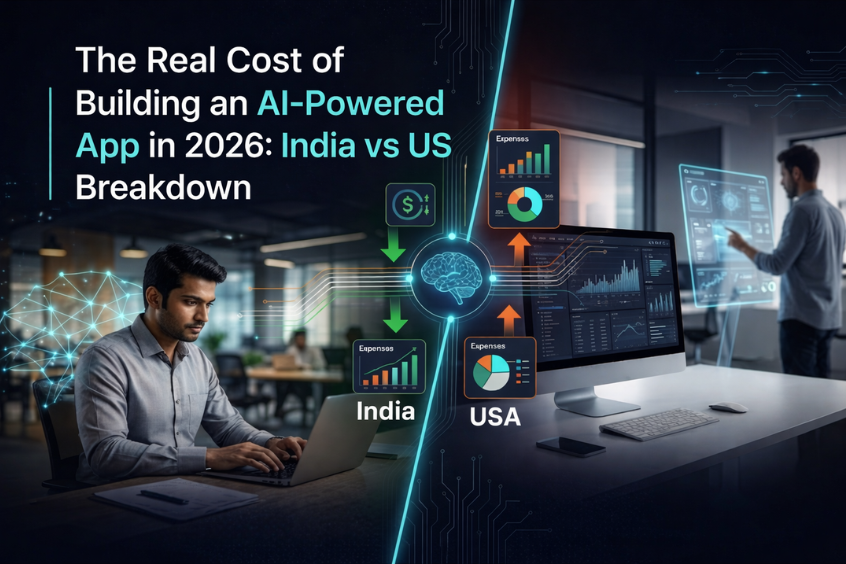
Somewhere right now, a business leader is staring at two
proposals on their desk. One from a US-based AI development firm — polished
deck, impressive credentials, and a project estimate that starts at $400,000.
The other from a top-tier Indian development team — AWS certified, enterprise
portfolio, and a quote that comes in at $95,000 for the same scope.
Same product. Same quality bar. A $305,000 difference.
This is the reality of AI app development costs in 2026 —
and most businesses are still making decisions based on outdated pricing data,
vague estimates, or worse, gut feel. This guide fixes that. Whether you are
building an AI chatbot, a predictive analytics platform, or a full agentic
enterprise system, here is an honest, data-driven cost breakdown — by complexity
tier, by app type, and by geography — so you can budget intelligently and
choose the right partner.
Why AI App Costs Have Shifted in 2026
Three forces have fundamentally changed how AI apps are
priced this year.
First, the intelligence layer is now a utility. Tools
like OpenAI's API, Anthropic's Claude API, Google's Gemini, and AWS Bedrock
mean that most businesses no longer need to train large models from scratch.
You pay for access to pre-built intelligence and focus engineering budget on
integration, fine-tuning, and product logic. This has compressed the lower end
of AI development costs significantly.
Second, agentic AI has raised the complexity ceiling. The
high-end of AI development in 2026 is not answering questions — it is taking
autonomous actions across systems. Building agentic AI workflows requires
multi-step reasoning, tool use, and memory layers — which is substantially more
engineering-intensive than a simple chatbot.
Third, the India talent market has matured dramatically. India
is no longer just a low-cost back-office for AI work. It has become a global
centre of excellence for LLM fine-tuning, RAG pipeline architecture, and data
engineering. Senior AI engineers in Bengaluru, Hyderabad, and Mohali now
deliver production-grade enterprise AI at rates that are 60-70% lower than
their US counterparts.
Key Statistics for 2026:
- Global AI market size: $757 billion in 2026
- 80%+ of enterprises are deploying GenAI applications (Gartner, 2026)
- Offshore AI development in India saves businesses 60-70% vs US rates
- 70-85% of AI projects fail due to poor planning, not technology limitations
AI App Development Cost: The Three Complexity Tiers
The single biggest mistake businesses make when
budgeting for AI is treating all AI as the same. A customer support chatbot and
an autonomous financial reconciliation agent are completely different
engineering challenges. Here is how the market is structured in 2026:
Tier 1: API-First AI Apps — Chatbots, Assistants, Simple Automation
India: $20,000-$75,000 | US:
$80,000-$200,000
These apps plug into existing AI models (OpenAI,
Claude, Gemini) via API and wrap them with custom business logic. Think customer
support bots, internal knowledge assistants, document summarisation tools, and
basic recommendation engines. Build time is typically 2-4 months with a small
team. This is where most businesses should start.
Tier 2: Fine-Tuned & RAG-Powered Applications — Domain-Specific AI
India: $80,000-$200,000 | US:
$250,000-$500,000
When off-the-shelf models are not accurate enough for
your domain — legal analysis, medical coding, financial risk modelling — you
move into fine-tuning or Retrieval-Augmented Generation (RAG) systems. This
requires machine learning engineers, proprietary datasets, and evaluation
frameworks. Data preparation alone typically accounts for 25-35% of the total
budget at this tier.
India: $200,000-$500,000+ | US:
$500,000-$1.5M+
The frontier of AI development in 2026. Agentic
platforms take actions — they call APIs, read and write databases, orchestrate
workflows, and make decisions across systems with minimal human input. Building
these systems requires senior AI architects, robust evaluation pipelines, and
enterprise-grade security and governance layers.
India vs US: Where Your Money Actually Goes
The location of your development team is still the
single largest variable in your AI app budget. Here is the honest picture:
United States — Senior AI Engineers
- Average hourly rate: $150-$250 per hour
- 5-person team for 6 months: $780,000-$1,300,000
- High overhead, including benefits and office costs
- Typical hiring timeline: 3-6 months per senior engineer
India (Top-Tier Firms) — Senior AI Engineers
- Average hourly rate: $30-$70 per hour
- 5-person team for 6 months: $195,000-$420,000
- No hiring overhead or employment benefits costs
- Team ready to start within days, not months
Important: Not all India-based AI teams are equal.
The rate range in India spans from $15/hr (junior freelancers with no AI
specialisation) to $70/hr (AWS-certified senior AI architects at established
firms with enterprise portfolios). Pay the difference for the latter. The
cheapest offshore team is rarely the most cost-efficient when you factor in
rework, delays, and technical debt.
AI App Cost by App Type — 2026 Benchmarks
Real-world cost benchmarks by AI application type,
with India vs US estimates:
- AI Chatbot / Support Bot: India $20K-$50K | US $80K-$150K | Timeline: 2-3 months
- AI-Powered Analytics Dashboard: India $40K-$90K | US $150K-$280K | Timeline: 3-5 months
- Predictive Analytics Platform: India $60K-$130K | US $200K-$400K | Timeline: 4-6 months
- NLP / Document Intelligence App: India $50K-$120K | US $180K-$350K | Timeline: 3-6 months
- Computer Vision Application: India $80K-$200K | US $280K-$600K | Timeline: 5-9 months
- AI Recommendation Engine: India $55K-$140K | US $200K-$420K | Timeline: 4-7 months
- AI MVP (Proof of Concept): India $20K-$40K | US $80K-$160K | Timeline: 6-10 weeks [RECOMMENDED STARTING POINT]
- Agentic Enterprise AI Platform: India $200K-$500K+ | US $500K-$1.5M+ | Timeline: 8-18 months
The 6 Cost Factors Most Businesses Overlook
1. Data Preparation — The Most Underestimated Expense
AI models are only as good as the data they are trained or grounded on. In 2026, data preparation — cleaning, labelling, structuring, and curating proprietary datasets — typically accounts for 25-40% of the total AI project budget. This cost is almost never mentioned in initial proposals. Ask your vendor how much data work is included before you sign anything.
2. Cloud Infrastructure and Ongoing Inference Costs
5 Proven Ways to Reduce Your AI Development Cost Without Cutting Corners
- Start with an AI MVP, not the full vision. A focused AI MVP validates your use case in 6-10 weeks and $20K-$40K. Real user data then guides where to invest in the full build.
- Use pre-trained APIs before building custom models. OpenAI, Anthropic, and Gemini APIs give you production-grade AI intelligence for a fraction of the cost of training your own model. Only move to fine-tuning when the use case genuinely demands it.
- Choose serverless cloud architecture. Serverless tools like AWS Lambda and Google Cloud Functions auto-scale and charge only for actual usage — cutting infrastructure costs by 30-40% compared to traditional server setups.
- Partner with a certified offshore AI team. A top-tier India-based AI development partner with AWS certifications can reduce a $150,000 US-quoted build to $60,000 — without sacrificing production quality, timelines, or architecture decisions.
- Define success metrics before development starts. Projects with clear, measurable outcomes consistently outperform those that begin with a broad vision. Undefined metrics are the number one reason AI projects expand scope and exceed budget.
Why Businesses Are Choosing Naxtre for AI Development
Final Take: What You Should Actually Budget in 2026
Let's Talk
About Your Idea!