- Home
- ServicesCrafted for Growth
Our development solutions are designed to transform your vision into a thriving success story.
- TechnologiesTech Solutions
We leverage cutting-edge technology to drive efficiency, scalability, and excellence in every project we undertake.
- Contact Us
How to Build a SaaS MVP in 2026: A Step-by-Step Guide for Startups and Businesses
Posted By
naxtre
Published Date
27-03-2026

What Is a SaaS MVP — and Why Does It Matter in 2026?
Here is why the MVP approach matters more than ever in 2026:
- The SaaS market is exploding. Global SaaS revenue is projected to reach over $1 trillion by 2032, growing at a CAGR of nearly 14%. The opportunity is real — but so is the competition.
- AI has shortened development timelines. With AI-assisted coding tools and modern frameworks, a lean SaaS MVP can now be built in 6–10 weeks by an experienced team.
- Investors expect validated traction. In 2026, no serious investor will fund a full SaaS product without at least 3–6 months of MVP data. The MVP is your fundraising proof.
- Runway is finite. For every founder who built too much before validating, there is a better-resourced competitor who validated faster and won the market.
What Every SaaS MVP Needs: The Essential Feature List
Must-Have Features for Any SaaS MVP
- User authentication — sign-up, login, password reset (do not build this from scratch; use Auth0 or Clerk)
- Core workflow — the single problem your product solves, built end-to-end
- Basic data management — the ability to create, view, edit, and delete records
- Notifications — email confirmations, status updates (not push notifications yet)
- Payment integration — even at MVP stage, connect Stripe or Razorpay to validate willingness to pay
- Simple admin panel — so your team can manage users and troubleshoot without a developer
- Analytics — basic usage tracking (Google Analytics or Mixpanel at minimum)
What to Leave Out of Version 1
- Advanced reporting and custom dashboards
- Native mobile apps (build web-first, always)
- Complex integrations (CRM, ERP, third-party APIs — unless they are the core feature)
- Multi-language support
- Enterprise-grade security and compliance features (unless your market requires it from day one)
The 80/20 rule of SaaS MVPs:
Research consistently shows that around 80% of SaaS features in standard off-the-shelf products are never used. Build the 20% that creates real value — nothing more.
How to Build a SaaS MVP: 7 Steps That Actually Work
Step 1: Validate the Problem Before Writing a Line of Code
Step 2: Define Your Core Value Proposition
Step 3: Map the Single Core User Journey
Step 4: Choose Your Tech Stack and Architecture
Step 5: Build in Sprints — Ship Every 2 Weeks
Step 6: Launch to a Closed Beta
Step 7: Measure, Iterate, and Decide to Scale or Pivot
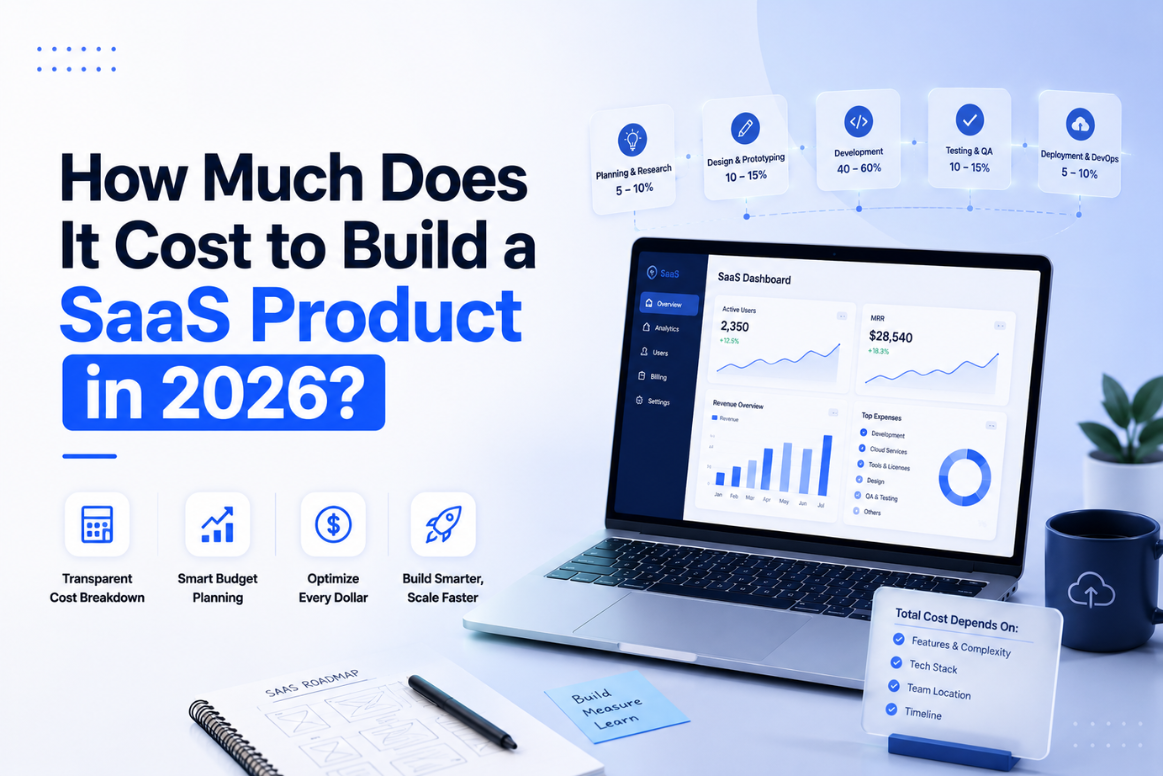
SaaS MVP Cost in 2026: What You Actually Need to Budget
|
MVP Tier |
India Cost
(USD) |
US/UK Cost
(USD) |
Timeline |
|
Simple MVP
(1 core feature) |
$8,000–$20,000 |
$40,000–$80,000 |
6–10 weeks |
|
Standard
SaaS MVP |
$15,000–$40,000 |
$60,000–$150,000 |
10–16 weeks |
|
AI-Integrated
MVP |
$25,000–$60,000 |
$120,000–$300,000+ |
16–24 weeks |
|
Enterprise
/ Compliance |
$40,000–$90,000 |
$200,000–$500,000+ |
4–6 months |
- Annual maintenance: budget 15–20% of the build cost per year
- Cloud infrastructure: $200–$3,000/month, depending on traffic
- Third-party SaaS tools: $200–$500/month at launch (auth, email, monitoring)
- Post-launch iteration: your first 3 sprints after launch will cost as much as your last 3 during the build
How Businesses Benefit from the SaaS MVP Approach
The SaaS MVP model is not just for startups. Established businesses launching internal tools, digitising legacy processes, or entering new markets benefit equally.For Startups
- Validate product-market fit before committing full development budget
- Attract seed or Series A funding with real usage data
- Launch 3–6 months faster than competitors building full products from day one
For Enterprises Launching New Digital Products
- De-risk a new business unit by testing market demand before full investment
- Use MVP data to build the business case for internal stakeholder sign-off
- Avoid the most common enterprise software failure mode: building what the internal team wants, not what customers need
For SMEs Digitalising Core Processes
- Replace expensive, bloated off-the-shelf software with a lean custom tool built around your actual workflow
- Own your data, your architecture, and your roadmap — instead of being at the mercy of a vendor's pricing decisions
- Scale incrementally as the business grows, adding features only when there is a proven user need
The 5 Most Common SaaS MVP Mistakes (and How to Avoid Them)
- Building too many features. An MVP with 15 features is not a minimum viable product. It is a full product with a misleading name. Pick one. Build one.
- Skipping UI/UX investment. A poorly designed MVP gives you bad data. Users abandon before reaching the value moment — not because the idea is wrong, but because the interface made it too hard. Budget 15–20% of the build cost for design.
- Not launching until it is 'perfect.' The goal of an MVP is to be imperfect and live, not perfect and in development. Ship when the core flow works end-to-end. Not before. Not after.
- Choosing the wrong development partner. The cheapest bid is never the right answer. Choosing a development partner for an MVP is the most consequential tech decision you will make. Technical debt from a poor build is far more expensive than the money saved on the initial quote.
- Measuring the wrong metrics. Vanity metrics like 'sign-ups' and 'page views' tell you nothing about product viability. Measure activation, retention, and revenue. Everything else is noise.
Why Partner with Naxtre for Your SaaS MVP?
- Dedicated development teams. You get a fixed, named team — a senior developer, a frontend specialist, a QA engineer, and a project manager — not a rotating pool of freelancers. Your team learns your product and stays accountable.
- Full-stack expertise across every layer of a SaaS product. React, Node.js, Flutter, AWS, PostgreSQL, Redis — our engineers are senior-level specialists, not generalists who 'can figure it out.'
- Transparent, sprint-based delivery. You see working software every two weeks. No black-box development. No 'we'll show you at the end.'
- India-based pricing, international-grade delivery. Our clients consistently quote 60% cost savings versus equivalent US or UK teams — without compromising on engineering quality, communication, or delivery reliability.
- Post-launch support as standard. We do not disappear after launch. Every SaaS MVP engagement includes 90 days of post-launch iteration support, so you can fix what the data tells you to fix.
Ready to build your SaaS MVP?
Talk to our team today. We will scope your MVP, give you a realistic cost estimate, and tell you honestly how long it will take. No obligation. No sales pressure.
Final Thoughts: The Best SaaS MVP Is the One That Ships
Frequently Asked Questions
How long does it take to build a SaaS MVP in 2026?
How much does SaaS MVP development cost in India?
Should I build a mobile app for my SaaS MVP?
What tech stack should I use for a SaaS MVP?
How do I choose the right SaaS development company?
Let's Talk
About Your Idea!