- Home
- ServicesCrafted for Growth
Our development solutions are designed to transform your vision into a thriving success story.
- TechnologiesTech Solutions
We leverage cutting-edge technology to drive efficiency, scalability, and excellence in every project we undertake.
- Contact Us
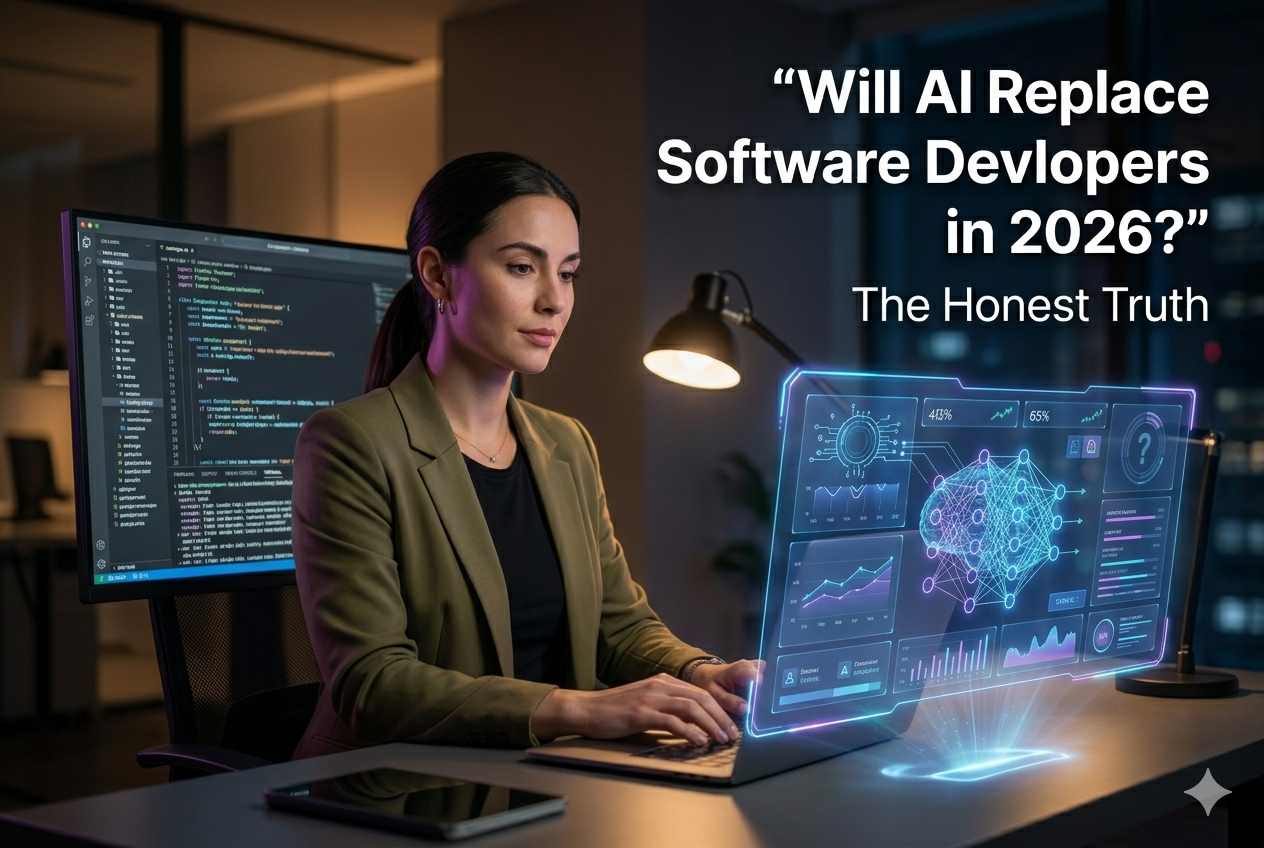
Will AI Replace Software Developers in 2026? The Truth
Posted By
naxtre
Published Date
24-04-2026
It is the question every founder, CTO, and business leader is quietly asking in 2026. Newspapers call it a revolution. LinkedIn is full of either panic or euphoria. And somewhere in the middle, real decisions are being made about whether to invest in human engineering talent or let AI handle it.
The short answer is: no, AI will not replace software developers in 2026. But the longer, more useful answer is that the role of a developer is changing faster than at any point in the past two decades — and businesses that understand what that actually means will make dramatically better technology decisions than those reacting to headlines.
This article cuts through the noise. We look at what the data says, what is genuinely changing on the ground in 2026, which tasks AI is taking over, and what that means if you are building a product or managing a technology team right now.
What the Data Actually Says in 2026
The numbers are striking, and it is worth stating them plainly before interpreting them:
- 90% of software development teams now use AI tools in their daily workflow, according to the State of AI-Assisted Software Development report.
- 41% of all code written globally in 2026 is AI-generated, up from under 5% just two years ago.
- Gartner projects that by the end of 2026, 40% of enterprise applications will feature task-specific AI agents — up from less than 5% in 2025.
- GitHub recorded a 23% year-on-year increase in pull requests merged in 2025, and a 25% rise in commits — more code is being shipped than ever before.
- AI productivity gains in software development are measured at 26% by McKinsey — but only for well-structured teams with strong engineering foundations.
Here is the critical insight buried in those numbers: more code is being written, not less. More developers are employed in software, not fewer. What is changing is how that work gets done and what kind of expertise commands the highest value.
What AI Can Genuinely Do in 2026 (And Do Well)
Overstating AI’s capabilities is as dangerous as understating them. Here is an honest inventory of what AI tools are reliably handling in professional software teams this year:
Code Generation and Completion
AI coding assistants like GitHub Copilot, Cursor, and Claude Code can generate production-ready functions, components, and even full modules from natural language descriptions. For repetitive, well-defined tasks — CRUD operations, standard API integrations, boilerplate setup — the time savings are real and substantial.
Automated Testing and QA
AI tools now generate test suites, identify edge cases, and run regression testing with a degree of coverage that would take a human QA team weeks to replicate. The 2025 State of Quality report found that 45% of mature QA teams run fully automated regression pipelines, with AI generating the majority of test cases.
Documentation
One of the most universally celebrated AI applications in development teams is documentation generation. AI reads existing codebases and produces inline comments, API documentation, and onboarding guides that are genuinely accurate and up to date.
Debugging and Code Review
AI systems can scan pull requests for common vulnerabilities, flag logic errors, and suggest performance improvements. Tools trained on security frameworks like OWASP can now surface issues that previously required a dedicated security engineer to identify.
Vibe Coding — The 2026 Wildcard
“Vibe Coding” — the practice of describing software in plain language and having AI generate the working code — was named the Word of the Year for 2025 and has entered mainstream development in 2026. Non-technical founders are shipping early MVPs. Product managers are prototyping features directly. The barrier to creating functional software has genuinely fallen.
But vibe-coded applications are also shipping with security vulnerabilities at 2.74 times the rate of human-written code, according to Stack Overflow’s 2025 Developer Survey. Speed without oversight is not an advantage — it is a liability.
What AI Cannot Do — And Will Not Do in 2026
This is where the honest conversation gets important. Every major research report published in the past six months converges on the same conclusion: AI is an amplifier of existing engineering quality, not a substitute for it.
Systems Architecture and Strategic Technical Decisions
Deciding how to structure a multi-tenant SaaS platform, which database architecture serves a specific business model, or how to build a system that scales from 100 to 10 million users — these are judgment calls that require deep experience, business context, and accountability. AI can suggest options. It cannot own the consequences.
Understanding Business Requirements
Software exists to solve real business problems. Translating a founder’s vision, a customer’s pain point, or a market opportunity into a technical specification requires human conversation, critical thinking, and domain expertise. An AI agent given a vague brief will generate a vague solution.
Security Oversight and Compliance
AI-generated code introduces security risks that require human review to identify and remediate. For any product handling user data, financial transactions, or regulated information — which describes the vast majority of commercial software — experienced developers remain essential to ensure compliance and security.
Complex Problem-Solving and Debugging at Scale
Gartner found that 90% of software engineers are shifting from hands-on coding toward AI orchestration — but that orchestration role requires deep technical literacy. The most valuable developers in 2026 are those who understand AI’s outputs well enough to know when they are wrong.
"AI agents are indifferent to whether they are scaling good practices or bad ones. Organizations without strong engineering foundations will simply generate chaos quicker." — TechTarget, Software Development in 2026
The Role That Is Actually Emerging: The AI Orchestrator
The O’Reilly Radar Trends Report for April 2026 puts it precisely: writing code is becoming less important, while reviewing, directing, and taking accountability for AI-generated code is becoming more so.
The developer of 2026 is less like a craftsman writing every line by hand and more like a senior architect who knows which tools to use, how to verify their output, and when to override them. That is not a less skilled role. It is a different — and in many respects, more demanding — one.
The skills that define high-value developers in 2026:
- Specification writing: Translating business requirements into precise prompts and architectural briefs that AI can execute reliably.
- Output evaluation: The ability to read AI-generated code critically, identify errors, and understand the security and performance implications of what has been generated.
- Systems thinking: Designing architectures that work at scale, across distributed systems, with security and maintainability built in from day one.
- AI orchestration: Managing multiple AI agents working in parallel, coordinating their outputs, and maintaining codebase coherence across automated contributions.
What This Means If You Are Building a Product in 2026
For founders and CTOs making resourcing decisions right now, the practical implications are significant:
You Still Need Experienced Developers — Just Fewer of Them for Certain Tasks
A well-structured team of experienced developers using AI tools can now accomplish what previously required a team twice the size — for repetitive development tasks. But the experienced developers are not optional. They are the ones ensuring that AI’s output is actually correct, secure, and architecturally sound.
Junior Developer Roles Are Changing Most Dramatically
Stanford economists documented a 20% decline in software developer employment for the 22–25 age group since 2022. Entry-level roles that were primarily about writing boilerplate code are being compressed. This is accelerating the shift toward developers who combine technical depth with business understanding.
Speed to Market Has Genuinely Increased — for Teams That Are Ready
Salesforce research found that organizations pairing AI tools with experienced developers are shipping features 30–50% faster. That advantage is real. But it requires the engineering discipline to manage AI’s outputs. Teams without that foundation are not shipping faster — they are accumulating technical debt at an accelerated rate.
Outsourced and Dedicated Teams Now Deliver Even More Value
AI tools have increased the leverage of experienced developers, which means an experienced offshore development team in 2026 delivers more output per developer than it did two years ago — without a proportional increase in cost. For startups and enterprises evaluating their development model, this is a compelling argument for dedicated team arrangements with partners who have deep AI-augmented delivery capabilities.
How Naxtre Builds Software in 2026
At Naxtre Technologies, we have integrated AI tools across our entire development lifecycle — not as a replacement for our engineers, but as a force multiplier for them.
Here is what that looks like in practice:
- AI-augmented development teams: Our developers use agentic coding tools for code generation, testing, and documentation — accelerating delivery without compromising quality or security.
- Human-led architecture: Every project is designed by experienced senior engineers who own the technical decisions that AI cannot make — system architecture, security posture, and scalability planning.
- Security-first review: All AI-generated code goes through structured human review and automated security scanning before deployment. We do not ship what we cannot verify.
- Faster MVPs, better products: For startups, our AI-augmented approach means we can deliver production-ready MVPs in 8–12 weeks — timelines that simply were not achievable two years ago.
- Full-stack AI capability: From AI-powered SaaS products to recommendation engines and NLP solutions, our team builds AI into your product, not just around it.
The result is a development partnership that gives you the speed advantages of AI and the judgment and accountability of experienced engineers. Neither alone is sufficient in 2026.
The Honest Answer
AI will not replace software developers in 2026. But it is already replacing certain tasks, compressing certain roles, and fundamentally changing what “good” software development looks like.
The businesses that will win are not the ones who ignore AI — nor the ones who hand everything to it uncritically. They are the ones who build with experienced teams that know how to use AI with precision, verify its outputs with discipline, and take accountability for what they ship.
That is exactly the model we operate at Naxtre. And if you are building something serious in 2026, it should be the standard you hold any development partner to.
Ready to Build with a Team That Understands Both AI and Engineering?
Book a free discovery call with Naxtre. We’ll walk you through exactly how our AI-augmented development approach applies to your specific product — and give you a straight answer on timelines, costs, and what it takes to build well in 2026.
Start the conversation at www.naxtre.com
Frequently Asked Questions
Q: Will AI fully replace software developers in the near future?
Not in any realistic near-term scenario. AI is automating specific tasks within software development — particularly code generation, testing, and documentation — but the roles of system architecture, business requirement translation, security oversight, and quality accountability remain deeply human. What is changing is the composition of developer work: more time directing and evaluating AI, less time writing boilerplate. The total demand for software is increasing faster than AI can displace individual roles.
Q: What is “Agentic AI” and how does it affect software development?
Agentic AI refers to systems that can plan and execute multi-step tasks autonomously — unlike traditional AI tools that respond to individual prompts. In software development, an agentic system might receive a task, research the codebase, write the code, run tests, fix failures, and open a pull request — all without step-by-step human direction. Gartner projects that 40% of enterprise applications will feature task-specific AI agents by the end of 2026. This is genuinely changing how development teams operate, but it increases the importance of experienced developers who can oversee and validate agentic output — not reduce it.
Q: Is vibe coding safe to use for production software?
Vibe coding — generating software from plain-language descriptions without traditional coding — is a genuinely useful tool for prototyping, MVPs, and internal tools where security requirements are lower. For production software handling user data, financial transactions, or regulated information, vibe-coded outputs require rigorous human review and security scanning. AI-generated code contains 2.74 times more security vulnerabilities than human-written code, according to Stack Overflow’s 2025 survey. Used correctly, it accelerates delivery. Used carelessly, it creates technical debt and security exposure.
Q: How should businesses think about hiring developers in 2026?
The practical advice for 2026 is to prioritise developers with strong systems thinking and AI literacy over those whose primary value was writing large volumes of repetitive code. Senior developers who understand architecture, security, and how to evaluate AI-generated output are more valuable than ever. For cost efficiency, dedicated offshore development teams that operate with AI-augmented workflows now deliver more output per developer than two years ago — making them an even stronger value proposition for startups and enterprises alike.
Q: How does Naxtre use AI in its development process?
Naxtre integrates AI tools across code generation, automated testing, documentation, and security review — but all AI output is reviewed and validated by experienced senior developers before delivery. Our architecture and technical decisions are made by humans with full accountability for what we ship. This AI-augmented model allows us to deliver production-ready MVPs in 8–12 weeks and accelerate feature development cycles for ongoing product partnerships. Visit naxtre.com to discuss how this applies to your project.
Q: Does outsourcing development to India still make sense with AI in 2026?
More than ever. AI tools have increased the productivity leverage of experienced developers, which means a well-structured dedicated development team in India now delivers more output per developer than it did two years ago — at the same cost point. The cost advantage of offshore development remains significant (50–70% versus equivalent UK/US teams), and the quality of AI-augmented delivery from experienced Indian engineering teams is directly competitive with any onshore alternative. The key is choosing a partner with genuine AI-augmented capability and the engineering discipline to use it responsibly.
Let's Talk
About Your Idea!