- Home
- ServicesCrafted for Growth
Our development solutions are designed to transform your vision into a thriving success story.
- TechnologiesTech Solutions
We leverage cutting-edge technology to drive efficiency, scalability, and excellence in every project we undertake.
- Contact Us
Vertical SaaS vs Horizontal SaaS: Which Should Your Business Build in 2026?
Posted By
naxtre
Published Date
19-05-2026
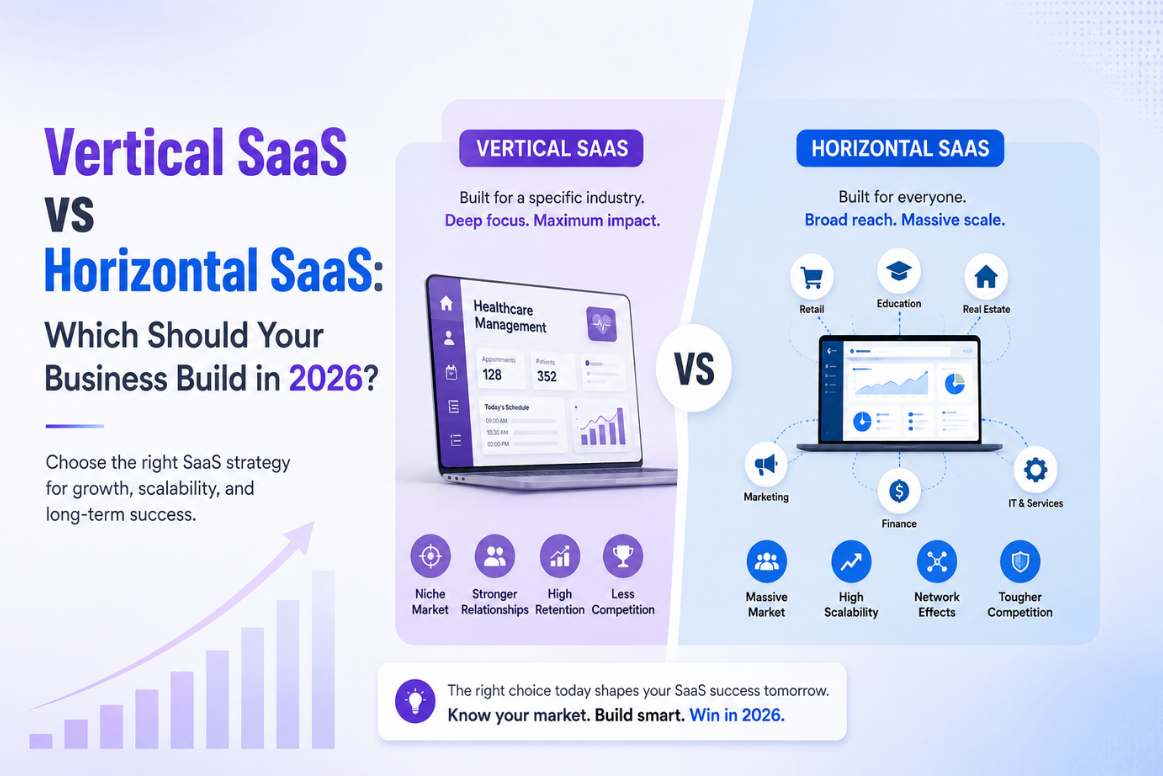
What is Horizontal SaaS? A Plain Definition
- Salesforce — CRM for any industry
- Slack — Communication for any team
- HubSpot — Marketing automation for any business
- QuickBooks — Accounting for any company size
- Zoom — Video conferencing for any organisation
What is Vertical SaaS? A Plain Definition
- Veeva Systems — CRM and data management built exclusively for pharmaceutical and life sciences companies. Market cap exceeding $35 billion.
- Procore — Project management built exclusively for construction. Connects owners, architects, and contractors in ways generic project tools cannot.
- DrChrono — Electronic health records and billing built exclusively for medical practices.
- Toast — Point-of-sale and restaurant management built exclusively for the food and beverage industry.
- ServiceTitan — Field service management built exclusively for HVAC, plumbing, and electrical contractors. IPO valued at approximately 12× forward revenue.
Vertical SaaS vs Horizontal SaaS: 6 Key Differences in 2026
1. Market Size and Growth Rate
2. Customer Retention
3. Development Complexity
4. Sales and Marketing Motion
5. Competitive Dynamics
6. Valuation and Investment Attractiveness
Which Model Is Right for Your Business? A Decision Framework
The choice between vertical SaaS vs horizontal SaaS ultimately depends on four factors specific to your situation. Therefore, work through these questions before committing to a product strategy.Choose Vertical SaaS if:
- You have genuine domain expertise in a specific industry — or direct access to it through advisors or co-founders
- The industry you are targeting is underserved by existing software, still relying on manual processes, spreadsheets, or generic tools with heavy workarounds
- Your go-to-market advantage is deep industry relationships, not broad marketing reach
- You are building a product where compliance, regulation, or sector-specific workflows are core requirements — not optional features
- You are building for long-term retention and expansion revenue rather than rapid volume acquisition
- You are a first-time founder or early-stage company — vertical SaaS is significantly easier to sell when you can say exactly who your product is for
Choose Horizontal SaaS if:
- Your product genuinely solves a universal business problem that applies across all industries with minimal customisation
- You have the resources for broad, volume-driven customer acquisition and the brand building required to compete with established horizontal players
- Your differentiation is technical — a genuinely superior approach to a function every business needs — rather than domain depth
- You are targeting a specific business function (communication, payments, analytics) where industry specialisation adds minimal value
- You have strong distribution advantages — existing partnerships, a large captive audience, or platform ecosystem relationships
The Hybrid Path: Vertical Features on a Horizontal Foundation
How Naxtre Builds Both Vertical and Horizontal SaaS Products
- Vertical SaaS: We have built a dental recruitment CRM specifically for the UK staffing market — serving Fillingz, Penns Dental Recruitment, and Cavity Dental Staff Agency. This is a genuine vertical SaaS product, encoding the specific workflows, compliance requirements, and candidate management logic of the UK dental recruitment sector.
- Horizontal SaaS: We have delivered enterprise SaaS platforms for clients including Hitachi Energy and Sobeys — broad-use products requiring scalable architecture, multi-tenant infrastructure, and complex integration layers.
- AI-native SaaS: We integrate agentic AI, machine learning features, and real-time personalisation into SaaS products — building the execution layer that 2026 SaaS buyers expect as standard.
- Scalable cloud architecture: Our AWS-certified team designs multi-tenant, serverless, and microservices architectures that scale from MVP to enterprise without requiring a full rebuild.
Conclusion: The Smart Money Is Moving to the Niche
Frequently Asked Questions: Vertical SaaS vs Horizontal SaaS
Q1: What is the difference between vertical SaaS and horizontal SaaS?
Horizontal SaaS is software
designed to serve businesses across all industries — products like Salesforce,
Slack, and HubSpot that address universal business functions. Vertical SaaS is software
purpose-built for one specific industry, encoding its unique workflows,
compliance requirements, and domain logic directly into the product. The key
difference is depth versus breadth: horizontal SaaS serves many industries
shallowly, while vertical SaaS serves one industry deeply. In 2026, vertical
SaaS is growing at 32% annually compared to 12% for horizontal, driven by
higher customer retention, stronger product-market fit, and increasing investor
preference for specialised platforms.
Q2: Is vertical SaaS more profitable than horizontal SaaS?
In terms of retention and
expansion revenue, vertical SaaS consistently outperforms horizontal. Vertical
SaaS companies frequently achieve net revenue retention above 130%, meaning
customers expand their spend over time. Horizontal tools face higher churn
because switching costs are lower and competition is more intense. From a
valuation perspective, vertical SaaS commands premium multiples when retention
metrics are strong — a 10-point improvement in NRR can increase valuation by
20–30%. However, horizontal SaaS companies can reach larger absolute revenue
figures because their total addressable market is structurally broader. The
profitability question depends on which metrics and time horizon matter most to
your business model.
Q3: What are the best examples of vertical SaaS companies in 2026?
The most prominent vertical SaaS
companies in 2026 include Veeva Systems (pharmaceutical CRM, $35B+ market cap),
Procore (construction management), Toast (restaurant technology), DrChrono
(medical practice management), and ServiceTitan (field services for HVAC,
plumbing, and electrical). Each company dominates its specific industry by
encoding sector-specific workflows, compliance requirements, and data models
that generic horizontal tools cannot replicate without extensive customisation.
In the UK market specifically, dental recruitment CRM platforms like those
Naxtre has built for Fillingz and Penns Dental Recruitment represent this same
vertical specialisation applied to a high-value niche.
Q4: Should a startup build vertical SaaS or horizontal SaaS in 2026?
For most early-stage startups in
2026, vertical SaaS is the lower-risk path to product-market fit. The reason is
specificity: it is significantly easier to identify, reach, and sell to a
clearly defined industry audience than to compete for attention across all
industries simultaneously. Furthermore, a narrowly scoped vertical product can
reach feature completeness faster, generate stronger word-of-mouth within tight
professional communities, and build the domain reputation that horizontal
products take years and enormous budgets to establish. Venture capital data
supports this: $18 billion was invested in vertical SaaS in 2025, with
investors favouring companies that own an end-to-end industry workflow over
single-point-solution horizontal tools.
Q5: Can a SaaS product be both vertical and horizontal?
Yes — this hybrid model is
increasingly common in 2026. Established horizontal platforms (Salesforce,
ServiceNow, HubSpot) are building vertical product lines on top of their core
infrastructure to capture the retention and expansion benefits of industry
specialisation. For new products, some founders begin with a horizontal core
and add vertical features as they develop domain expertise in specific customer
segments. The risk is becoming superficially vertical — adding industry
terminology without genuinely encoding domain expertise — which defeats the
purpose. Genuinely vertical products require deep industry knowledge, not just
a renamed dashboard.
Q6: How long does it take to build a vertical SaaS product?
A well-scoped vertical SaaS MVP
can typically be built and launched in 12–20 weeks with a dedicated development
team. The timeline depends on the complexity of the industry-specific logic
being encoded — a dental staffing CRM has different complexity from a
construction project management platform — and the quality of domain expertise
available during the product design phase. At Naxtre, our SaaS development
practice includes a structured discovery process that defines scope,
architecture, and MVP feature set before a single line of code is written,
ensuring accurate timelines and no scope surprises at launch. Visit naxtre.com to start the conversation.
Let's Talk
About Your Idea!