- Home
- ServicesCrafted for Growth
Our development solutions are designed to transform your vision into a thriving success story.
- TechnologiesTech Solutions
We leverage cutting-edge technology to drive efficiency, scalability, and excellence in every project we undertake.
- Contact Us
What Is Agentic AI and How Should Businesses Use It in 2026?
Posted By
naxtre
Published Date
14-05-2026
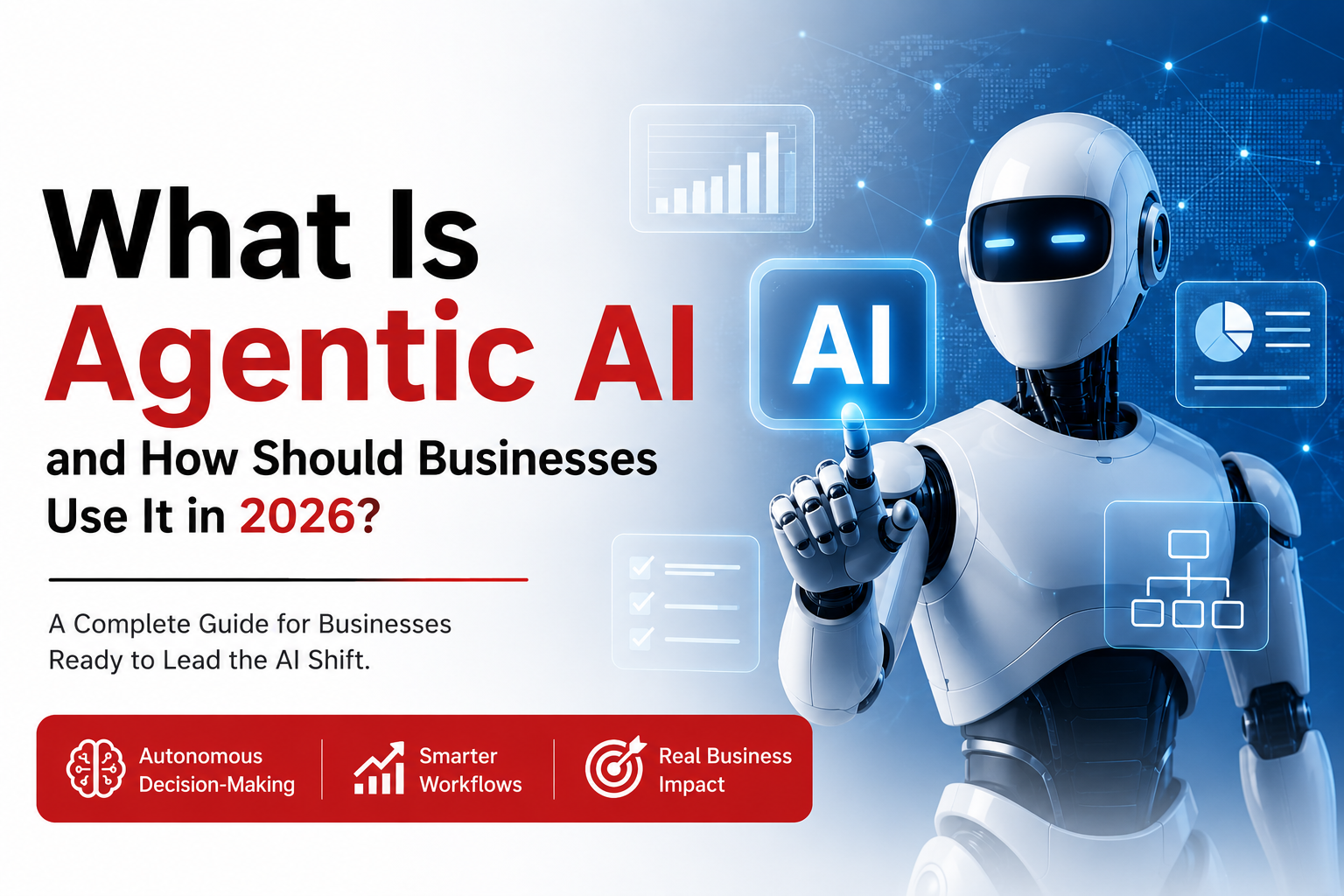
What Is Agentic AI? A Plain-Language Definition
How Does Agentic AI Actually Work?
1. Goal Reception
2. Task Decomposition
3. Tool Use and Decision-Making
4. Self-Evaluation and Iteration
The State of Agentic AI for Business in 2026
- 40% of enterprise applications will feature task-specific AI agents by end of 2026 (Gartner).
- 17% of organisations have fully deployed AI agents so far — yet more than 60% plan to do so within two years, the most aggressive adoption curve of any emerging technology (Gartner CIO Survey 2026).
- Telecommunications leads adoption at 48%, followed by retail and consumer goods at 47% (NVIDIA State of AI 2026).
- Businesses using AI agents report 55% higher operational efficiency and 35% cost reductions on average.
- The agentic AI market is growing at 43.84% CAGR through 2034, reaching an estimated $196.6 billion by that point.
- 92% of technology executives plan to expand their agentic AI funding in the next 12 months (EY Technology Pulse Poll).
Top Agentic AI Use Cases for Businesses in 2026
Customer Service Automation
Software Development and Code Review
Finance and Operations
Healthcare Workflow Automation
Marketing and Sales Automation
Supply Chain and Manufacturing
How to Deploy Agentic AI in Your Business: A Practical Framework
- Define the outcome, not the technology. Start with a specific business process that currently consumes significant human time, has clear inputs and outputs, and follows a repeatable pattern. Invoice processing, support ticket triage, and onboarding workflows are classic starting points.
- Audit your data and tool infrastructure. Agentic AI is only as effective as the systems it can access. Before deployment, ensure that the relevant data sources, APIs, and internal tools are connected, documented, and accessible. Agents run continuously and generate ongoing API and compute costs, so infrastructure planning matters from day one.
- Start narrow and validate. Deploy a single, tightly scoped agent for one specific workflow. Measure its performance against a clear baseline. Track accuracy, time saved, cost per task, and error rate. Expand only after validation is complete.
- Build governance in from the start. A defining signal in the 2026 Gartner Hype Cycle is the growing emphasis on governance, security, and cost management alongside core agentic capabilities. Establish human review checkpoints for high-stakes decisions, define escalation paths for agent failures, and track ROI per agent rigorously.
How Naxtre Builds Agentic AI Solutions for Businesses
- Custom agent design: We build task-specific AI agents tailored to your workflows, data sources, and business logic — not generic automation that requires your team to adapt around it.
- Multi-agent orchestration: For complex workflows involving multiple sequential tasks, we design and deploy coordinated agent systems that hand off outputs between agents reliably.
- Integration with existing systems: Our agents connect to your CRM, ERP, database, communication tools, and third-party APIs. Deployment does not require rebuilding your infrastructure.
- Governance and monitoring frameworks: Every agentic system we build includes logging, performance tracking, human escalation paths, and cost monitoring as standard components.
- Iterative improvement: We structure engagements as ongoing partnerships. As your agents process real data and real tasks, we optimise their performance based on measurable outcomes.
Conclusion: Agentic AI for Business Is Not the Future — It Is Right Now
Frequently Asked Questions About Agentic AI for Business
Q1: What is agentic AI for business and how is it different from regular AI?
Agentic AI for business refers to autonomous AI systems that can plan, decide, and execute complex, multi-step tasks without step-by-step human direction. Regular AI tools, such as chatbots or generative AI assistants, respond to individual prompts but do not take independent action. Agentic AI, by contrast, receives a high-level goal, breaks it into steps, uses connected tools and data sources, makes decisions throughout the process, and delivers a completed outcome. The key difference is autonomy: agentic AI acts, while traditional AI responds.
Q2: Is agentic AI safe for business-critical processes?
Agentic AI is safe for business-critical processes when deployed with appropriate governance frameworks. This includes defining clear escalation paths for edge cases, building human review checkpoints for high-stakes decisions, monitoring agent performance continuously, and restricting agent access to only the systems and data they need for their specific tasks. The 2026 Gartner Hype Cycle highlights governance, security, and cost management as the most important supporting capabilities for safe enterprise agentic AI deployment. Most failures in agentic AI deployments result from insufficient governance design, not from the underlying technology.
Q3: What industries benefit most from agentic AI in 2026?
According to NVIDIA’s State of AI 2026 report, telecommunications leads agentic AI adoption at 48%, followed by retail and consumer goods at 47%. Additionally, financial services, healthcare, manufacturing, and professional services are all reporting measurable ROI from production agentic AI deployments. In practical terms, any business with high-volume, repeatable workflows that currently require significant human coordination is a strong candidate for agentic AI. Customer service, finance operations, supply chain logistics, and software development are the four most validated use cases in 2026.
Q4: How long does it take to deploy an agentic AI agent?
Deployment timelines depend heavily on the scope of the use case and the quality of existing data infrastructure. A narrowly scoped agent for a single, well-defined workflow — such as invoice matching or support ticket triage — can typically be deployed within four to eight weeks by an experienced development team. More complex multi-agent systems with broad integrations require longer timelines. As a general principle, starting with the most constrained scope possible and validating before expanding produces better results than attempting large-scale deployment from the outset.
Q5: What does agentic AI cost to implement for a small or mid-sized business?
Cost varies significantly based on complexity, the number of systems being integrated, and whether the business is using existing cloud AI infrastructure or building custom models. For small to mid-sized businesses deploying a single-workflow agent using existing cloud AI models, implementation costs typically range from $15,000 to $50,000. Ongoing operational costs depend on agent usage volume, since agents generate API and compute costs continuously. Reputable development partners build cost monitoring into every deployment, with tiered model strategies using lower-cost AI models for routine tasks and premium models only for high-stakes decisions.
Q6: How can Naxtre help my business deploy agentic AI?
Naxtre Technologies provides end-to-end agentic AI development services for startups and enterprises. Our practice covers custom agent design, multi-agent orchestration, integration with existing business systems, governance and monitoring frameworks, and iterative performance optimisation. We have delivered AI and machine learning solutions across logistics, healthcare, B2B SaaS, and recruitment technology. If you are evaluating agentic AI for your business, we offer a free discovery call to help you assess where the genuine opportunities lie and what realistic deployment looks like. Visit naxtre.com to book yours.
Let's Talk
About Your Idea!