- Home
- ServicesCrafted for Growth
Our development solutions are designed to transform your vision into a thriving success story.
- TechnologiesTech Solutions
We leverage cutting-edge technology to drive efficiency, scalability, and excellence in every project we undertake.
- Contact Us
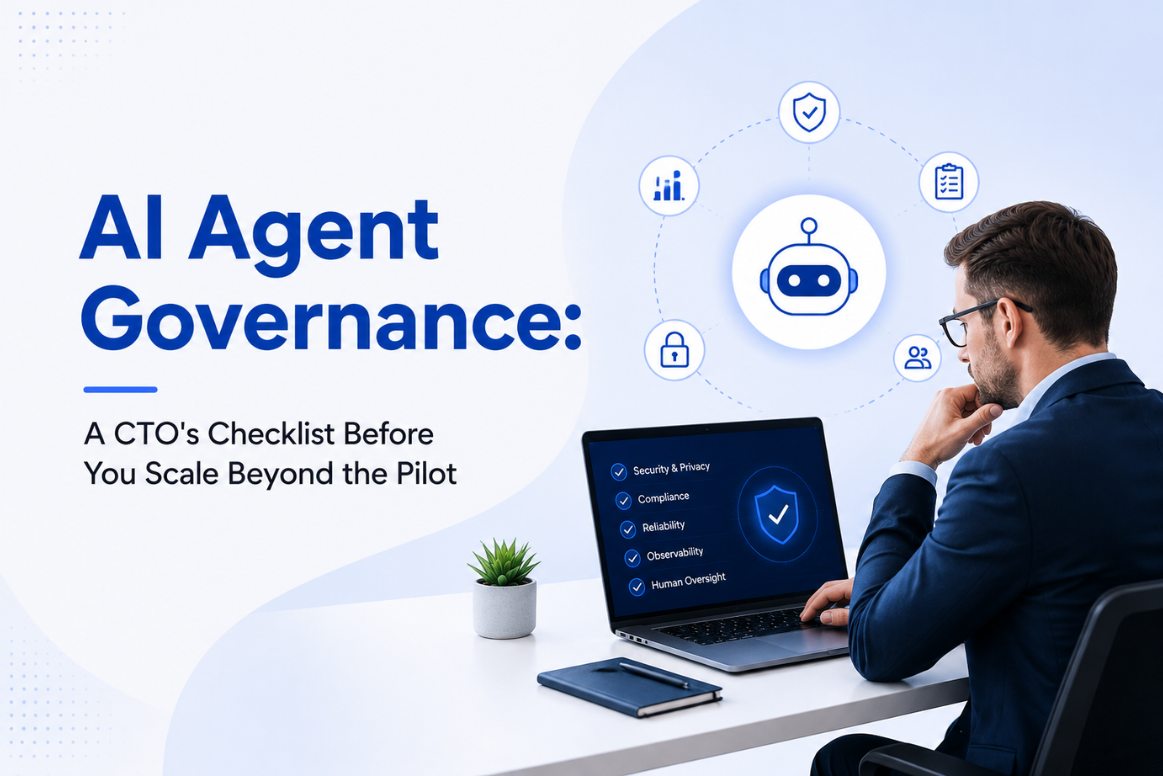
AI Agent Governance: A CTO's Checklist Before You Scale Beyond the Pilot
Posted By
naxtre
Published Date
19-06-2026
AI agent
governance is the set of policies, permissions, and controls that decide what
an autonomous AI agent is allowed to do, how its actions are monitored, and how
it can be stopped. It is the layer that turns a clever pilot into a system you
can safely run in production. Without it, autonomy becomes liability.
Most
enterprises in 2026 have the opposite problem they expected. The agents work.
The models are capable enough. What is missing is governance, and that gap is
now the single biggest reason AI agents stay stuck in pilots. As Deloitte put it, agentic AI is scaling faster
than the guardrails meant to control it.
This article is the practical guide I give CTOs before they scale agents into core systems. We will define what AI agent governance actually covers, why it matters more in 2026 than ever, the controls every governed agent needs, a side-by-side comparison of governed versus ungoverned agents, and a 10-point checklist you can run against your own deployment today. It is a companion to our pillar report on AI agents in production, which maps the four layers agents must clear before they ship.
Key takeaways
- AI agent governance answers three questions: what can the agent do, how do we see what it did, and how do we stop it fast.
- It is now the top differentiator between teams that scale agents and teams that get breached. Only about 21% of organizations report mature agentic governance, per Deloitte.
- The risk is already real: 67% of executives believe their organization has had a data leak from unapproved AI tools, and 35% say they could not immediately shut down a rogue agent.
- Governance is not a compliance afterthought. It is an engineering layer: least-privilege permissions, observability, audit logs, human-in-the-loop, and a kill switch.
- Frameworks like the NIST AI Risk Management Framework and OWASP guidance for LLM and agent risks give you a credible, auditable starting point.
What is AI agent governance, and why does it matter now?
AI agent
governance is the discipline of controlling autonomous agents across their full
lifecycle: what data and systems they can touch, what actions they may take
without approval, how their behavior is logged and monitored, and how a human
can intervene or shut them down. Traditional software does only what it is
explicitly coded to do. An AI agent reasons, plans, and acts, which means
governance has to constrain a system that can surprise you.
Why does this
matter so much in 2026? Because adoption has outrun control. Gartner expects 40% of enterprise applications
to use task-specific AI agents by the end of 2026, yet only around 21% of
organizations have a mature governance model for them. The result is a widening
exposure gap: more autonomous systems acting on production data, with fewer
guardrails than the technology demands.
The consequences are not hypothetical. Surveys in 2026 report that 67% of executives believe their company has already suffered a data leak tied to unapproved AI tools, and 35% admit they could not immediately pull the plug on a rogue agent. An agent with broad permissions and no oversight is not a productivity tool. It is an incident waiting for a trigger.
What does good AI agent governance actually include?
Strong AI agent
governance is not a document. It is a set of engineering controls wired into
the agent itself. Six controls form the core.
Least-privilege
permissions. The agent gets access only to the specific data and systems it
needs for its task, and nothing more. Over-permissioned agents are the root
cause of most serious incidents.
Action
boundaries. Define which actions an agent may take autonomously and which
require human approval. Sending an internal summary is low-risk. Issuing a
refund, deleting a record, or emailing a customer should sit behind an approval
gate until trust is earned.
Observability
and audit logs. Every decision and action an agent takes must be logged in a
way a human can review. If you cannot reconstruct what an agent did and why,
you cannot govern it. This is where strong DevOps
and cloud engineering practices, monitoring, tracing, and alerting,
do the heavy lifting.
Human-in-the-loop.
For high-impact actions, a person reviews and approves before the agent
proceeds. You relax these gates as the agent proves reliable, not before.
A kill switch.
You must be able to stop a single agent, or all agents, in seconds. The fact
that 35% of organizations cannot do this today is the clearest sign governance
is being treated as an afterthought.
Data and prompt security. Agents are exposed to prompt injection and data exfiltration. Input sanitization, output filtering, and guarding against the risks described in the OWASP guidance for LLM and agent applications belong inside governance, not beside it.
Governed vs ungoverned AI agents: what changes?
The difference
between a governed and an ungoverned agent is the difference between a
deployment and a liability. The table below makes it concrete.
| Dimension |
Ungoverned agent | Governed agent |
|---|---|---|
| Permissions |
Broad, standing access | Least-privilege, scoped to task |
| High-impact
actions | Executes autonomously | Behind human approval gate |
| Visibility |
Little or no logging | Full audit trail and observability |
| Failure
response | Hard to detect or stop | Kill switch, stops in seconds |
| Security |
Exposed to prompt injection | Input/output guards, monitored |
| Audit and
compliance | Cannot evidence behavior | Reviewable, framework-aligned |
| Business risk
| Incident waiting to happen | Safe to scale into core systems |
The lesson is simple. Governance is not the brake on AI agents. It is the steering and the seatbelt that let you drive them fast in production.
The 10-point AI agent governance checklist
Use this
checklist before you move any agent from pilot to production. We run a version
of it with clients during readiness reviews. Score each item as in place,
partial, or missing. Any high-impact agent with more than two missing items is
not ready to scale.
1. Inventory:
every agent is registered, with a named owner and a documented purpose.
2. Least
privilege: each agent's data and system access is scoped to its task and
reviewed regularly.
3. Action
policy: autonomous versus approval-required actions are explicitly defined per
agent.
4.
Human-in-the-loop: high-impact actions require human approval until reliability
is proven.
5.
Observability: every agent decision and action is logged and monitored in real
time.
6. Audit trail:
logs are retained, tamper-resistant, and reviewable for compliance.
7. Kill switch:
you can disable one agent or all agents within seconds.
8. Security
controls: prompt-injection defenses, input sanitization, and output filtering
are active.
9. Evaluation: agents
are tested against expected and adversarial cases before and after deployment.
10. Framework
alignment: governance maps to a recognized standard such as the NIST AI Risk
Management Framework.
This checklist is the original, practical core of this article. It turns "we need governance" into a list you can act on this week.
How do you implement AI agent governance step by step?
Governance is
most effective when you build it in stages rather than all at once. A practical
rollout looks like this.
First, inventory
and classify. List every agent, assign an owner, and rate each by impact. A
read-only reporting agent and an agent that moves money need very different
controls.
Second, scope
permissions. Apply least privilege to each agent, removing any access it does
not strictly need. This single step prevents the majority of serious incidents.
Third,
instrument everything. Add logging, tracing, and alerting so every agent action
is visible. You cannot govern what you cannot see, and observability is the
foundation the other controls stand on.
Fourth, gate
the high-impact actions. Put human approval in front of anything risky, then
relax those gates only as evidence of reliability accumulates.
Fifth, align to a framework. Map your controls to the NIST AI Risk Management Framework and relevant OWASP guidance so your governance is auditable and defensible, not ad hoc. For teams without in-house AI platform depth, a dedicated development team with artificial intelligence development experience can stand this up far faster than learning it under incident pressure.
Who owns AI agent governance inside an organization?
Governance
fails when nobody owns it, so this question matters. In practice, AI agent
governance is a shared responsibility with a clear lead. Engineering owns the
technical controls: permissions, logging, the kill switch, and security.
Security and risk teams own the policy, threat modeling, and framework
alignment. Business owners define what each agent is allowed to do in their
domain.
The common failure mode is treating governance as purely a compliance task handed to a team with no engineering authority. That produces a binder nobody enforces. The teams that get this right put governance in the same place as the build, owned by the people shipping the agents, with security and risk as partners rather than gatekeepers.
The bottom line
In 2026, the
hard part of AI agents is no longer making them capable. It is making them safe
to run without supervision. AI agent governance is the layer that closes that
gap, and it is the clearest dividing line between organizations that scale
agents into core systems and organizations that end up explaining a breach. The
controls are not exotic: least privilege, action boundaries, observability,
human-in-the-loop, a kill switch, and security, all mapped to a recognized
framework.
Start with the inventory, scope the permissions, and make sure you can stop every agent in seconds. Then earn your way toward more autonomy as the evidence supports it. If you want to pressure-test your own agents against this checklist, book a 30-minute AI readiness review and we will score your governance with you.
Frequently asked questions
What is AI agent governance?
AI agent
governance is the set of policies, permissions, and controls that define what
an autonomous AI agent can do, how its actions are monitored and logged, and
how it can be paused or stopped. It is the engineering layer that makes agents
safe to run in production.
Why is AI agent governance important in 2026?
Adoption has
outpaced control. Gartner expects 40% of enterprise apps to use AI agents by
end-2026, but only about 21% of organizations have mature governance. Without
it, autonomous agents act on production data with too few guardrails, creating
real breach and compliance risk.
What controls does AI agent governance require?
Six core
controls: least-privilege permissions, defined action boundaries with approval
gates, full observability and audit logs, human-in-the-loop for high-impact
actions, a fast kill switch, and security defenses against prompt injection and
data exfiltration.
What is the difference between a governed and ungoverned AI agent?
A governed
agent has scoped permissions, approval gates on risky actions, full logging, a
kill switch, and security controls, making it safe to scale. An ungoverned agent
has broad access, acts autonomously, lacks visibility, and is hard to stop,
making it a liability.
Which framework should I use for AI agent governance?
The NIST AI
Risk Management Framework is a widely recognized, auditable starting point,
complemented by OWASP guidance on LLM and agent security risks. Mapping your
controls to a known framework makes governance defensible and easier to audit.
Who is responsible for AI agent governance?
It is shared.
Engineering owns the technical controls, security and risk own policy and
framework alignment, and business owners define each agent's permitted actions.
The lead should sit with the teams shipping the agents, not a disconnected
compliance function.
Can you govern AI agents without slowing development?
Yes. Governance
done as an engineering layer, least privilege, observability, and approval
gates that relax as trust grows, actually speeds safe scaling. It removes the
uncertainty that otherwise keeps agents stuck in pilots.
Let's Talk
About Your Idea!