- Home
- ServicesCrafted for Growth
Our development solutions are designed to transform your vision into a thriving success story.
- TechnologiesTech Solutions
We leverage cutting-edge technology to drive efficiency, scalability, and excellence in every project we undertake.
- Contact Us
Agentic Commerce: How AI Agents Will Buy From Your Business
Posted By
naxtre
Published Date
28-07-2026
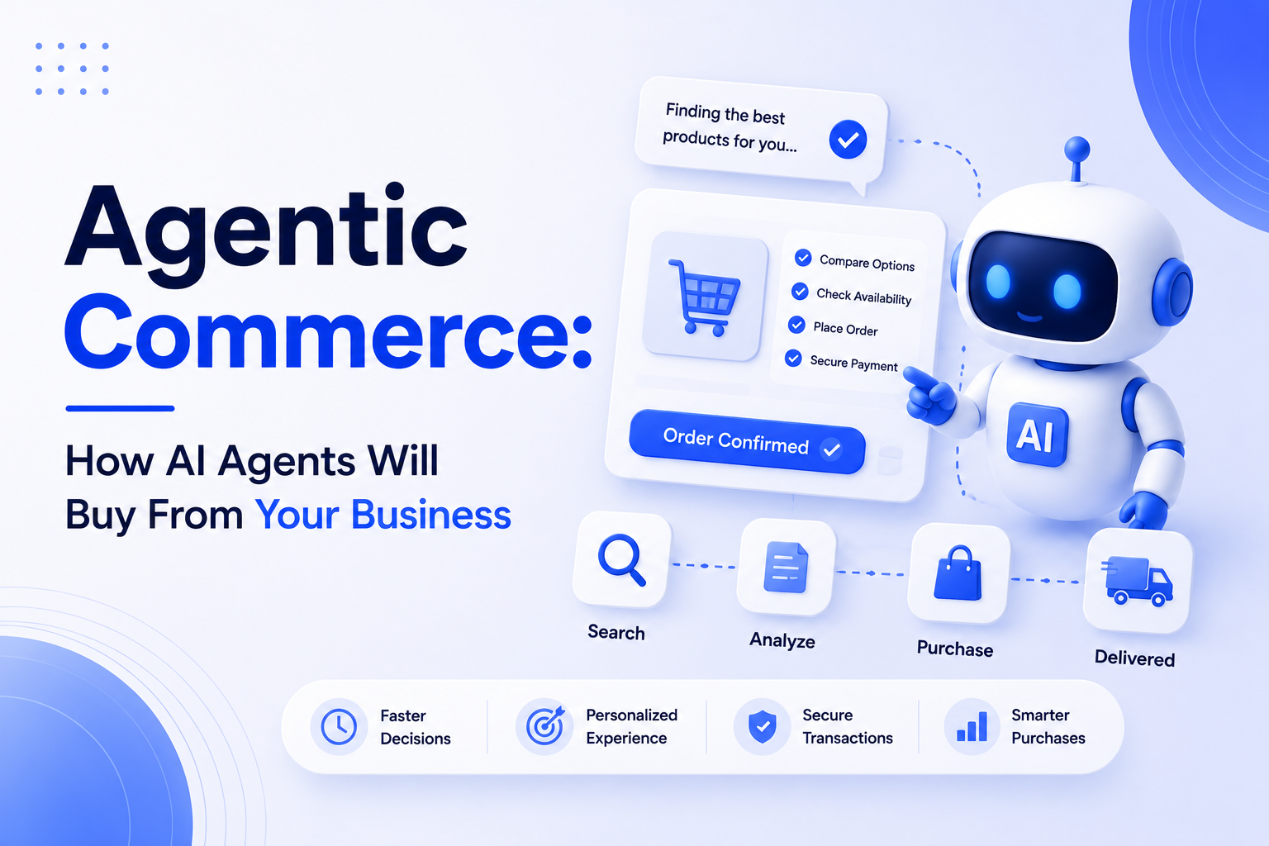
Agentic
commerce is online shopping where an AI agent handles part or all of the
purchase for a person, from finding the product to paying for it. Instead of a
customer clicking through your website, their AI assistant does the buying. It
is being called the biggest shift in digital payments since the smartphone, and
it is arriving now.
Picture a
customer telling ChatGPT, "order me more of that coffee." The agent
finds it, compares options, and pays, without the person ever opening your
site. That is not a future scenario. Since September 2025, OpenAI's Instant
Checkout in ChatGPT has let people buy products inside a
conversation, on a platform with roughly 900 million weekly users. Agentic
commerce has moved from idea to live infrastructure.
This guide is written for business owners, e-commerce leaders, and product teams who need to understand what is coming. We will explain what agentic commerce is, who is building it, how it works, and, most importantly, how to make your business ready to sell to agents, not just to people. It connects to our work in e-commerce application development and artificial intelligence development.
Key takeaways
- Agentic commerce is buying where an AI agent handles some or all of the transaction on a person's behalf.
- It is already live: OpenAI's Instant Checkout, powered by the Agentic Commerce Protocol, launched in ChatGPT in September 2025.
- The biggest names are building the rails: OpenAI and Stripe, Visa, Mastercard, PayPal, and Google all have agent-payment products.
- Analysts expect a multi-hundred-billion-dollar shift within five years, changing how customers discover and buy.
- The businesses that win will make themselves "agent-ready," with clean product data, clear APIs, and agent-friendly checkout.
What is agentic commerce?
Agentic
commerce is a model of online buying in which an autonomous AI agent carries
out part or all of a purchase for a user. The person states an intent, such as
"reorder my usual" or "find me a cheaper flight," and the
agent searches, compares, decides, and often pays. The human sets the goal; the
agent does the shopping.
Why does this
matter so much? Because it changes who your customer is. For twenty-five years,
e-commerce has optimized for human eyes: pretty pages, persuasive copy, and
smooth checkouts. In agentic commerce, the buyer is often software. It does not
care about your hero image; it cares about clean product data, price,
availability, and whether it can complete the purchase through a supported
protocol. As Stripe describes it, this is a genuinely new
commerce surface, not just a new marketing channel.
The simplest way to see it: traditional commerce is a shopper walking your store. Agentic commerce is the shopper sending a capable assistant with a list and a card. If your store is not set up for that assistant, it walks past you to a competitor who is.
Who is building agentic commerce?
This is not a
single company's experiment; the biggest players in payments and AI are
building the rails right now. That is the strongest signal that agentic
commerce is real. The table below shows the main efforts.
|
Player |
Product/protocol |
What
it does |
|
OpenAI
+ Stripe |
Agentic
Commerce Protocol (ACP) |
Powers
Instant Checkout inside ChatGPT |
|
Visa |
Intelligent
Commerce Connect |
One
integration for agent payments across protocols |
|
Mastercard |
Agent
Pay (Agentic Tokens) |
Lets
verified AI agents pay on a person's behalf |
|
Google |
Agent
Payments Protocol (AP2) |
Open
protocol for agent-led payments |
|
PayPal
/ Perplexity |
Agent
checkout integrations |
Agent-driven
buying in AI assistants |
Two things stand out. First, Visa's Intelligent Commerce gives merchants a single integration that works across several agent protocols, which lowers the barrier to joining. Second, Mastercard Agent Pay uses "agentic tokens" so a verified agent can transact securely. When Visa, Mastercard, OpenAI, and Google are all shipping products in the same year, the direction is set.
How does agentic commerce work?
Understanding
the flow helps you prepare for it, so here is what happens in a typical agentic
purchase.
1. Intent. The
customer tells their AI assistant what they want, in plain language.
2. Discovery.
The agent searches for products that match, pulling from catalogs, feeds, and
connected merchants.
3. Evaluation.
The agent compares price, availability, delivery, and reviews, then picks an
option.
4. Checkout.
The agent completes the purchase through a supported payment protocol, often
without opening your website.
5.
Confirmation. The order flows back to your systems like any other, but the
"shopper" was software acting for a person.
The critical point for businesses is step two and step four. If your products are not discoverable in a clean, structured way, the agent never considers you. And if your checkout cannot accept an agent-led payment, the agent cannot buy from you even if it wants to. This is why it is as much an engineering task as a marketing one, and why solid application integration matters.
How do you make your business agent-ready?
Preparing for
this shift is practical work you can start now. Use this checklist to become
"agent-ready" before your competitors do.
1. Clean,
structured product data. Make sure your catalog has accurate titles, prices,
availability, and attributes in a machine-readable format. Agents buy on data,
not design.
2. Expose a
clear API or feed. Agents need a reliable way to read your catalog and place
orders. A well-documented API or product feed is now a sales channel.
3. Support an
agent payment path. Plan to accept at least one agent-payment protocol, such as
ACP or a card network's agent product, so agents can actually check out.
4. Keep
inventory and pricing real-time. Agents act on live data. Stale stock or prices
lead to failed orders and lost trust.
5. Add
structured data and clear policies. Machine-readable shipping, returns, and
product schema help agents choose you with confidence.
6. Track agent
traffic separately. Start measuring which sales come from agents, so you can
see the shift as it grows.
This checklist is the practical core of the article. It turns "agentic commerce is coming" into concrete steps. Most of it is engineering your data and checkout for a non-human buyer, which a dedicated development team can implement alongside your existing store.
What are the risks and open questions?
This shift is
promising, but it is early, so go in with clear eyes. A few issues matter.
First, trust
and control. When an agent pays on someone's behalf, who is responsible if it
buys the wrong thing? Payment networks are addressing this with verified agents
and "agentic tokens," but the rules are still forming.
Second,
discovery and fairness. If agents favor certain catalogs or protocols, smaller
merchants risk being invisible. Getting your data and integrations right early
is how you stay in consideration.
Third, cost.
Agent platforms may charge fees; OpenAI, for example, charges
a 4% fee on Instant Checkout purchases. You will need to weigh that
against the new demand agents bring.
None of these should stop you from preparing. These are reasons to engage early and deliberately, not to wait. The businesses that treat agentic commerce as a real channel now will shape how it works for them, rather than reacting later.
The bottom line
Agentic
commerce moves the buyer from a person clicking your site to an AI agent acting
for them. It is already live in ChatGPT, and the largest payment and AI
companies are building the rails, which means it is a structural shift, not a
fad. For businesses, the question is no longer whether agents will buy, but
whether your store is ready to sell to them.
Get your product data clean, expose a reliable API, support an agent-payment path, and keep everything real-time. Do that and you stay in the consideration set as buying shifts to agents. Ignore it and you become invisible to a fast-growing channel. If you want to make your store agent-ready, book a 30-minute agentic commerce review and we will map the work with you.
Frequently asked questions
What is agentic commerce?
Agentic
commerce is online buying where an autonomous AI agent handles part or all of a
purchase for a person, including finding products, comparing options, and
paying. The human sets the intent and the agent does the shopping and checkout.
Is agentic commerce actually live in 2026?
Yes. OpenAI's
Instant Checkout, powered by the Agentic Commerce Protocol built with Stripe,
has let people buy inside ChatGPT since September 2025. Visa, Mastercard,
Google, and PayPal have all launched agent-payment products.
Who is building agentic commerce infrastructure?
The biggest
names in AI and payments: OpenAI and Stripe (Agentic Commerce Protocol), Visa
(Intelligent Commerce), Mastercard (Agent Pay), Google (Agent Payments
Protocol), plus PayPal and Perplexity integrations.
How is agentic commerce different from normal e-commerce?
In normal
e-commerce, a human browses your website. In agentic commerce, an AI agent buys
on the person's behalf, often without opening your site. It cares about clean
product data, price, availability, and a supported checkout, not page design.
How do I make my business ready for agentic commerce?
Provide clean,
structured product data, expose a reliable API or feed, support an
agent-payment protocol, keep inventory and pricing real-time, add structured
data and clear policies, and start tracking agent-driven sales separately.
Does agentic commerce cost merchants money?
It can. Agent
platforms may charge fees; OpenAI charges a 4% fee on Instant Checkout
purchases, for example. Businesses should weigh platform fees against the new
demand and reach that agent channels bring.
Will agentic commerce replace websites?
Not entirely,
but it adds a major new channel where the buyer is software. Many purchases,
especially reorders and simple decisions, will shift to agents, so businesses
need to serve both human visitors and AI agents.
Let's Talk
About Your Idea!