- Home
- ServicesCrafted for Growth
Our development solutions are designed to transform your vision into a thriving success story.
- TechnologiesTech Solutions
We leverage cutting-edge technology to drive efficiency, scalability, and excellence in every project we undertake.
- Contact Us
How Much Does It Cost to Build a SaaS Product in 2026?
Posted By
naxtre
Published Date
23-07-2026
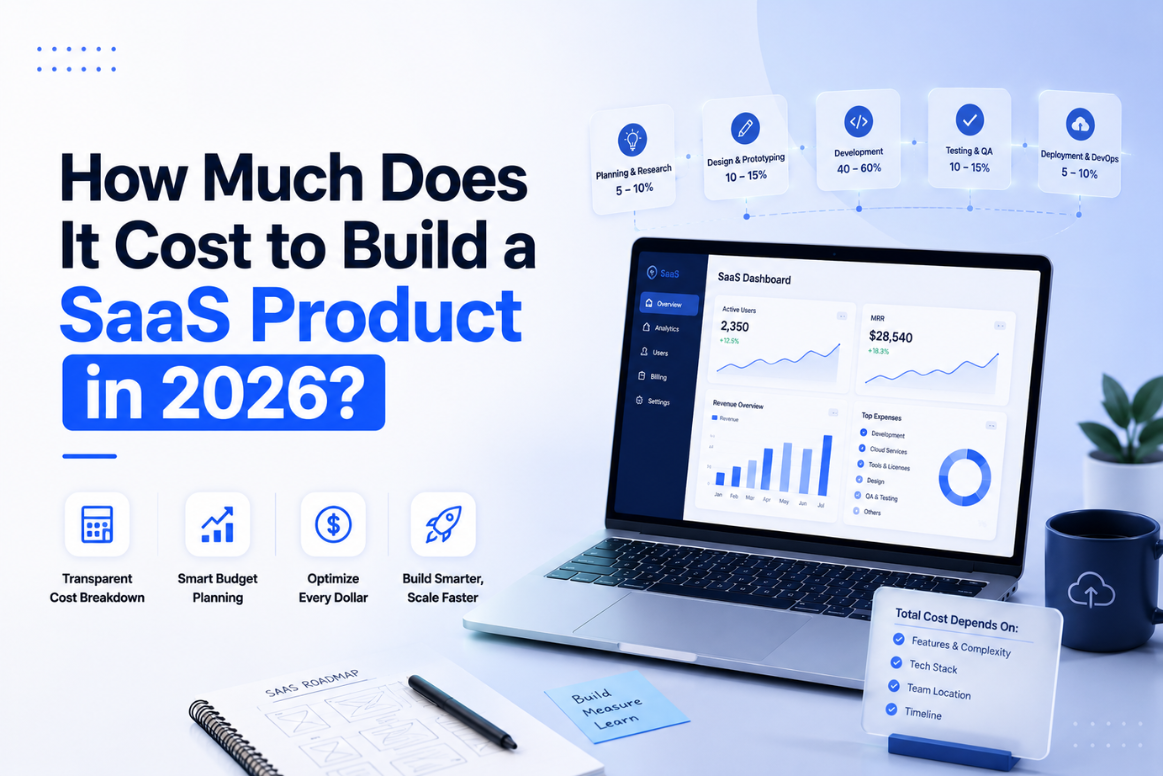
The cost to
build a SaaS product in 2026 typically ranges from around $15,000 for a
prototype to $75,000-$150,000 for an MVP, and $150,000-$300,000 for a
market-ready product. Enterprise-grade platforms run higher. The real driver is
not features, but complexity: user roles, billing, integrations, and
compliance.
Here is the
honest part most pricing pages skip: there is no single "SaaS price."
A simple internal tool and a multi-tenant, compliant enterprise platform are
both "SaaS," and they can differ by ten times in cost. So instead of
a made-up number, this guide gives you the real ranges, explains what actually
moves them, and shows how to spend the least while learning the most.
This is written for founders and product leaders budgeting a build. It focuses on the cost of a SaaS *platform*, which is different from a single mobile app; if you want app-specific numbers, see our guides on fintech app cost and iOS app cost. It also pairs with our vertical SaaS development and MVP development guides. All figures below are industry estimates, so treat them as planning ranges and scope your own build.
Key takeaways
·
The cost to build a SaaS
product in 2026 spans roughly $15K (prototype) to $300K+ (market-ready), with
enterprise platforms reaching $600K or more.
·
Cost is driven by complexity,
not feature count: user roles, billing, third-party integrations, and
compliance are the big levers.
·
A lean SaaS MVP is the cheapest
way to learn. No-code MVPs can start as low as $1K-$8K, though they trade
flexibility for speed.
·
Hidden costs, data prep,
infrastructure, and the pilot-to-production gap, routinely add 40-60% to naive
budgets.
· Budget 15-25% of the build cost per year for ongoing maintenance and support.
What does it cost to build a SaaS product in 2026?
The most useful
answer is a range by stage, because cost tracks how far you are trying to go.
Based on 2026 industry estimates, the picture looks like this.
|
SaaS
stage |
What
it includes |
Estimated
cost |
|
Prototype |
Clickable
design, no real backend |
~$15,000 |
|
MVP |
One
core workflow, real users, basic billing |
$75,000-$150,000 |
|
Market-ready |
Multiple
workflows, roles, integrations |
$150,000-$300,000 |
|
Enterprise-grade |
SSO,
audit trails, compliance, scale |
$280,000-$600,000+ |
|
No-code
MVP |
Built
on Bubble, Webflow, Glide |
$1,000-$8,000 |
These figures
are estimates drawn from published 2026 cost analyses, and real projects vary
with region, team, and scope. The pattern, though, is reliable: the more your
SaaS has to do and the more users and rules it must respect, the higher the
cost to build a SaaS product climbs. That is why scoping tightly, covered in
our MVP guide, is the single biggest cost lever you control.
What drives the cost to build a SaaS product?
Two SaaS
products with the same feature list can cost very differently, because cost
lives in complexity, not the feature count. Five drivers do most of the work.
|
Cost
driver |
Why
it adds cost |
|
User
roles and permissions |
Multi-tenancy
and role logic multiply testing and security work |
|
Billing
and payments |
Subscriptions,
plans, proration, and tax handling are deceptively complex |
|
Integrations |
Every
third-party system adds development and maintenance |
|
Compliance |
GDPR,
HIPAA, SOC 2, and audit trails require real engineering |
|
Data
and AI features |
Data
pipelines and model costs add build and running expense |
Notice that
none of these is "number of screens." A SaaS with five screens and
full compliance costs more than one with twenty simple screens. When you
estimate the cost to build a SaaS product, start by rating your build on these
five drivers, not by counting features. Getting billing and permissions right
early, supported by solid cloud application development, prevents
expensive rework later.
What hidden costs blow SaaS budgets?
The sticker
price is rarely the final price, so plan for the parts that surprise teams.
Industry analysis notes that hidden costs, data preparation, infrastructure,
post-launch maintenance, and the pilot-to-production gap, routinely inflate
budgets by 40-60%. Three deserve special attention.
First, data
preparation. Getting data clean, structured, and ready is often underestimated,
especially for analytics and AI features.
Second, the
pilot-to-production gap. A demo that works for ten users needs real infrastructure,
monitoring, and security to serve thousands. That gap is where budgets quietly
overrun.
Third, ongoing
maintenance. SaaS is never "done." Plan for 15-25% of your original
build cost every year to cover updates, fixes, security, and support. A
$150,000 build implies roughly $22,000-$37,000 a year to keep healthy.
The lesson is simple: budget the full lifecycle, not just the first launch. A realistic estimate of the cost to build a SaaS product includes the year after launch, not only the months before it.
How can you reduce the cost to build a SaaS product?
You have more
control over cost than most pricing pages admit, so use it deliberately. The
biggest savings come from scope and sequence, not from cutting corners on
quality.
·
Start with an MVP. Build the
one core workflow first, prove people want it, then invest more. This is the
single largest cost saver.
·
Rate your five cost drivers
early. Delay heavy compliance or complex billing until the product is
validated, where the business allows.
·
Use offshore or nearshore
teams. Skilled teams in regions like India deliver strong quality at a fraction
of onshore rates, which is why many founders build this way; see our guidance
on reducing software development costs.
·
Reuse, do not rebuild. Proven
frameworks, managed services, and existing components beat building everything
from scratch.
·
Plan for maintenance from day
one. Clean architecture costs a little more now and saves far more later.
A dedicated development team that scopes tightly and builds on reusable foundations can deliver the same validated SaaS for meaningfully less than an unfocused build. The goal is not the cheapest build; it is the lowest cost to learn whether the product works.
Does SaaS pricing model affect development cost?
It can, and
founders often miss this link. In 2026, many SaaS products use usage-based or
outcome-based pricing rather than flat per-seat fees. That choice affects the
build, because usage-based billing needs accurate metering, real-time tracking,
and often more sophisticated infrastructure than a simple subscription.
So your pricing model is not just a business decision; it is a cost driver. If you plan to charge by usage or outcomes, budget for the metering and billing engineering that requires. If a simple subscription fits your market, you can keep that part lean. Deciding this early, alongside your SaaS product development plan, avoids expensive billing rework after launch. It also connects to a wider point we cover in our post on SaaS challenges: how you charge shapes what you must build.
The bottom line
The cost to
build a SaaS product in 2026 is not one number; it is a range that follows your
ambition. A lean MVP can start under six figures, a market-ready product often
lands in the low-to-mid six figures, and enterprise platforms go higher. But
the number you should focus on is not the total. It is the cost to learn
whether your idea works.
Scope tightly, build the core workflow first, rate your real cost drivers, and budget the full lifecycle including maintenance. Do that and you spend where it matters and avoid the 40-60% overruns that catch unprepared teams. If you want a grounded estimate for your specific SaaS idea, book a 30-minute scoping call and we will map the cost drivers with you.
Frequently asked questions
How much does it cost to build a SaaS product in 2026?
Industry
estimates put a prototype around $15,000, an MVP at $75,000-$150,000, a
market-ready product at $150,000-$300,000, and enterprise-grade platforms at
$280,000-$600,000 or more. Actual cost depends on complexity, region, and team.
What is the cheapest way to build a SaaS product?
The cheapest
validated route is a lean MVP that solves one core workflow. No-code MVPs on
platforms like Bubble can cost as little as $1,000-$8,000, though they trade
flexibility and scale for speed and low upfront cost.
What drives the cost to build a SaaS product?
Complexity, not
feature count. The biggest drivers are user roles and multi-tenancy, billing
and payments, third-party integrations, compliance requirements, and data or AI
features. Rate your build on these before estimating.
Why do SaaS budgets go over?
Hidden costs.
Data preparation, production infrastructure, security, and the
pilot-to-production gap routinely add 40-60% to naive budgets. Teams also
forget ongoing maintenance, which runs 15-25% of the build cost per year.
How much does SaaS maintenance cost per year?
Plan for 15-25%
of the original build cost annually. A $150,000 SaaS build implies roughly
$22,000-$37,000 per year for updates, security, fixes, and support. SaaS is
never finished, so this is a permanent line item.
Is it cheaper to build SaaS offshore?
Often, yes.
Skilled offshore and nearshore teams in regions like India deliver strong
quality at a fraction of onshore rates. The savings are real for well-scoped
projects, though clear communication and a dedicated project manager matter to
protect quality.
Does the pricing model affect SaaS build cost?
Yes.
Usage-based or outcome-based pricing needs accurate metering, real-time
tracking, and more billing infrastructure than a flat subscription. Decide your
pricing model early, because it is a genuine cost driver, not just a business
choice.
Let's Talk
About Your Idea!