- Home
- ServicesCrafted for Growth
Our development solutions are designed to transform your vision into a thriving success story.
- TechnologiesTech Solutions
We leverage cutting-edge technology to drive efficiency, scalability, and excellence in every project we undertake.
- Contact Us
Vertical SaaS Development: How to Build a Vertical SaaS Product in 2026
Posted By
naxtre
Published Date
10-07-2026
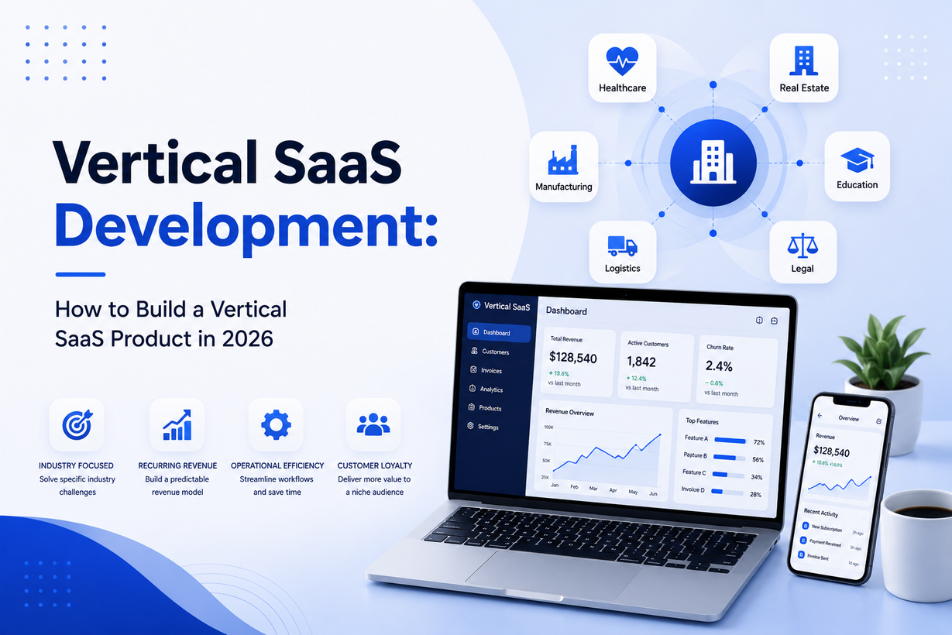
Vertical SaaS
development means building software for one specific industry, such as dental
clinics, logistics firms, or law practices, instead of a general tool for
everyone. It trades a smaller market for a deeper fit, stronger loyalty, and
better margins. In 2026, this focused approach is where much of the new SaaS
growth is happening.
For years, the
winning SaaS playbook was to build broad. Make a tool that works for any team,
then scale to millions. That game is now crowded and expensive. The quieter,
more durable opportunity is to go narrow: solve one industry's exact problem
better than any general tool can. That is the heart of vertical SaaS
development, and it is why founders and product leaders are paying attention.
This guide explains it in plain terms. We will define vertical SaaS, compare it with the horizontal model, show why it wins, walk through a six-step build framework, and help you choose the right niche. It builds on our SaaS product development work and is written for anyone deciding where to place their next product bet.
Key takeaways
·
Vertical SaaS development
builds software for one industry; horizontal SaaS builds one tool for everyone.
·
Vertical and micro-SaaS are set
to drive a majority of new SaaS market growth, with the vertical segment
projected to reach hundreds of billions of dollars by 2028.
·
Vertical products win on deeper
fit: higher retention, easier sales, and pricing power, because they solve a
specific industry's real problems.
·
The build should start with
deep industry knowledge, not features. Domain expertise is the moat.
· Modern vertical SaaS increasingly bakes in AI and usage-based pricing from day one.
What is vertical SaaS development?
Vertical SaaS
development is the process of building a software product tailored to the
needs, workflows, and rules of a single industry. A horizontal SaaS tool, like
a general project manager or a generic CRM, tries to serve every business. A
vertical SaaS product serves one, such as a scheduling and records platform
built only for dental clinics, or a compliance tool built only for logistics.
Why does this
focus matter so much now? Because the broad market is saturated and buyers want
tools that already understand their world. Industry analysts expect vertical
and micro-SaaS to command the majority of new SaaS growth, with the vertical
segment projected to reach around $720 billion by 2028 at a high growth rate, according
to 2026 SaaS trend analysis. Deloitte's
technology predictions point the same way, noting SaaS is being reshaped by
deep specialization and embedded AI.
The simple idea: a general tool is a Swiss Army knife. A vertical tool is the exact scalpel a surgeon reaches for. In 2026, more buyers want the scalpel.
Vertical SaaS vs horizontal SaaS: what is the difference?
Choosing
between the two shapes everything else, so let us make it concrete. The table
below compares the models on the dimensions that matter to a founder.
| Dimension |
Horizontal SaaS | Vertical SaaS |
|---|---|---|
| Audience |
Any industry | One specific industry |
| Market size |
Large but crowded | Smaller but focused |
| Competition |
Intense, many players | Fewer, often weaker incumbents |
| Product fit |
Broad and generic | Deep and specific |
| Sales |
Harder to stand out | Easier; you speak their language |
| Retention |
Lower; easy to switch | Higher; deeply embedded |
| Pricing power
| Limited | Stronger; hard to replace |
| Main risk |
Getting lost in the crowd | Picking too small a niche |
The takeaway is that vertical SaaS development trades reach for depth. You give up the dream of serving everyone in return for becoming irreplaceable to someone. For most new products in 2026, that trade is the smarter bet.
Why does vertical SaaS development win in 2026?
Vertical
products win for reasons that compound over time. Three stand out.
First, deeper
product fit. When you build for one industry, you can match its exact
workflows, terminology, and compliance rules. A dental platform can handle
insurance claims the way dentists actually work. A general tool cannot, without
heavy customization.
Second,
stronger retention and loyalty. A product built around an industry's core
operations becomes hard to rip out. That embedment shows up as lower churn and
longer customer lifetimes, which is why investors increasingly favor the model.
Third, easier
sales and marketing. When your product speaks a buyer's exact language,
marketing gets sharper and sales cycles get shorter. You are not explaining why
a generic tool could work; you are showing a tool that clearly already fits.
Reliable data analytics services then let you prove
that fit with the customer's own numbers.
How do you build a vertical SaaS product? A 6-step framework
Vertical SaaS
development succeeds or fails on domain depth, not feature count. Use this
framework to build in the right order.
1. Master the
niche. Learn the industry's workflows, pain points, language, and regulations
before writing code. This domain knowledge is your real moat.
2. Validate
with real operators. Talk to people who do the work daily. Confirm the problem
is painful and that they would pay to solve it.
3. Design for
their workflow, not a generic one. Shape the product around how the industry
actually operates, including its compliance and reporting needs.
4. Build a
focused MVP. Solve the single most painful problem exceptionally well before
adding breadth. A narrow tool that nails one job beats a broad tool that
half-solves ten.
5. Bake in AI
and integrations. Modern buyers expect intelligent features and connections to
the tools they already use. Plan artificial intelligence development and
integrations early, not as afterthoughts.
6. Price for
value, and expand. Start with a pricing model that reflects the value
delivered, then grow into adjacent workflows once you own the core one.
This framework is the practical core of the article. It keeps you from the most common mistake in vertical SaaS: building features before understanding the industry. If you lack in-house domain-plus-engineering capacity, a dedicated development team that pairs engineers with your domain experts can move far faster than a generalist build.
How do you choose the right niche?
Niche choice
decides your ceiling, so treat it as the most important decision. A good
vertical SaaS niche usually meets most of this checklist.
·
Real pain: the industry has a
clear, expensive problem that current tools handle badly.
·
Enough buyers: the market is
small enough to focus on but large enough to sustain a business.
·
Willingness to pay: operators
already spend money solving this, even if clumsily.
·
Weak incumbents: existing
software is dated, generic, or hated, leaving room to win.
·
Access: you can actually reach
and understand these buyers, ideally through existing relationships.
·
Room to expand: once you own
one workflow, adjacent ones let you grow without changing industries.
The biggest risk in vertical SaaS development is picking a niche that is too small to sustain growth or too broad to feel specific. The sweet spot is a focused industry with real pain, real budgets, and weak existing tools.
What does vertical SaaS cost and how is it priced?
Cost depends on
scope, but the pattern is predictable. A focused MVP that solves one core
workflow costs far less than a sprawling platform, which is exactly why the
focused approach is smart. You prove value in one industry before investing in
breadth.
On pricing, 2026 has shifted. Many AI-native SaaS products now use usage-based or outcome-based pricing rather than flat per-seat fees, charging for value delivered such as actions taken or results produced. For a vertical product, this can align your revenue tightly with the customer's success. The key is to pick a model your specific industry finds fair and predictable, then revisit it as you add AI features that carry their own running costs. Building on solid cloud application development keeps those costs scalable as you grow.
The bottom line
Vertical SaaS
development is the focused bet that fits 2026. Instead of chasing a crowded horizontal
market, you become irreplaceable to one industry by understanding it better
than anyone else. The growth data supports it, and so does the logic: deeper
fit drives higher retention, easier sales, and stronger pricing power.
The winners will not be the teams with the most features. They will be the teams with the deepest understanding of one industry, expressed in software that feels built exactly for it. Start with the niche, validate with real operators, build a focused MVP, and bake in AI and fair pricing from the start. If you are weighing a vertical SaaS idea and want a candid view on the build, book a 30-minute product review and we will pressure-test it with you.
Frequently asked questions
What is vertical SaaS development?
Vertical SaaS
development is building software for one specific industry, tailored to its
workflows, terminology, and rules. It contrasts with horizontal SaaS, which
builds a single general tool for any business. Vertical products trade market
size for deeper fit and loyalty.
What is the difference between vertical and horizontal SaaS?
Horizontal SaaS
serves any industry with a general tool, competing in a large, crowded market.
Vertical SaaS serves one industry deeply, with fewer competitors, higher
retention, and stronger pricing power. The trade is reach for depth.
Why is vertical SaaS growing so fast in 2026?
Because the
broad market is saturated and buyers want tools that already understand their
industry. Analysts expect vertical and micro-SaaS to drive most new SaaS
growth, with the vertical segment projected to reach around $720 billion by
2028.
How do you build a vertical SaaS product?
Start by
mastering the niche, validate the problem with real operators, design around
their actual workflow, build a focused MVP that nails one core problem, bake in
AI and integrations, and price for value. Domain knowledge matters more than
feature count.
How do you choose a vertical SaaS niche?
Look for a
real, expensive problem, enough buyers to sustain a business, existing
willingness to pay, weak incumbent software, access to the buyers, and room to
expand into adjacent workflows. Avoid niches that are too small or too broad.
How much does vertical SaaS development cost?
It varies with
scope, but a focused MVP that solves one workflow costs far less than a broad
platform. Building narrow first lets you prove value in one industry before
investing in breadth, which controls cost and risk.
How should vertical SaaS be priced?
Increasingly
with usage-based or outcome-based pricing rather than flat per-seat fees,
charging for value delivered. Choose a model your specific industry finds fair
and predictable, and revisit it as AI features add their own running costs.
Let's Talk
About Your Idea!