- Home
- ServicesCrafted for Growth
Our development solutions are designed to transform your vision into a thriving success story.
- TechnologiesTech Solutions
We leverage cutting-edge technology to drive efficiency, scalability, and excellence in every project we undertake.
- Contact Us
The Real Cost of Running AI in Production: A CTO's Guide to AI Cost Optimization
Posted By
naxtre
Published Date
06-07-2026
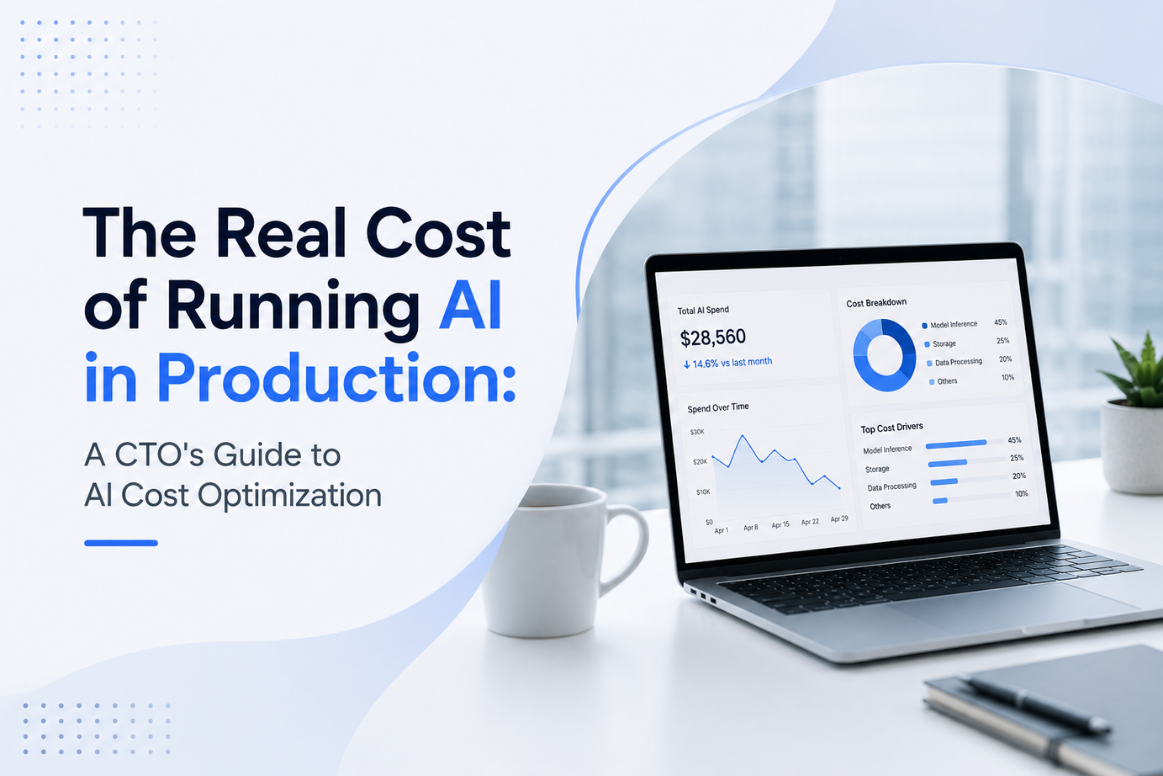
AI cost
optimization is the practice of controlling what your AI systems cost to run,
not just to build. It means tracking spend per request, cutting waste in models
and infrastructure, and tying every dollar to a business outcome. In 2026,
running AI, not building it, is where budgets quietly break.
Most teams
budget carefully for building an AI feature and then get surprised by the bill
to keep it running. That surprise even has a name now: "inference bill
shock." Once an AI feature is live, every user request costs money, and
those costs scale with usage in ways a traditional app never did. This is why
AI cost optimization has become its own discipline, often called FinOps for AI.
This guide is written for CTOs and product leaders who need AI to be affordable at scale, not just impressive in a demo. We will explain why AI costs spiral, the two metrics that expose the problem, the levers that actually cut spend, and a simple checklist to run against your own systems. It is about the cost of running AI, which is a different problem from the cost of *building* software, covered in our guide on reducing software development costs.
Key takeaways
·
AI cost optimization controls
the cost of running AI in production, where usage-based inference spend now
sits, not one-time build cost.
·
The primary cloud cost driver
in 2026 is inference, a trend the FinOps community calls "inference bill
shock."
·
Two metrics expose the problem:
cost per token and cost per successful interaction. Track these before anything
else.
·
The biggest savings are
structural: right-sizing models (small language models can cut cost up to 90%
for specialized tasks), specialized hardware, and killing idle GPU capacity.
· FinOps for AI works only when finance, engineering, and product share one view of AI spend.
What is AI cost optimization (FinOps for AI)?
AI cost
optimization is the process of measuring, controlling, and reducing what it
costs to operate AI systems in production. The wider practice is known as
FinOps for AI: bringing finance, engineering, and business teams together so
everyone sees AI spend and can make informed trade-offs. The FinOps Foundation now treats managing
generative AI and large language model costs as a core discipline in its own
right.
Why is this
suddenly a separate skill? Because AI breaks the old cost model. Traditional
cloud FinOps assumed fairly predictable servers and storage. AI adds
unpredictable GPU availability and complex, per-token pricing. As several 2026
FinOps guides note, the main driver of cloud cost is no longer just keeping the
lights on; it is inference, the cost of the model actually answering users.
That shift is what makes AI cost optimization a board-level concern, not a line
item.
The simplest way to think about it: building the model is a project cost. Running the model is a forever cost. AI cost optimization is how you keep the forever cost from eating your margin.
Why do AI costs spiral in production?
AI bills grow
for reasons that are easy to miss in a demo and painful to discover in
production. Three causes do most of the damage.
First,
usage-based inference. Every request to a model costs money, usually priced per
token. A feature that delights ten testers behaves very differently when a
hundred thousand users hit it daily. Cost scales with success, which is a trap
teams rarely plan for.
Second,
oversized models. Teams often reach for the largest, most capable model for
every task, including simple ones. That is like hiring a senior architect to
reset passwords. Most tasks do not need the biggest model, and using it
everywhere multiplies cost.
Third, idle
infrastructure. GPUs are expensive, and they are often badly utilized. Industry
FinOps analysis puts GPU underutilization as high as 70 to 85 percent in many
setups. You pay for capacity you never use.
Layer in agent systems that call other agents, and the spend compounds fast. This is exactly why cost control sits at the center of running AI agents in production, a theme we cover in our work on AI agent systems and reinforce with strong DevOps and cloud engineering practices.
Which metrics matter most for AI cost optimization?
You cannot
optimize what you do not measure, and the usual cloud dashboards miss the point
for AI. Two metrics matter most.
Cost per token.
This is the raw unit cost of your model calls. It tells you how expensive each
interaction is at the model level and where prompt or model choices are
inflating spend.
Cost per
successful interaction. This is the metric that changes decisions. It divides
total AI spend by outcomes that actually worked, a completed answer, a resolved
ticket, a booked order. It exposes which features quietly drain margin because
they burn tokens without delivering value. FinOps guides increasingly call this
the "golden metric" for AI.
The shift here is subtle but important. Traditional software optimizes for uptime and response time. AI cost optimization optimizes for value per dollar. A feature can be fast, popular, and still lose money on every use. Cost per successful interaction is how you catch that early, and clean data analytics services make the number trustworthy.
What are the biggest AI cost optimization levers?
The largest
savings are structural, not cosmetic. The table below shows the levers that
move the needle, with the savings ranges reported across 2026 FinOps analysis.
Treat the numbers as directional and confirm them against your own workload.
| Lever | What
it does | Reported typical saving |
|---|---|---|
| Right-size
the model | Use a small language model (SLM) for specialized tasks instead of a
large one | Up to ~90% for suitable tasks |
| Specialized
hardware | Run inference on chips like AWS Inferentia2 or Trainium instead of
general GPUs | Up to ~50% vs general-purpose GPUs |
| Fix idle GPUs
| Use GPU pooling and dynamic scaling to reclaim unused capacity | Recovers
70-85% typical underutilization |
| Use RAG |
Retrieve from a knowledge base instead of stuffing giant prompts | Lower tokens
per call, better answers |
| Cache and
batch | Reuse answers and group requests to avoid repeat calls | Varies; often
significant |
| Set budgets
and alerts | Cap spend per feature and get warned before overruns | Prevents
bill shock |
The pattern is clear. Match the model to the task, run it on the right hardware, stop paying for idle capacity, and put a budget around every AI feature. Most teams find their biggest win in the first row alone: they were using an expensive model where a smaller one would do.
How do you implement AI cost optimization? A 6-point checklist
Use this
checklist to bring AI spend under control. We run a version of it with clients
during AI reviews. Score each item as done, partial, or missing, and start with
whichever is missing.
1. Visibility:
you can see AI spend broken down by feature, model, and team, not just one
total cloud bill.
2. Metrics: you
track cost per token and cost per successful interaction for each AI feature.
3.
Right-sizing: every task uses the smallest model that meets its quality bar,
not the biggest by default.
4.
Infrastructure: idle GPU capacity is minimized through pooling, scaling, or the
right inference hardware.
5. Budgets:
each AI feature has a spend cap with alerts, so nothing runs away silently.
6. Shared
ownership: finance, engineering, and product review AI spend together on a
regular cadence.
This checklist is the practical core of the article. It turns "our AI bill is scary" into a short, ordered list you can act on this quarter.
When should you invest in AI cost optimization?
Timing matters,
so be deliberate. In the pilot stage, do not over-optimize; focus on proving
the feature works and instrument basic cost visibility. The moment a feature
moves toward real usage, though, AI cost optimization should become a
first-class requirement, because that is when usage-based inference starts to
compound.
The clearest trigger is scale. If an AI feature is growing in users or requests, its cost is growing too, often faster than revenue. That is the point to right-size models, fix idle infrastructure, and set budgets. Waiting until the bill is alarming is the expensive path. For teams without in-house FinOps depth, a dedicated development team with artificial intelligence development experience can build cost controls in from the start rather than retrofitting them under pressure.
The bottom line
The hard part
of enterprise AI in 2026 is no longer making it work. It is making it
affordable to run at scale. AI cost optimization, or FinOps for AI, is how
serious teams keep inference spend from quietly eating their margin. The
playbook is not exotic: measure cost per successful interaction, match models
to tasks, run on the right hardware, kill idle capacity, and budget every
feature.
Do this early and AI stays a profitable advantage. Ignore it and even a popular feature can lose money on every request. If you want a clear read on where your AI spend is leaking and how to fix it, book a 30-minute AI cost review and we will map your levers with you.
Frequently asked questions
What is AI cost optimization?
AI cost
optimization is the practice of measuring and reducing what it costs to run AI
systems in production. It covers model choice, infrastructure, and usage-based
inference spend, and ties cost to business outcomes. The broader discipline is
known as FinOps for AI.
Why are AI running costs so high?
Because AI is
priced by usage. Every request costs money, usually per token, so cost scales
with success. Oversized models and idle GPU capacity, which industry analysis
puts at 70-85% underutilization, make it worse.
What is the difference between AI build cost and AI run cost?
Build cost is
the one-time cost to develop an AI feature. Run cost is the ongoing cost to
operate it in production, driven by inference. AI cost optimization targets run
cost, which usually becomes the larger number over time.
What metrics should I track for AI cost optimization?
Track cost per
token, the unit cost of model calls, and cost per successful interaction, which
divides total AI spend by outcomes that actually worked. The second metric
exposes features that burn money without delivering value.
How can I reduce AI costs without hurting quality?
Use the smallest
model that meets the quality bar (small language models can cut cost up to 90%
for specialized tasks), run inference on specialized hardware, use RAG to
shrink prompts, cache repeat answers, and set per-feature budgets.
What is FinOps for AI?
FinOps for AI
is the discipline of managing AI cloud spend by bringing finance, engineering,
and product together with shared visibility. It extends traditional cloud
FinOps to handle GPU costs and per-token inference pricing.
When should we start optimizing AI costs?
Start with
basic cost visibility in the pilot stage, then make optimization a priority the
moment a feature scales toward real usage. Usage-based inference compounds with
growth, so early control is far cheaper than fixing an alarming bill later.
Let's Talk
About Your Idea!