- Home
- ServicesCrafted for Growth
Our development solutions are designed to transform your vision into a thriving success story.
- TechnologiesTech Solutions
We leverage cutting-edge technology to drive efficiency, scalability, and excellence in every project we undertake.
- Contact Us
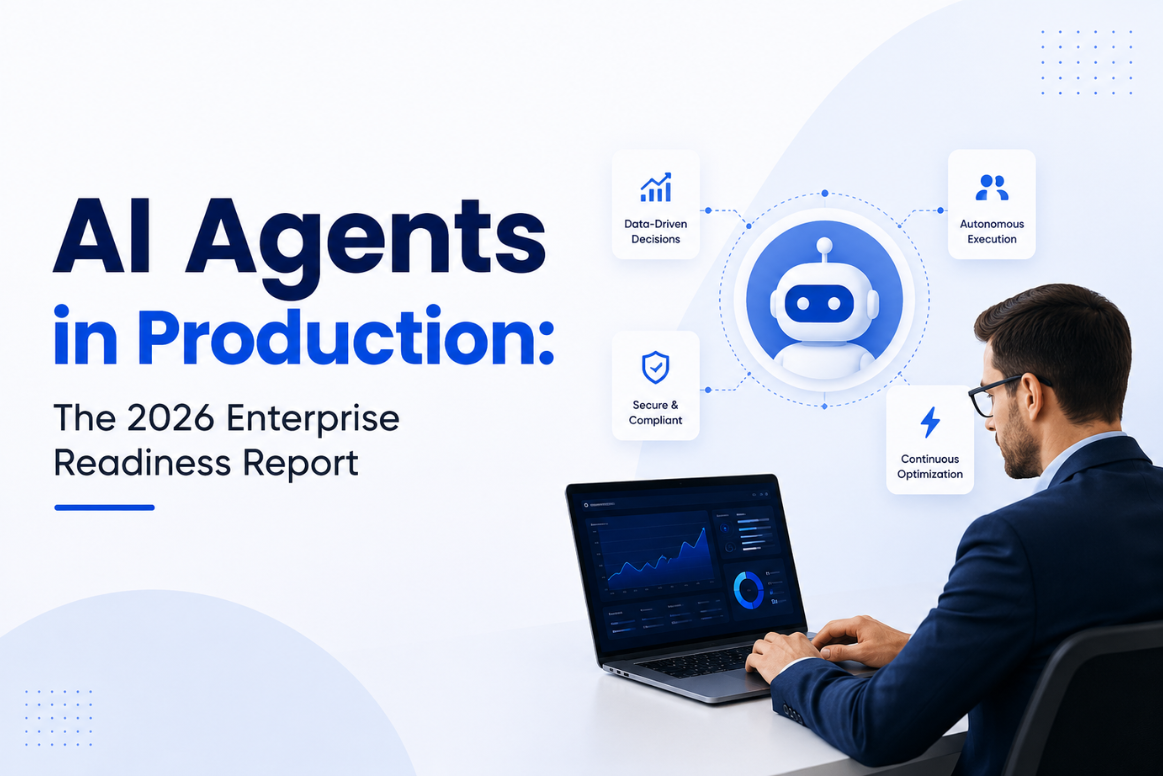
AI Agents in Production: The 2026 Enterprise Readiness Report
Posted By
naxtre
Published Date
15-06-2026
Most enterprise
AI agents never reach production. Getting AI agents in production has become
the defining challenge of enterprise AI in 2026, because the gap between a
working pilot and live deployment is where most projects die. Gartner expects 40% of enterprise applications to
use task-specific AI agents by the end of 2026, yet fewer than one in four
organizations have scaled agents to production. This report explains why, with
data.
The story of AI
agents in production in 2026 is not a story about smarter models. It is a story
about everything around the model: data, integration, governance, and
orchestration. In our artificial intelligence development work,
teams that treat agents as a model problem stall, and teams that treat them as
a systems problem ship.
To make that
concrete, this report does two things. First, it benchmarks where enterprises
actually stand with AI agents in production, using the latest published data.
Second, it introduces a practical scoring tool we use with clients, the 4-Layer
AI Agent Readiness Model, so you can locate exactly where your own agents will
break before they do.
Key takeaways (the 2026 data)
·
Adoption is early: roughly 17%
of organizations have deployed AI agents, while more than 60% expect to within
two years (Gartner).
·
The pilot-to-production gap is
the real story: fewer than one in four organizations have successfully scaled
agents to production.
·
Governance lags badly: only
about 21% of organizations report a mature governance model for agentic AI
(Deloitte).
·
Risk is already real: 67% of
executives believe their organization has had a data leak tied to unapproved AI
tools, and 35% say they could not immediately shut down a rogue agent.
·
The top blocker is not
intelligence: 46% cite integration with existing systems as their primary
challenge, and data quality is repeatedly named the number-one obstacle.
What is the state of AI agents in production in 2026?
In 2026, enterprises have moved past the question of whether to adopt AI agents and into the much harder question of how to run them in production. The intent is overwhelming. According to Gartner's 2026 survey data, only about 17% of organizations have deployed AI agents so far, but more than 60% expect to within two years. Deloitte's research frames the same moment differently: agentic AI is scaling faster than the guardrails meant to control it.
The result is a
widening gap. Experimentation is everywhere, but durable AI agents in
production are rare. Fewer than one in four organizations have actually scaled
agents into reliable production use. That gap, not model quality, is where 2026
budgets are won and lost.
It is also
where the ROI disconnect lives. Despite heavy investment, only around 29% of
organizations report significant ROI from generative AI, and roughly 23% from
AI agents. The productivity ceiling is real for the few who get it right;
reports of AI super-users delivering 5x gains are common. But most
organizations are stuck below that ceiling because their agents never make it
past the pilot.
Why do most AI agents stall before production?
When an agent
demos beautifully and then dies on the way to production, the failure is almost
never the model. It is one of four layers underneath it. Across enterprise
engagements, the same four failure points repeat, and they map directly to the
framework below.
The first is
data. Agents reason over your data, and if that data is fragmented,
undocumented, or stale, the agent inherits every flaw. Data quality is
consistently named the number-one blocker to scaling AI agents in production.
The second is
integration. An agent that cannot securely reach your real systems is a demo,
not a deployment. Gartner reports that 46% of organizations cite integration
with existing systems as their primary challenge. The hardest part of agentic
workflows in 2026 is not intelligence; it is secure, reliable access to
production systems.
The third is
governance. Deloitte finds only about 21% of organizations have a mature
governance model for agentic AI, even as adoption accelerates. The consequences
are already visible: 67% of executives believe they have suffered a data leak
from unapproved AI tools, and 35% admit they could not immediately pull the
plug on a rogue agent.
The fourth is
orchestration. A single agent is easy. Fifty agents coordinating across
workflows, with monitoring, fallback, and cost control, is a different
discipline entirely.
The 4-Layer AI Agent Readiness Model
To move AI agents in production from luck to process, we use a simple model with clients. We call it the 4-Layer AI Agent Readiness Model. Each layer must be solid before the one above it matters. Skip a layer, and the agent stalls exactly there.
Layer 1 - Data readiness
This is the
foundation. Before an agent can act reliably, its data must be accessible,
accurate, well-documented, and governed. That means clear ownership of each
data source, consistent schemas, and a way to keep the data fresh. Reliable data
analytics services and clean data pipelines are what make this layer
production-grade. Most stalled agents fail here first. If your data is not
ready, no model is good enough to compensate.
Layer 2 - Integration readiness
Here the agent
meets your real systems: legacy applications, APIs, authentication, and
production latency. Readiness at this layer means the agent has secure,
monitored, permissioned access to the systems it needs, with the integration
patterns and data contracts to keep those connections stable. Strong DevOps
and cloud engineering practices are what hold these connections
together in production. This is where 46% of enterprises say the hardest work
lives, and they are right.
Layer 3 - Governance readiness
Governance is
what makes an agent safe to run unsupervised. A ready organization can answer
three questions instantly: what is this agent allowed to do, how do we observe
what it actually did, and how do we stop it in seconds if it misbehaves. Given
that only about 21% of organizations have mature agentic governance, this layer
is the single biggest differentiator between teams that scale and teams that
get breached.
Layer 4 - Orchestration readiness
The top layer is about running many agents together in production. Readiness means reliable coordination between agents, observability across the whole system, graceful fallback when an agent fails, and active cost control so token spend does not spiral. A dedicated development team that owns this orchestration end to end is what turns pilots into platforms.
How do you score your AI agent readiness?
The model
becomes useful when you score it. We use a simple rubric we call the Agent
Production Readiness Index. Rate each of the four layers from 0 to 5, where 0
means "not started" and 5 means "production-grade and
monitored." Add them for a score out of 20.
A score of 0 to
8 means you are in pilot territory; do not put agents near production yet. A
score of 9 to 14 means you can run narrow, supervised agents on non-critical
workflows. A score of 15 to 20 means you are ready to scale agents into core,
customer-facing systems. The value of the index is not the number. It is that
it forces an honest conversation about your weakest layer, which is exactly
where your next agent will fail.
What separates teams that scale AI agents in production from teams that stall?
The pattern across 2026 is consistent. Teams that successfully run AI agents in production do the unglamorous work first. They fix data ownership before they pick a model. They treat integration and governance as first-class engineering, not afterthoughts. And they instrument everything, so a misbehaving agent is caught in seconds, not weeks.
Teams that
stall do the opposite. They start with the model, demo a pilot on clean sample
data, and discover the data, integration, and governance gaps only when real
users and real systems arrive. By then the fix is expensive. The lesson of AI
agents in production in 2026 is that the model was never the hard part. The boring
infrastructure was, and it always is.
If you are
planning agentic AI for the year ahead and your roadmap reads like a list of
model names, you are planning the demo. If it reads like a plan for data,
integration, governance, and orchestration, you are planning the deployment.
That distinction, more than any model choice, decides who ships. If you want to
benchmark your own four layers, book a 30-minute AI readiness review and we
will score them with you.
Frequently asked questions
What percentage of AI agents reach production in 2026?
Adoption is early and the pilot-to-production gap is wide. Gartner reports about 17% of organizations have deployed AI agents, while fewer than one in four have successfully scaled them to production, even though more than 60% expect to deploy within two years.
Why do enterprise AI agents fail to reach production?
They fail at
one of four layers below the model: data quality, system integration,
governance, or orchestration. Data quality and integration are the most cited
blockers, with 46% of organizations naming integration with existing systems as
their primary challenge.
What is the biggest risk of running AI agents in production?
Ungoverned
autonomy. Only about 21% of organizations have mature agentic governance, 67%
of executives believe they have already had a data leak from unapproved AI
tools, and 35% say they could not immediately stop a rogue agent.
What is the 4-Layer AI Agent Readiness Model?
It is a
framework for assessing whether AI agents are ready for production across four
layers: data readiness, integration readiness, governance readiness, and
orchestration readiness. Each layer must be solid before the layer above it can
be trusted.
How do I know if my organization is ready to deploy AI agents?
Score each of
the four readiness layers from 0 to 5 using the Agent Production Readiness
Index. A total of 15 to 20 indicates you can scale agents into core systems;
below 9 means you should stay in supervised pilots.
Is the problem with AI agents the model or the infrastructure?
Almost always
the infrastructure. Models are capable enough for most enterprise tasks. Agents
stall because of data, integration, governance, and orchestration gaps, not
because the underlying model is too weak.
How long does it take to get AI agents production-ready?
It depends on
your weakest layer. Organizations with clean, governed data and solid
integration can reach supervised production in weeks; those starting with
fragmented data and no governance should expect a longer foundation phase
before any agent touches production.
Let's Talk
About Your Idea!