- Home
- ServicesCrafted for Growth
Our development solutions are designed to transform your vision into a thriving success story.
- TechnologiesTech Solutions
We leverage cutting-edge technology to drive efficiency, scalability, and excellence in every project we undertake.
- Contact Us
Why AI-Powered Cloud-Native Web Apps Are the Future of Business Software in 2026
Posted By
naxtre
Published Date
13-03-2026
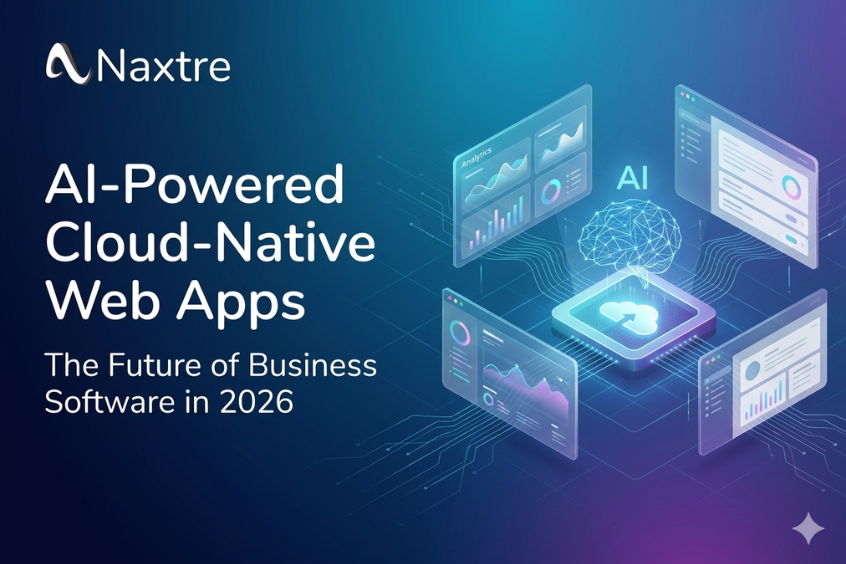
The way businesses build and deliver software has fundamentally changed. In 2026, companies that still rely on monolithic, on-premise applications are losing ground — fast. The winners are those investing in intelligent, cloud-native web applications built on modern JavaScript frameworks, TypeScript, and scalable SaaS architectures.
According to industry analysts, the global software market is projected to surpass $800 billion by 2026, driven by cloud-native development, AI integration, and the accelerating demand for digital transformation. For business owners, CTOs, and product managers, this isn't a distant trend — it's the competitive landscape right now.
Whether you're a startup planning your first product or an enterprise modernising a legacy system, understanding where web application development is heading — and how to execute it — is critical. This article breaks down the trends, the technology, and the practical steps your business needs to take.
1. The State of Web Application Development in 2026
The software development landscape has never moved faster. Three forces are reshaping how web applications are conceived, built, and deployed in 2026:
- AI-assisted development is now mainstream — over 84% of developers use AI tools in their daily workflow, with productivity gains of up to 55% on complex coding tasks.
- Cloud-first architecture has shifted from best practice to baseline expectation, with cloud computing valued at nearly $913 billion globally in 2025 and growing at a 21% annual rate.
- The talent gap is widening — global demand for skilled developers far outpaces supply, pushing businesses toward outsourcing and staff augmentation models to stay competitive.
📊 Fast Fact: The custom software development market is forecast to grow from $43 billion in 2024 to $146 billion by 2030. Early movers in cloud-native and AI-augmented development are capturing disproportionate market share.
2. The Front-End Technology Stack Powering Modern Apps
Choosing the right front-end framework is one of the most consequential technical decisions a business makes. The wrong choice can slow your team, limit scalability, and create painful re-architecture work down the road. Here's where the industry stands in 2026:
React: The Market Leader for Dynamic User Interfaces
Partnering with a ReactJS development company remains the most popular choice for building fast, dynamic, component-driven web applications. React's virtual DOM, massive ecosystem, and compatibility with server-side rendering (via Next.js) make it the preferred framework for startups and enterprise teams alike. Companies like Meta, Airbnb, and Netflix continue to drive React's evolution — and the community shows no sign of slowing down.
Angular: Enterprise-Grade Structure at Scale
For larger organisations that need strong architectural guardrails, working with an AngularJS development company delivers real advantages. Angular's opinionated structure, native TypeScript support, and built-in dependency injection make it highly suitable for complex enterprise applications — particularly in financial services, healthcare, and government sectors where maintainability and testability are non-negotiable.
Vue.js: The Agile Team's Framework of Choice
Increasingly, product teams are turning to a VueJS development company when they need rapid iteration without sacrificing structure. Vue 3's Composition API, excellent developer experience, and lightweight footprint make it ideal for SaaS dashboards, internal tools, and startups that need to ship quickly and pivot often.
TypeScript: The Foundation of Maintainable Code
Across all three frameworks, TypeScript development services have become the industry standard. TypeScript's static typing catches errors at compile time rather than runtime, dramatically reducing production bugs and making large codebases far easier to navigate. For any business building software that will evolve over years — not just months — TypeScript is no longer optional.
⚙️ Choosing between React, Angular, and Vue isn't just a technical question — it's a business decision. The right answer depends on your team size, product complexity, and long-term roadmap. An experienced front-end development services partner can guide this decision objectively.
3. Cloud-Native & SaaS: Building for Scale from Day One
Modern applications are born in the cloud. Whether you're building an internal enterprise tool or a customer-facing product, cloud application development services provide the infrastructure foundation that makes global scalability, continuous delivery, and resilient performance achievable without an army of infrastructure engineers.
Cloud-native development means designing applications as collections of loosely coupled microservices, containerised with Docker, orchestrated with Kubernetes, and deployed on platforms like AWS, Google Cloud, or Azure. This architecture enables:
- Independent scaling of application components — only scale what needs to scale
- Continuous delivery pipelines that push updates multiple times per day, not once a quarter
- Built-in resilience — if one service fails, the rest of the application keeps running
- Cost efficiency — pay only for the compute resources you actually consume
SaaS: The Most Commercially Powerful Business Model in Software
Working with a SaaS product development company is often the most commercially powerful path for businesses building software products. The SaaS model — delivering software as a subscription via the cloud — provides predictable recurring revenue, lower barriers to entry for customers, and the ability to iterate continuously based on user feedback.
From HR platforms to project management tools to AI-powered analytics dashboards, SaaS continues to dominate enterprise software buying. The key to a successful SaaS product in 2026 is building on a cloud-native foundation from the start, rather than retrofitting a legacy application to behave like a modern product.
4. How AI Is Reshaping the Development Lifecycle
Artificial intelligence is no longer a feature you add to software — it's a tool that shapes how software is built. In 2026, AI is embedded at every stage of the development process:
- Code generation & completion: AI coding assistants help developers write boilerplate, suggest architecture patterns, and generate unit tests — reducing development time by up to 40%.
- Automated testing: AI-driven QA tools analyse requirements, generate test cases, and run regression tests automatically, catching issues before they reach production.
- Performance monitoring: Intelligent observability platforms predict performance degradation and security vulnerabilities in real time, before users are affected.
- UX personalisation: Machine learning models embedded in front-end applications dynamically adapt interfaces based on individual user behaviour, increasing engagement and retention.
For businesses, this translates directly into faster time to market, lower development costs, and higher software quality. The organisations best positioned to capture these benefits are those working with a JavaScript development company that has already integrated AI tooling into their delivery workflows — not one that is still figuring out how to use it.
5. Real-World Business Use Cases
Fintech Startup: From Idea to Funded SaaS Product
A fintech startup needed to build a personal finance management platform in under six months to hit a funding deadline. By engaging a SaaS product development company with deep React and Node.js expertise, they launched a fully cloud-native MVP on AWS with multi-tenant architecture — on time and under budget. The product scaled to 50,000 users within three months of launch without requiring any infrastructure re-architecture.
Enterprise Retailer: Angular-Powered Digital Transformation
A mid-sized retail chain undertaking a digital transformation journey needed to replace three separate legacy internal tools with a unified Angular-based operations platform. By outsourcing development to a specialist AngularJS development company with TypeScript development services, they delivered a single application handling inventory, staff scheduling, and customer analytics — reducing operational software costs by 38% annually.
Healthcare SaaS Provider: Vue.js + Cloud for Global Scale
A healthcare SaaS provider needed to expand from a single-country deployment to serving clients across seven countries. Their existing application couldn't handle the data residency, localisation, or performance requirements. A rebuild using Vue 3, TypeScript, and cloud application development services on Google Cloud — with region-specific deployments — enabled global scale in under eight months, opening three new markets.
6. Key Benefits for Startups & Enterprises
Regardless of company size or stage, investing in modern web application development on a cloud-native foundation delivers measurable advantages:
- Speed to market: Modern JavaScript frameworks and cloud deployment pipelines let teams ship features in days, not months.
- Lower total cost of ownership: Cloud infrastructure eliminates large upfront capital expenditure, and SaaS models shift spend from capex to predictable opex.
- Scalability without re-architecture: Cloud-native applications scale horizontally to millions of users without fundamental design changes.
- Talent access: Working with a software development outsourcing services partner gives you access to a global pool of framework specialists without the overhead of full-time hiring.
- Competitive differentiation: Businesses that ship faster, adapt quicker, and deliver better user experiences consistently outperform slower-moving competitors.
🚀 Businesses that partner with experienced software development outsourcing services providers consistently report 30–50% faster delivery timelines compared to purely in-house development — without sacrificing code quality or security.
7. How to Execute: Software Outsourcing & Staff Augmentation
One of the most common barriers businesses face when adopting modern web development approaches is talent. Skilled React, Angular, Vue, and TypeScript developers are in high demand globally, and building an in-house team from scratch takes months — time most businesses don't have.
Two models are helping companies solve this problem effectively in 2026:
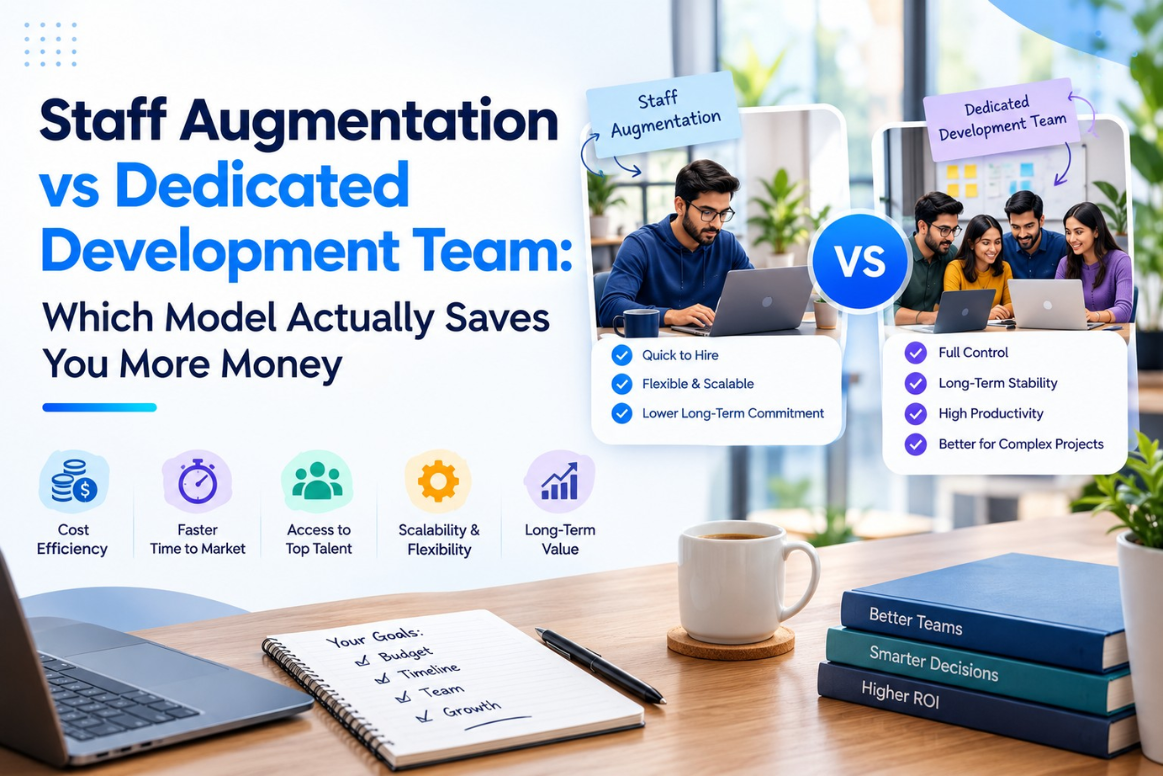
Software Development Outsourcing
Engaging a software development outsourcing services provider means handing off a project — or a portion of it — to an external team. This model works well when you need a complete product built end-to-end, need specialist expertise for a defined scope of work, or want to launch quickly without building an internal team first. The key to success is choosing a partner who functions as a true collaborator, not just a vendor — one who understands your business goals, not just your technical requirements.
IT Staff Augmentation
For businesses with an existing development team that needs to move faster or fill specific skill gaps, IT staff augmentation services offer a more flexible model. Augmented developers integrate directly into your existing team and processes, working alongside your internal engineers. This model gives you the control of an in-house team with the flexibility and breadth of an external talent pool — and you can scale up or down based on your product roadmap.
The best approach often combines both — using outsourcing to build your initial product quickly, then transitioning to a staff augmentation model as your internal team grows and your product matures.
8. Frequently Asked Questions
Q: What is the best front-end framework for a new SaaS product in 2026?
A: It depends on your team and product complexity. React remains the most versatile choice with the largest talent pool. Angular suits enterprise-scale applications with large teams and complex business logic. Vue.js is an excellent choice for fast-moving startups and SaaS dashboards. All three benefit significantly from TypeScript development services. A qualified front-end development services partner can help you evaluate the right choice for your specific situation.
Q: How does cloud-native development differ from simply hosting an app in the cloud?
A: Cloud-native means the application was designed specifically to leverage cloud capabilities — microservices, containers, auto-scaling, and managed services. Simply hosting a traditional application in the cloud gives you some infrastructure benefits but doesn't deliver the scalability, resilience, or deployment speed that cloud application development services are designed to provide.
Q: Is outsourcing software development risky for a startup?
A: Not if you choose the right partner. The risks associated with software development outsourcing services — quality, communication, IP security — are manageable with clear contracts, proper vetting, and an experienced partner who operates transparently. Many of the world's most successful software products were built primarily by outsourced teams, including Slack, GitHub, and Skype in their early stages.
Q: When should a business choose IT staff augmentation over full outsourcing?
A: IT staff augmentation services are most effective when you have an existing internal team and clear processes but need to move faster or fill specific technical skill gaps. Full outsourcing is more suitable when you need a complete product built from scratch or don't yet have internal technical leadership. Many businesses use both models at different stages of growth.
Q: How long does it take to build a cloud-native SaaS product?
A: A well-scoped MVP built by an experienced SaaS product development company typically takes three to six months, depending on complexity. The key is starting with a tight scope focused on core user value, then iterating based on real feedback. Trying to build a complete product before launch almost always delays the point at which you get meaningful market validation.
9. Conclusion: The Businesses That Move First, Win
The convergence of AI, cloud-native architecture, and modern JavaScript frameworks is creating a window of competitive advantage for businesses willing to invest in the right technology and the right partners now.
Waiting for the market to mature further is not a neutral decision — it's a choice to fall behind competitors who are already shipping faster, scaling more efficiently, and delivering better user experiences. The tools, frameworks, and development models exist today to build world-class software products regardless of your company size or current technical capability.
The question isn't whether to invest in modern web application development, cloud application development services, or a strong front-end stack. The question is how quickly you can get the right digital transformation partner in place to execute.
Let's Talk
About Your Idea!