- Home
- ServicesCrafted for Growth
Our development solutions are designed to transform your vision into a thriving success story.
- TechnologiesTech Solutions
We leverage cutting-edge technology to drive efficiency, scalability, and excellence in every project we undertake.
- Contact Us
Software Project Rescue: How to Recover a Failed or Stalled Build
Posted By
naxtre
Published Date
29-05-2026
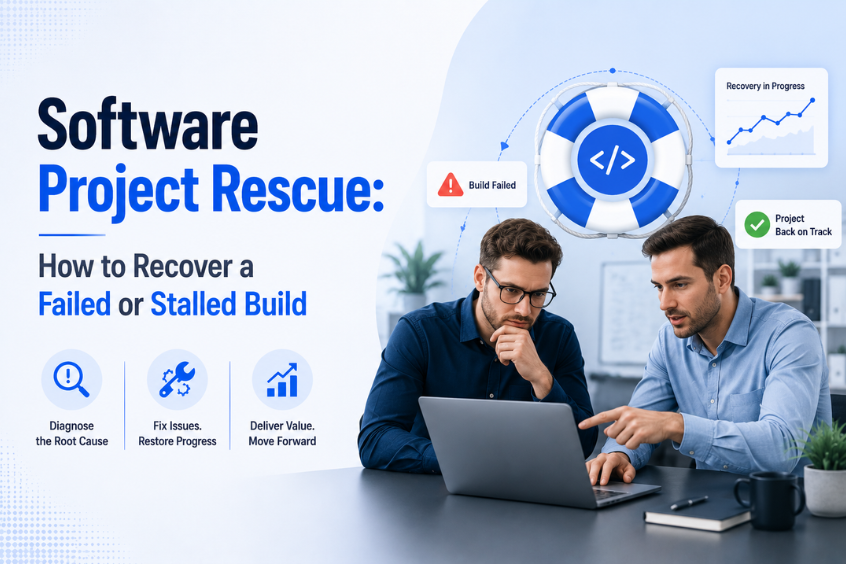
In short: A software project rescue is the structured process of taking over a failed or stalled build, stabilising it, and getting it back to shipping. It starts with an honest audit of the code, the team, and the timeline. Then you stop the bleeding, fix the critical path, and rebuild momentum without scrapping everything.
Most teams call for a software
project rescue far too late. The signs were there for months — slipping
deadlines, a codebase nobody wants to touch, a vendor who goes quiet when
things break. But admitting a project is failing feels like admitting defeat,
so leaders wait. Meanwhile, the cost climbs and the options shrink.
I have walked into dozens of
these situations. The good news is simple: most failing projects are
recoverable. The build is rarely as broken as it feels in the panic. What is
broken is usually the process around it. This guide gives you the framework I
use to diagnose the damage and bring a project back.
Key takeaways
•
A software project rescue works best when you act
early, while the codebase is still salvageable and the budget still has room.
•
Start with a fixed-scope technical audit, not a
rewrite. You cannot fix what you have not measured.
•
Most failures are process failures, not code failures —
unclear ownership, no testing, and silent vendors.
•
Stabilise the critical path first. Restore deployments,
fix the worst bugs, and rebuild trust before adding features.
•
A clean handover with documentation and tests protects
you from ever needing the next rescue.
What actually causes a software project to fail?
Failed projects rarely die from
one dramatic event. They erode. And the erosion almost always traces back to
the same handful of causes.
First, scope creep with no
owner. Features keep getting added, but nobody guards the timeline or the
architecture. Every change becomes a meeting, and the codebase grows faster
than anyone can maintain it.
Second, no testing or quality
discipline. The first release works because it is small. By release five, every
fix breaks something else, because there is no test suite catching regressions.
Third, a vendor who optimised
for the demo, not the deployment. The pilot looked great. Then the build met
real data, real users, and real load — and it cracked.
Fourth, key-person risk. One
developer held the whole system in their head, and then they left. Suddenly, nobody understands how anything works.
Notice that only one of these is
really about code. The rest are about process and ownership. That is why a
software project rescue is rarely a rewrite. It is a reset.
How do you know you need a software project rescue?
Some warning signs are obvious.
Others are quiet, and the quiet ones are the dangerous ones. Watch for these.
Deadlines slip repeatedly, and
each new estimate feels less believable than the last. Deployments become rare
and terrifying, because every release risks breaking production. Your team
avoids certain files or modules entirely, because touching them causes chaos.
Bug counts rise faster than the team can close them. And communication from
your vendor gets vaguer exactly when you need it to get clearer.
If two or more of these are
true, you are not facing a rough patch. You are facing a project that needs
intervention. The sooner you treat it as a software project rescue, the more of
your investment you can save.
The software project rescue framework: four phases
Over the years this has settled
into four phases. Each one has a clear goal, and you do not move forward until
the current goal is met.
Phase 1 — Diagnose before you touch anything
Resist the urge to start coding.
A rescue begins with a fixed-scope, time-boxed audit. We review the codebase,
the architecture, the deployment pipeline, the test coverage, and the
documentation. We also review the human side: who owns what, how decisions get
made, and where knowledge is trapped.
The output is a clear map. It
shows what is healthy, what is salvageable, and what genuinely needs replacing.
This map turns a vague feeling of dread into a concrete plan. Sometimes the
audit reveals that 80% of the code is fine and only the data layer is broken.
That is a much smaller, cheaper fix than a full rebuild.
Phase 2 — Stop the bleeding
Before adding a single feature,
stabilise the patient. The goal here is to make the system safe to work on
again.
That usually means restoring a
reliable deployment pipeline first, so changes can ship without fear. Next, we
fix the highest-severity bugs — the ones causing data loss, outages, or
security exposure. We also add a baseline of automated tests around the
critical paths, so future fixes stop creating new breakages.
This phase is not glamorous. But
it is where trust starts to come back, both in the build and in the team
running it.
Phase 3 — Rebuild the critical path
With the system stable, we
rebuild momentum on what matters most to the business. Not every feature. The
critical path — the core flow that users and revenue depend on.
Here we often introduce a dedicated development team so progress is predictable and ownership is clear.
Where the architecture is genuinely outdated, targeted application modernisation replaces the weakest components without a risky big-bang rewrite.
Progress becomes visible again, week over week.
Phase 4 — Hand over cleanly so it never happens again
A real software project rescue
ends with you in a stronger position than before the project ever wobbled. That
means documentation that a new engineer can actually follow. It means a test
suite that catches regressions automatically. And it means no single point of
failure in the team.
The aim is independence, not
dependence. You should be able to take the project anywhere afterwards,
including away from us. A partner confident in their work welcomes that.
Should you rescue the project or start over?
This is the question every
leader asks, and the honest answer is: usually rescue, occasionally rebuild. A
full rewrite feels clean, but it throws away every lesson already paid for, and
it carries its own high failure rate.
The deciding factor is what the
audit finds. If the core architecture is sound and the problems are
concentrated, rescue is faster and far cheaper. If the foundation is
fundamentally wrong for where the business is going, a staged rebuild — one
component at a time — beats both a blind rescue and a risky from-scratch
restart. Either way, you make that call with data from the audit, not from
panic.
The bottom line
A failing software project is
not a verdict on your team or your idea. It is a signal that the process broke
somewhere, and process can be fixed. The leaders who recover well are the ones
who act early, demand an honest audit, and stabilise before they sprint. Treat
the situation as a structured software project rescue rather than an emergency,
and you usually keep most of what you have already built.
If you are watching a build slip
and you want a candid second opinion, book a 30-minute project review. We will
tell you honestly whether it is a rescue or a rebuild.
Frequently asked questions
What is a software project rescue?
A software project rescue is the
structured process of taking over a failed or stalled software build,
stabilising it, and returning it to a shippable state. It begins with a
technical and process audit, then fixes the critical path before adding new
work.
When should I call for a software project recovery?
Call early. If deadlines slip
repeatedly, deployments are rare and risky, bug counts keep rising, or your
vendor has gone quiet, the project needs intervention. The earlier you act, the
more of your budget and codebase you save.
Is it cheaper to rescue a project or start over?
In most cases, rescuing is
cheaper. A rewrite discards work you already paid for and carries its own
failure risk. A proper audit usually shows that much of the code is salvageable
and only specific components need replacing.
How long does a software project rescue take?
It varies with the damage, but
the first two phases — audit and stabilisation — typically take a few weeks.
The goal is fast: restore safe deployments and fix critical bugs early, then
rebuild the core flow steadily after that.
Can you take over a project from another vendor?
Yes. Taking over an outsourced
or in-house build is a common rescue scenario. It starts with an audit of the
existing code and documentation, followed by a structured handover so nothing
critical is lost in the transition.
How do I stop a project from failing again after the
rescue?
Insist on three things: clear
documentation, an automated test suite, and no single point of failure in the
team. These remove the conditions that cause most failures and keep you
independent of any one vendor or developer.
Let's Talk
About Your Idea!