- Home
- ServicesCrafted for Growth
Our development solutions are designed to transform your vision into a thriving success story.
- TechnologiesTech Solutions
We leverage cutting-edge technology to drive efficiency, scalability, and excellence in every project we undertake.
- Contact Us
Agent-Ready Websites: How to Prepare Your Site for AI Agents
Posted By
naxtre
Published Date
13-08-2026
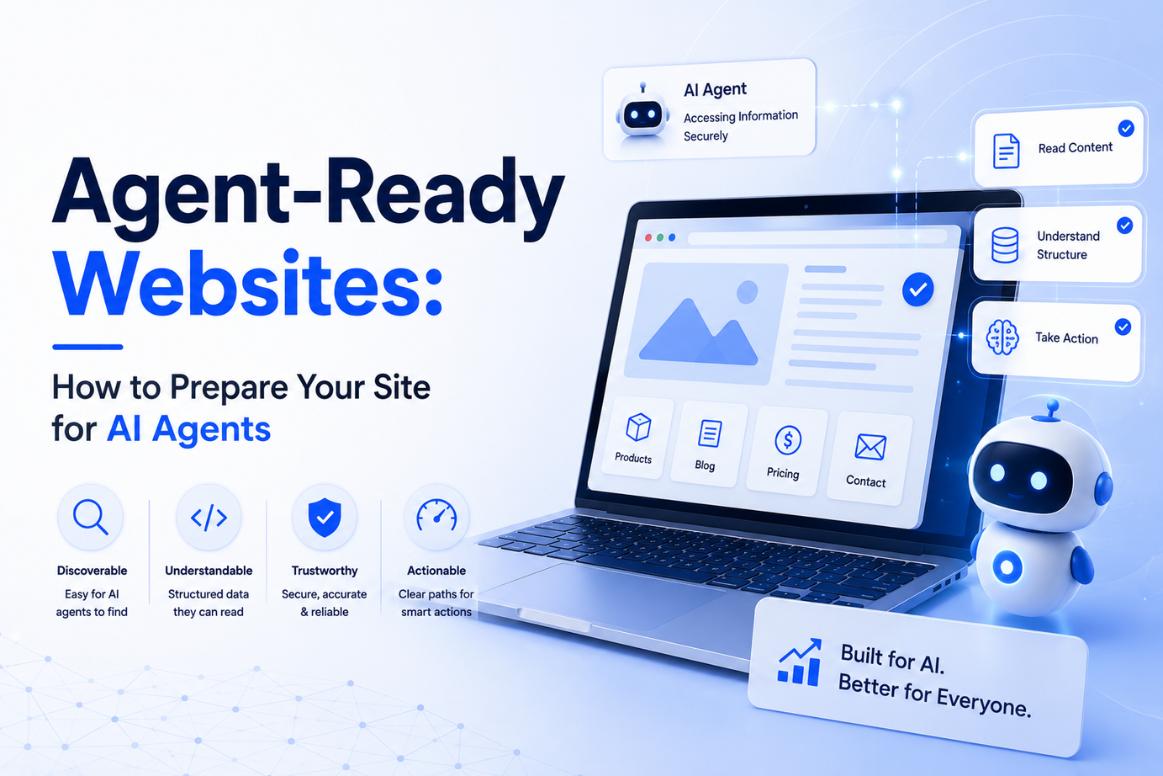
An agent-ready
website is one built so AI agents, not only humans, can read it, understand it,
and act on it. That means clean structure, machine-readable content, and clear
signals about what your site offers. As people increasingly ask AI assistants
to research and buy for them, the site an agent can actually use is the one
that gets chosen.
Here is a shift
I did not expect to happen this fast. For most of my career, we built websites
for one audience: people. We obsessed over layouts, load times, and copy that
persuades. Now a second audience has quietly arrived, and it does not have
eyes. It is the AI agent, the assistant working on a person's behalf, and it
reads your site very differently from the way a human does.
If that sounds abstract, it is not. Tools that audit sites for AI accessibility now flag things like a missing llms.txt file and whether your pages are structured for machines. So this piece is my practical take on what an agent-ready website actually is, why it matters now, and the specific steps to get there. It sits alongside our thinking in GEO vs SEO and our artificial intelligence development work.
Key takeaways
· An agent-ready website is designed so AI agents can read, understand, and act on it, not just human visitors.
·
AI assistants and agents now
research, recommend, and even buy for people, so being usable by them is
becoming a real traffic and revenue channel.
·
Agents care about structure and
data: clean HTML, structured data, clear content, and files like llms.txt, not
visual design.
·
Small, practical changes, an
llms.txt file, structured data, clean markup, and machine-readable content,
make a big difference.
· This is the next chapter of SEO: optimizing not only for search engines and readers, but for the AI systems that increasingly sit between them.
What is an agent-ready website?
An agent-ready
website is a site engineered so that AI agents can navigate it and use its
information reliably. A human visitor looks at your page and understands it
visually, colors, images, layout, and the meaning behind them. An agent does
not see any of that. It reads the underlying code and content, and it needs
that content to be clear, structured, and honest about what it represents.
Think about how
you use an AI assistant today. You might ask it to compare products, summarize
a service, or find a supplier. To answer well, it has to pull information from
websites and make sense of it fast. If your site is a tangle of scripts, vague
copy, and no structure, the agent struggles or gives up. If it is clean and
well-marked, the agent understands you and can recommend or act. That
difference is what agent-readiness is about.
The honest way to put it: your website now has two audiences with very different needs. Humans want a beautiful, persuasive experience. Agents want clarity and structure. An agent-ready website serves both without forcing you to choose.
Why does agent-readiness matter now?
I get why this
feels early, so let me be concrete about why it is not. The behavior has
already changed. More people are starting their research inside AI tools like
ChatGPT, Gemini, and Perplexity instead of a traditional search box. When they
do, an AI system decides which sources to trust and surface. If your site is
hard for that system to read, you are invisible in the exact place buyers are
now looking.
And the tooling is already here. Site audits now check for AI-accessibility signals, including whether you publish an llms.txt file that tells AI systems what your site is about. When auditors start scoring something, it usually means the market is about to care. Better to be early than to scramble later.
How do AI agents read a website?
To make a site
agent-ready, it helps to know how an agent actually processes it. The
experience is nothing like a human visit. Here is roughly what happens.
First, the
agent fetches your page and strips it down to content and structure. It ignores
the visual polish and looks for meaning: headings, text, links, and any
structured data you provide. Second, it tries to understand what the page is
for, is this a product, a service, an article, a contact page? Clear structure
answers that instantly; a messy page leaves it guessing. Third, if you provide
machine-friendly signals like structured data or an llms.txt file, the agent
uses them to understand you faster and more accurately.
The lesson is simple but important. Agents reward clarity and punish clutter. A page that reads cleanly in plain HTML, with sensible headings and honest labels, is a page an agent can trust. Heavy JavaScript, hidden content, and vague copy all make you harder to use. This is where solid engineering, the kind we bring to web application development, quietly pays off.
Human-first vs agent-ready: what actually changes?
You do not
throw away your existing site; you extend it. The table below shows how the
priorities differ between a purely human-first site and an agent-ready one.
|
Element |
Human-first
site |
Agent-ready
website |
|
Main
audience |
People |
People
and AI agents |
|
Content |
Persuasive,
visual |
Clear,
structured, machine-readable |
|
Structure |
Looks
good on screen |
Clean
HTML and headings underneath |
|
Data |
Implied
by design |
Explicit
via structured data |
|
AI
signals |
None |
llms.txt,
schema, clear metadata |
|
Success
measure |
Clicks
and conversions |
Clicks,
plus agent visibility and actions |
The takeaway is that an agent-ready website is not a different website. It is your site with a stronger, cleaner foundation underneath the design, so both audiences get what they need.
How do you make your website agent-ready? A checklist
This is the
part you can act on today. None of it requires reinventing your site; it is
mostly good engineering hygiene plus a few new signals. Here is the checklist
we use.
1. Publish an
llms.txt file. Add a simple file at your root that tells AI systems what your
site is about and points to your key pages. It follows the emerging llms.txt standard and is a low-effort, high-signal start.
2. Add
structured data. Use schema
markup so agents can read your products, services, articles, and
business details without guessing, following Google's structured data guidelines. This is
the clearest language you can speak to a machine.
3. Clean up
your HTML. Make sure your important content lives in real, readable markup, not
buried in scripts. If content only appears after heavy JavaScript, many agents
miss it.
4. Write clear,
honest content. Say plainly what you do, what you sell, and who it is for.
Agents, like good buyers, reward clarity and distrust fluff.
5. Keep
information accurate and current. Agents act on your data. Stale prices, wrong
hours, or dead links lead to bad recommendations and lost trust.
6. Allow the
right crawlers. Check your robots.txt so you are not accidentally blocking the
AI systems you want to reach, while still controlling what they can access.
That checklist is the practical heart of this article. Most of it is a weekend or two of focused work, and a dedicated development team can implement it alongside your normal site without a redesign.
Is an agent-ready website just SEO with a new name?
Fair question,
and the answer is no, though they are cousins. Traditional SEO optimizes for search
engines that return a list of links for a human to click. Agent-readiness
optimizes for AI systems that read your content, form an understanding, and
then answer or act on it, sometimes without any click at all. The audience and
the outcome are different.
The two overlap in a healthy way, though. Clean structure, fast pages, honest content, and good markup help you with search engines, with AI answer engines, and with agents all at once. That is the reassuring part: making your site agent-ready is not a strange new project that competes with your SEO. It is the natural next step of it, which is exactly the shift we explored in our GEO vs SEO post. Do the fundamentals well and you serve every audience at the same time.
The bottom line
For twenty-five
years we built the web for human eyes. That is not going away, but a second
reader has arrived, one that works on people's behalf and judges your site on
clarity and structure rather than looks. An agent-ready website simply makes
sure that reader can understand you and act on what you offer.
The good news is that none of this asks you to abandon what you have. Publish an llms.txt file, add structured data, clean up your markup, write plainly, and keep your information accurate. Do that, and you stay visible as buying and research move toward agents, instead of quietly disappearing from the places people now ask. If you want help making your site agent-ready, book a 30-minute review and we will map the work with you.
Frequently asked questions
What
is an agent-ready website?
An agent-ready
website is a site built so AI agents, not only human visitors, can read,
understand, and act on it. It uses clean structure, machine-readable content,
structured data, and signals like an llms.txt file so agents can use your
information reliably.
Why do
I need to prepare my website for AI agents?
Because people
increasingly research and buy through AI assistants. If an agent cannot read
your site, it cannot recommend you or buy from you, so you lose visibility and
sales in a fast-growing channel where buyers now start.
What
is an llms.txt file?
An llms.txt
file is a simple text file placed at your site's root that tells AI systems
what your site is about and points to your key pages. It follows the emerging
llms.txt standard and is a low-effort way to help agents understand you.
How is
an agent-ready website different from SEO?
Traditional SEO
optimizes for search engines that show links to humans. Agent-readiness
optimizes for AI systems that read your content and answer or act on it, often
without a click. They overlap, because clean structure and honest content help
both.
What
are the first steps to make a site agent-ready?
Publish an
llms.txt file, add structured data with schema markup, clean up your HTML so
content is readable without heavy scripts, write clear and honest copy, keep
your information current, and make sure your robots.txt allows the AI crawlers
you want.
Does
structured data help with AI agents?
Yes. Structured
data is the clearest way to tell an agent what your content means, your
products, services, prices, and business details, without it having to guess.
It improves how accurately agents understand and represent you.
Will
agent-ready changes hurt my normal website?
No. Agent-ready
work is mostly clean structure, good markup, and clear content, which also
helps human visitors, search engines, and page speed. You extend your existing
site rather than replacing it, so both audiences benefit.
Let's Talk
About Your Idea!