- Home
- ServicesCrafted for Growth
Our development solutions are designed to transform your vision into a thriving success story.
- TechnologiesTech Solutions
We leverage cutting-edge technology to drive efficiency, scalability, and excellence in every project we undertake.
- Contact Us
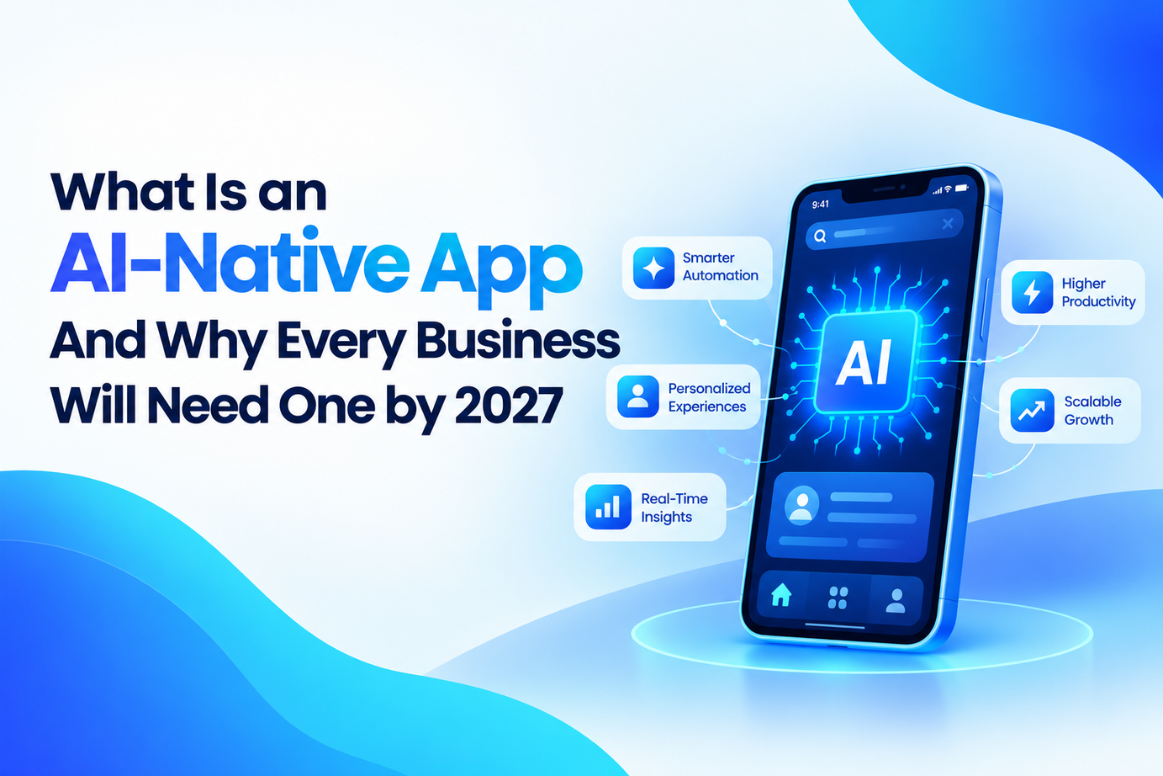
What Is an AI-Native App and Why Every Business Will Need One by 2027
Posted By
naxtre
Published Date
08-09-2026
Quick Answer
An AI-native app is a software product built with artificial intelligence as its core architecture, not as an add-on feature. Unlike traditional apps that bolt AI on after the fact, AI-native apps are designed from day one to learn, adapt, personalise, and improve automatically. They are fundamentally different in how they are built, how they perform, and what they can do.
Here is a question worth sitting with for a moment. When your users open your app tomorrow, is it just running software or is it actually thinking?
That distinction is what separates a traditional app from an AI-native app. And by 2027, it is going to matter more than almost any other product decision a founder or CTO makes.
We are not talking about adding a chatbot to your app, or plugging in a recommendation engine as a feature. AI-native is a fundamentally different approach to how software gets built. The AI is not something you add. It is something you design around, from the very first line of architecture.
In 2026, AI penetration in mobile app development hit 63%, meaning nearly two-thirds of apps now incorporate some form of AI (CMARIX, 2026). But there is a massive difference between an app that uses AI and an app that is built on AI. Understanding that difference right now puts you ahead of the vast majority of companies still treating intelligence as an optional upgrade.
Key Takeaways
• AI-native apps are architected around AI from day one, not retrofitted with it after launch.
• Amazon's AI recommendation engine generates 35% of all revenue, that is what AI-native looks like at scale.
• 63% of apps now incorporate AI, but most are doing it wrong, adding features instead of rethinking the foundation.
• AI-native apps outperform traditional apps on personalisation, retention, speed, and cost efficiency.
• By 2026, more than 80% of companies will deploy AI-enabled applications, but only a fraction will build them natively (Index.dev, 2026).
• Building AI-native is not just a technical decision, it is a business strategy. Products that adapt to users consistently outperform products that do not.
• You do not need to rebuild everything, but starting your next product AI-native is almost always the smarter move.
What Makes an App AI-Native? The Real Difference
Let us cut through the confusion, because it is real. A lot of products right now claim to be AI-powered when what they mean is: we added a chatbot, or we surface some ML-generated recommendations on one screen. That is not AI-native.
An AI-native app is one where the entire product architecture- how data flows, how decisions get made, how the interface adapts, is built around intelligent systems from the beginning. It is the difference between a house that was wired for electricity when it was built versus a house that had extension cords stapled to the walls after the fact.
Here is what AI-native actually looks like in practice:
• The app learns from every user interaction and gets better over time, not because a developer pushed an update, but because the model updates.
• Personalisation is not a feature, it is the default experience. Every user sees something different based on their behaviour, preferences, and context.
• Decisions inside the app are made by models, not hardcoded logic. Content ranking, pricing, routing, recommendations, all driven by AI.
• The interface adapts, what you see when you open the app on Tuesday morning after a gym session is genuinely different from what you see on Friday afternoon.
Compare that to a traditional app with AI features: the core logic is static, the AI sits on top as a separate system, and when the AI part changes, it needs to be manually integrated. Maintenance doubles. Latency increases. And the intelligence feels bolted on, because it is.
Why Does This Actually Matter for Your Business?
Let us talk about what this means in revenue terms, because that is what actually moves decisions.
Amazon built its recommendation engine as a core piece of product infrastructure, not a side feature. That engine now generates approximately 35% of Amazon's total revenue. Netflix's content recommendation system, same architecture, same philosophy, is estimated to save the company over $1 billion per year in churn prevention. These are not small numbers.
Now, you are probably not Amazon. But the underlying principle scales to any product size. When your app adapts to your users instead of making them adapt to your app, retention improves. When recommendations are genuinely personalised instead of people also bought, conversion rates climb. When the product gets smarter with every session, the switching cost for your users goes up.
Developers who use AI tools write code up to 55% faster than those who do not. C-suite executives report saving an average of $28,249 per developer annually from AI investments, translating to over $750 billion in potential global value (GitLab, 2026).
The business case for AI-native is not speculative. Generative AI app downloads hit 1.7 billion in the first half of 2025 alone, with in-app revenue nearly doubling to $1.9 billion in the same period (Sensor Tower). Users are actively choosing intelligent apps over dumb ones. The market is already voting.
What Does an AI-Native App Look Like in the Real World?
It helps to move away from abstract definitions and look at what this actually means across different industries.
E-commerce and retail
An AI-native retail app does not show the same homepage to every user. It analyses browsing history, purchase timing, geographic context, and live inventory data to surface products each individual user is most likely to buy right now. Search results rerank in real time. Pricing adjusts based on demand signals. The cart page shows cross-sells that are genuinely relevant, not algorithmically random.
Healthcare and fitness
An AI-native health app does not just log your data, it interprets it. It notices patterns you would not spot yourself, adjusts recommendations based on your actual behaviour rather than your stated goals, and surfaces interventions at the right moment. The difference between an app that records your sleep and an app that actually helps you sleep better is AI-native architecture.
B2B SaaS
An AI-native SaaS product adapts its interface based on how each user actually works. Power users see depth. New users see simplicity. Alerts surface based on what matters to that specific account, not generic thresholds. And the product's core intelligence improves as more customers use it, a compounding advantage traditional SaaS products cannot match.
Logistics and operations
An AI-native logistics app does not just display delivery statuses; it predicts delays before they happen, reroutes dynamically, and learns which suppliers are most reliable under which conditions. The intelligence is embedded in the decision-making layer, not bolted on as a reporting dashboard.
How Is an AI-Native App Built Differently?
This is the part most articles skip. Knowing what AI-native is does not help much if you do not understand what building it actually requires.
Architecture starts with data, not features
In traditional app development, you design features first and figure out data later. In AI-native development, the data architecture comes first. What data will the system collect? How will it be stored? What models will process it? How will outputs feed back into the interface? These questions get answered before the first UI screen is designed.
The model is a first-class citizen
In a traditional app, the database is the source of truth. In an AI-native app, the model is part of the core system architecture. That means decisions about which model to use, on-device vs cloud, LLM vs specialised ML, real-time vs batch inference, are engineering decisions that shape the entire product, not afterthoughts.
Feedback loops are built in from day one
AI-native apps improve through use. That requires explicit feedback loops, signals from user behaviour, ratings, corrections, and engagement that flow back into model training. Building these loops after launch is painful and expensive. Building them at the start is the difference between a product that gets smarter and one that stays the same forever.
Privacy and performance are design constraints, not optimisations
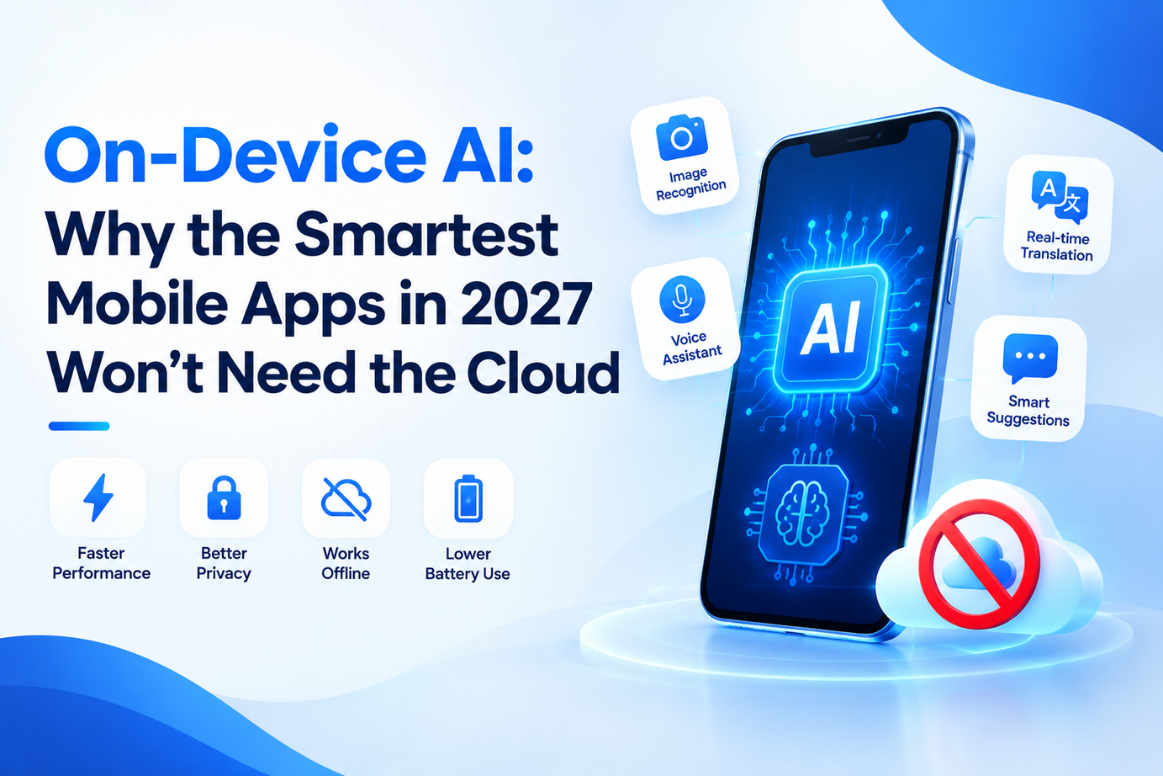
Users expect intelligent features to respond instantly and handle their data responsibly. For AI-native apps, this means thinking about edge AI, running models on the device rather than the cloud, efficient model serving, and privacy-preserving data pipelines from the first planning session. Not after launch when users complain.
Is Your Business Ready to Build AI-Native?
Honestly, the question most founders and CTOs should be asking is not should we go AI-native, it is what would our product look like if we did?
Because here is the uncomfortable reality: more than 80% of companies will deploy AI-enabled applications by 2026 (Index.dev). But most of those applications will be traditional apps with AI features stapled on. The minority who build natively, who design the intelligence into the foundation, will have products that get better every week while their competitors ship manual updates.
A few honest signals that you are ready to build AI-native:
• Your product already generates user data but you are not doing much with it
• You have features that require constant manual tuning to stay relevant
• Your users experience the same product regardless of how they actually use it
• You are starting a new product from scratch and have the chance to get the architecture right
• You are rebuilding a legacy app and want to do it once, properly
How Naxtre Builds AI-Native Products
At Naxtre, building intelligent applications is not a new line item on a service menu. It is something we have been doing across mobile apps, SaaS platforms, IoT products, and enterprise analytics for years.
The People's Insight project is a good example. We built a political analytics platform using AI, machine learning, and Power BI that processes large-scale survey data and surfaces predictive insights in real time. The intelligence is not a dashboard sitting on top of a database, it is embedded in the core of how the product processes and presents information. That is what AI-native looks like in practice.
Our AI and machine learning practice covers the full stack: data pipeline architecture, model selection and training, on-device vs cloud inference decisions, feedback loop design, and ongoing model optimisation after launch. Because AI-native is not a one-time build, it is a product strategy that needs engineering support as your product and your data grow.
If you are evaluating whether your next product should be AI-native, or want to understand what it would take to rebuild an existing product with intelligence at its core, the discovery call is the right starting point. It is free, specific to your situation, and there is no sales pitch attached.
The Bottom Line: This Is Not a Trend. It Is the New Default.
Every few years there is a shift in how software gets built that looks optional at first and mandatory in hindsight. Cloud-native looked like a nice-to-have in 2012. Mobile-first looked like a nice-to-have in 2015. Looking back, neither was optional, they were just early.
AI-native app development is that shift happening right now. Products built around intelligence from the start will outlearn, outpersonalise, and outperform products that treat AI as a feature. The gap will compound every year.
You do not need to be Amazon to benefit from this. You just need to start the right way.
Book a free discovery call at www.naxtre.com
Frequently Asked Questions
What is an AI-native app, exactly?
An AI-native app is a software product designed and built with artificial intelligence as its core architectural foundation, not as a feature added after the fact. In a traditional app, a developer hardcodes the logic that drives how the product behaves. In an AI-native app, intelligent systems make decisions, adapt to individual users, and improve automatically over time.
How is an AI-native app different from a regular app with AI features?
A regular app with AI features treats intelligence as a module you plug in, a recommendation widget here, a chatbot there. The core product logic is still static. An AI-native app is designed differently from the ground up: the data architecture, the decision-making layer, the interface, and the feedback loops are all built around intelligent systems. As a result, AI-native apps learn from every interaction, personalise experiences by default, and get meaningfully smarter with use.
What are good examples of AI-native apps?
Amazon's recommendation engine is the clearest large-scale example, generating approximately 35% of total revenue. Netflix's content intelligence saves an estimated $1 billion per year in churn. At a smaller scale, AI-native apps appear in healthcare platforms that adapt clinical recommendations to individual patient data, in B2B SaaS tools that surface personalised alerts for each account, and in logistics products that predict delivery delays before they happen.
Is building AI-native more expensive than traditional app development?
The upfront architecture work does require more careful planning, particularly around data pipelines, model selection, and feedback loop design. However, the ongoing cost advantage tends to be significant. AI-native products improve through use rather than requiring constant manual development to stay relevant. The right question is not whether AI-native costs more to build, but what it costs to build a product that does not learn.
What industries benefit most from AI-native app development?
Any industry where personalisation drives value, where decisions need to be made faster than humans can make them, or where data volume exceeds what manual analysis can handle is a strong candidate. The clearest ROI comes from e-commerce, healthcare, logistics, fintech, and B2B SaaS.
How long does it take to build an AI-native app?
A focused AI-native MVP with a clearly defined intelligence layer and well-structured data can realistically be delivered in 14 to 20 weeks with a dedicated development team. More complex products requiring custom model training or regulatory compliance typically run 6 to 12 months.
Can Naxtre build AI-native mobile and web apps?
Yes. Naxtre's AI and machine learning practice covers the full spectrum of AI-native development from data pipeline architecture to ongoing model optimisation post-launch. Start a conversation at naxtre.com
Let's Talk
About Your Idea!