- Home
- ServicesCrafted for Growth
Our development solutions are designed to transform your vision into a thriving success story.
- TechnologiesTech Solutions
We leverage cutting-edge technology to drive efficiency, scalability, and excellence in every project we undertake.
- Contact Us
How to Scale a SaaS Product from 100 to 100,000 Users Without Rebuilding Everything
Posted By
naxtre
Published Date
09-10-2026
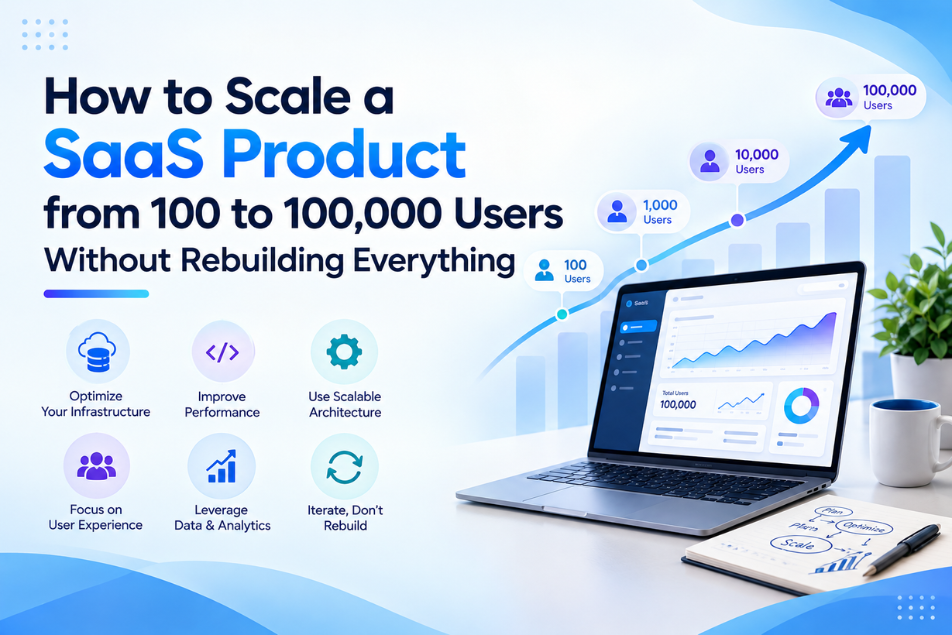
What you will learn in this guide:
●
The 4 predictable scaling stages every SaaS product
goes through
●
Why most products break between 1,000 and 10,000 users
and how to prevent it
●
When to move from a monolith to microservices
architecture
●
How to implement multi-tenancy and database sharding
without downtime
●
The caching and auto-scaling strategies Netflix,
Shopify, and Airbnb actually use
●
A practical SaaS scaling checklist you can apply to
your product today
You built a SaaS product. Users are signing up. Revenue is
growing. Then somewhere around 1,000 to 5,000 users, something breaks. Queries
slow down. The deployment pipeline starts failing. Your infrastructure bill
triples. And someone on the team suggests you need to rebuild everything from
scratch.
Most founders have been there. And most of them made the
wrong call.
Scaling a SaaS product is not about rewriting your codebase.
It is about making the right architectural moves at the right stage. The
companies that reach 100,000 users without a catastrophic rebuild share a
common approach: they evolve their architecture in layers, not in leaps.
The global SaaS market reached $465
billion in 2025 and continues to grow at over 13 percent annually. With
that growth comes enormous pressure on engineering teams to scale without
sacrificing stability. This guide gives you the roadmap that actually works.
Key Takeaways
●
The danger zone for most SaaS products is between 1,000
and 10,000 users. This is where architectural debt becomes visible.
●
You almost never need to rebuild from scratch. You need
to evolve your monolith strategically.
●
Multi-tenancy is the single most important
architectural decision for SaaS scalability.
●
Database sharding and read replicas should be
introduced before you need them, not during a crisis.
●
Redis caching alone can reduce database load by 40 to
60 percent at the 10,000 user stage.
●
Kubernetes and auto-scaling groups give you
infrastructure elasticity without over-provisioning.
●
The modular monolith is an underrated intermediate
architecture that serves most products well through 50,000 users.
●
Every scaling decision should be driven by metrics, not
by engineering instinct or chasing trends.
Stage 1: The Foundation Stage (0 to 1,000 Users)
At this stage, your primary goal is product-market fit, not
infrastructure elegance. Your monolithic application is not a liability here.
It is an asset. It is fast to build, easy to debug, and simple to deploy.
What should your architecture look like at this
stage?
A single-server monolith is perfectly appropriate. You
should be running on a managed cloud provider such as AWS, Google Cloud, or
Azure with a single database instance, a basic load balancer, and a simple
CI/CD pipeline. Most founders over-engineer this stage and pay for it later in
unnecessary complexity.
The one investment that pays dividends later is building for
modularity from the start. Structure your codebase so that business logic, the
data access layer, and the API layer are cleanly separated. You do not need to
deploy them separately yet. But separating them conceptually costs nothing and
saves enormous refactoring effort later.
Instrumentation is the one thing you must get right at Stage
1. Set up logging, error tracking, and performance monitoring from day one.
Tools like Datadog, New Relic, or the open source Prometheus stack will tell
you exactly where your bottlenecks appear before they become crises. You cannot
scale what you cannot measure.
Stage 2: The First Growth Surge (1,000 to 10,000
Users)
This is where most SaaS products break. The single database
instance starts struggling. Query times creep up. Certain API endpoints begin
timing out under load. Your deployment pipeline, which used to take four
minutes, now takes twenty-two.
Why do SaaS products break at this stage?
The most common failure point is the database. A shared
database handling both read-heavy reporting queries and write-heavy
transactional operations simultaneously will degrade fast. The solution is not
a bigger server. The solution is architectural separation.
There are three moves that get you through Stage 2.
The first is introducing read replicas. A primary database
handles writes. One or more read replicas handle reporting, analytics, and
read-heavy API calls. This single change often delivers a 3x improvement in
read performance. Most managed database services including AWS RDS, Google
Cloud SQL, and Azure Database make this a two-click operation.
The second is adding a caching layer. Redis is the industry
standard. Redis
caching can reduce database load by 40 to 60 percent for typical SaaS
workloads by storing frequently accessed data in memory. Start with caching
your most expensive queries and API responses. A simple rule: if a query runs
more than 100 times per minute and its result changes less than once per
minute, it should be cached.
The third is separating background jobs. Long-running
processes such as email delivery, PDF generation, report compilation, and data
exports should never run in your main application thread. Move them to a
dedicated job queue using tools like Bull for Node.js, Celery for Python, or
Sidekiq for Ruby. This alone eliminates a major category of timeout errors
under load.
Stage 3: The Scaling Inflection Point (10,000 to
50,000 Users)
At this stage, the question shifts from database performance
to architectural design. You are likely running multiple application servers
behind a load balancer. Your feature set has grown significantly. And your
codebase, however well structured initially, is starting to show the strain.
Should you migrate to microservices at 10,000
users?
Probably not yet. This is where most engineering teams make
a costly mistake. Microservices solve real problems, but they introduce
significant operational complexity including service discovery, distributed
tracing, inter-service authentication, eventual consistency, and deployment
orchestration. Unless your team has the operational maturity to manage all of
that, the cure is often worse than the disease.
The better answer for most SaaS products at this stage is
the modular monolith. This architecture keeps your application as a single
deployable unit while imposing strict module boundaries at the code level.
Shopify ran a modular monolith at scale for years before selectively extracting
services that genuinely required independent deployment.
At Stage 3 there are four things worth focusing on.
Horizontal scaling means deploying multiple instances of your application
behind a load balancer and ensuring your application is stateless, with session
state stored in Redis rather than in memory. Database connection pooling using
a tool like PgBouncer for PostgreSQL prevents connection exhaustion under
concurrent load. Moving all images, scripts, and stylesheets to a CDN such as
CloudFront or Fastly dramatically reduces origin server load. And implementing
a feature flag system decouples deployment from feature release, which enables
gradual rollouts without risk.
The Architecture Decision That Defines SaaS
Scalability: Multi-Tenancy
More than 70
percent of modern SaaS vendors use multi-tenant architecture according to
industry analysis. Multi-tenancy means multiple customers share the same
application infrastructure while their data remains logically separated.
Understanding which multi-tenancy model you use, and choosing it deliberately,
determines your scaling ceiling.
Which multi-tenancy model is right for your SaaS
product?
|
Model |
How it Works |
Best For |
Scaling Trade-off |
|
Shared Schema |
All tenants share tables and a tenant_id column identifies
data |
Cost-efficient, high volume SMB SaaS |
Noisy neighbour risk and complex query isolation |
|
Separate Schema |
Each tenant gets a dedicated database schema within a
shared server |
Mid-market SaaS with moderate tenant count |
Good balance of isolation and resource efficiency |
|
Database Per Tenant |
Each tenant has a fully isolated database instance |
Enterprise SaaS with compliance requirements |
High cost but maximum isolation and portability |
Most early-stage SaaS products should start with shared
schema and a robust tenant isolation layer. As enterprise customers arrive with
compliance requirements, introducing a database-per-tenant option for that
segment makes sense. This is the exact model used by Salesforce, HubSpot, and
most successful multi-tier SaaS businesses.
Stage 4: Scaling to 100,000 Users and Beyond
By the time you reach 50,000 to 100,000 users, you have
solved the basic infrastructure challenges. The problems at this stage are
architectural. Specific services have become bottlenecks, your deployment
pipeline cannot safely push changes at the pace your engineering team works,
and your database is approaching its practical limits.
When is the right time to extract microservices?
Microservices extraction makes sense when a specific bounded
context in your application has significantly different scaling requirements
from the rest of the system. Netflix did not rebuild everything as
microservices overnight. They identified their most resource-intensive
components, including streaming delivery, the recommendation engine, and
authentication, and extracted those into independent services while the rest of
the platform remained more monolithic.
There are four signals that a module is ready to extract. It
has a distinct team of two or more engineers who own it entirely. It scales
independently, meaning traffic spikes in this module do not correlate with
traffic in others. Its deployment cycle is blocked by unrelated changes
elsewhere in the codebase. And it has its own data model and does not share
tables with the rest of the application.
What does database sharding look like in
practice?
Shopify used database sharding to handle Black Friday peaks,
distributing tenant data across multiple database shards to prevent any single
instance from becoming a bottleneck. Their sharding
approach partitioned merchants across independent database pods, each with
its own primary and replica instances.
For most SaaS products, the practical sharding approach is
horizontal partitioning by tenant ID. Early tenants land on Shard 1. New
tenants are distributed across shards using a consistent hashing algorithm. A
shard map service knows which tenant lives on which shard and routes queries
accordingly.
Kubernetes and Auto-Scaling: The Infrastructure
Layer
Do you actually need Kubernetes?
Kubernetes is genuinely powerful for SaaS products at scale,
but it carries significant operational overhead. The honest assessment is that
most SaaS products do not need Kubernetes before 50,000 users. Managed
auto-scaling groups on AWS using ECS with Fargate, Google Cloud Run, or Azure
Container Apps deliver around 80 percent of the benefit at a fraction of the
operational complexity.
When you do introduce Kubernetes, focus on three
capabilities first. The Horizontal Pod Autoscaler scales your application pods
based on CPU and memory metrics. The Cluster Autoscaler dynamically adjusts
node count based on workload. And setting proper resource requests and limits
prevents the noisy-neighbour problem at the pod level.
How does Netflix handle traffic spikes at 260
million subscribers?
Netflix migrated from a single data centre to Amazon Web
Services over a seven-year migration. Their core infrastructure principles have
been widely documented: design for failure, which means assuming any service
can fail at any moment; use chaos engineering to deliberately inject failures
and test resilience; and keep services independently deployable. Applying even
the first two of these principles to a SaaS product dramatically improves its
scaling posture.
Scaling Architecture: Monolith vs Modular
Monolith vs Microservices
|
Factor |
Monolith |
Modular Monolith |
Microservices |
|
Best user range |
0 to 5,000 |
5,000 to 100,000+ |
100,000+ (specific services) |
|
Deployment complexity |
Low |
Low to Medium |
High |
|
Team size |
1 to 5 engineers |
5 to 25 engineers |
25+ engineers |
|
Operational overhead |
Minimal |
Moderate |
High |
|
Scaling granularity |
Full application |
Full application |
Per service |
|
Development speed |
Fastest |
Fast |
Slower initially |
|
Ideal next step |
Add modules |
Extract services selectively |
Refine service boundaries |
Recommended Reading for SaaS Founders
If you are evaluating how to staff your engineering team as
your SaaS scales, read our guide on Staff
Augmentation vs Dedicated Development Team: Which Model Saves You More Money.
For teams building SaaS products from the ground up, our
breakdown of SaaS
product development best practices covers the technical architecture
decisions that matter most in the first 12 months.
To understand how AI is changing SaaS architecture and what
to build for the next phase of growth, see our AI integration
guide for SaaS products.
How Naxtre Helps SaaS Products Scale Without the
Rebuild
At Naxtre Technologies, we specialise in SaaS product
development and scaling architecture for startups and mid-market companies. Our
teams have designed and shipped multi-tenant SaaS platforms across fintech,
recruitment, logistics, and B2B software verticals.
Whether you are hitting performance walls at 5,000 users or
planning the infrastructure for a 100,000-user product, our engineering team
can conduct a SaaS architecture review, identify your bottlenecks, and deliver
a clear implementation plan without requiring a full rebuild.
●
SaaS architecture audits and scaling roadmaps
●
Multi-tenant database design and migration
●
Microservices extraction and modular monolith
structuring
●
Kubernetes and cloud infrastructure setup
●
Performance optimisation and database tuning
Questions This Guide Answers
●
How do I scale a SaaS product without rebuilding it?
●
At what point should a SaaS product move from monolith
to microservices?
●
What is the best database architecture for a
multi-tenant SaaS product?
●
How does database sharding work for SaaS applications?
●
When should I use Kubernetes for my SaaS product?
●
How much does Redis caching improve SaaS database
performance?
●
What multi-tenancy model should I use for a SaaS
product?
●
How did Netflix and Shopify scale their SaaS
infrastructure?
●
What is a modular monolith and when should I use one?
●
How do I add horizontal scaling to my SaaS application?
Frequently Asked Questions
When should a SaaS product stop using a monolith
and move to microservices?
Most SaaS products should not move to microservices until
they have at least 50,000 active users and an engineering team of 20 or more.
Before that point, the operational complexity of microservices including
service discovery, distributed tracing, and inter-service authentication
outweighs the scaling benefits. The modular monolith is a better intermediate
architecture for most growing SaaS products.
What is the most common reason SaaS products fail
to scale?
The single most common cause is database architecture. A
shared database instance handling both transactional writes and read-heavy
reporting simultaneously degrades quickly under load. The fix is almost always
introducing read replicas and a caching layer before considering any other
architectural change.
How does multi-tenancy affect SaaS scalability?
Multi-tenancy is the architectural foundation of scalable
SaaS. Without it, each customer requires dedicated infrastructure, which makes
unit economics unworkable at scale. With shared-schema multi-tenancy, a single
database instance can serve thousands of tenants cost-effectively. The
trade-off is query complexity and the need for robust tenant isolation logic.
What is database sharding and do I need it for my
SaaS product?
Database sharding distributes data across multiple database
instances based on a partition key, which is typically tenant ID in SaaS. Most
products do not need sharding until they reach 500,000 or more active records
per table, or when a single database instance can no longer handle peak write
throughput. Read replicas and caching should always be implemented before
sharding, as they are simpler and often sufficient.
How much does adding Redis caching improve SaaS
performance?
The performance improvement depends on your read-to-write
ratio, but for typical SaaS applications with heavy dashboard and reporting
usage, Redis caching reduces database load by 40 to 60 percent. Latency for
cached queries drops from hundreds of milliseconds to single-digit
milliseconds. The highest-impact caches to implement first are authentication
tokens, user session data, and the results of your most expensive reporting
queries.
What is horizontal scaling and how is it
different from vertical scaling?
Vertical scaling means adding more resources such as CPU,
RAM, or storage to a single server. Horizontal scaling means adding more server
instances and distributing load across them. Vertical scaling is simpler but
has a ceiling and creates a single point of failure. Horizontal scaling has no
theoretical ceiling and provides redundancy, but it requires your application
to be stateless, which means moving session state out of application memory and
into a shared store like Redis.
Does Naxtre build scalable SaaS products?
Yes. Naxtre Technologies designs and builds SaaS products
with scalability built into the architecture from the outset. Our services
cover multi-tenant database design, cloud infrastructure setup, microservices
architecture, and performance optimisation for products across all growth
stages. Visit naxtre.com to book a free discovery call.
How long does it take to refactor a SaaS product
for better scalability?
The timeline depends on the scope of the refactoring.
Introducing read replicas and Redis caching typically takes two to four weeks
and delivers the highest impact for most products. Extracting a bounded context
into a microservice takes six to twelve weeks per service, including testing
and gradual traffic migration. A full architectural review and roadmap can be
delivered in five to seven business days.
Let's Talk
About Your Idea!