- Home
- ServicesCrafted for Growth
Our development solutions are designed to transform your vision into a thriving success story.
- TechnologiesTech Solutions
We leverage cutting-edge technology to drive efficiency, scalability, and excellence in every project we undertake.
- Contact Us
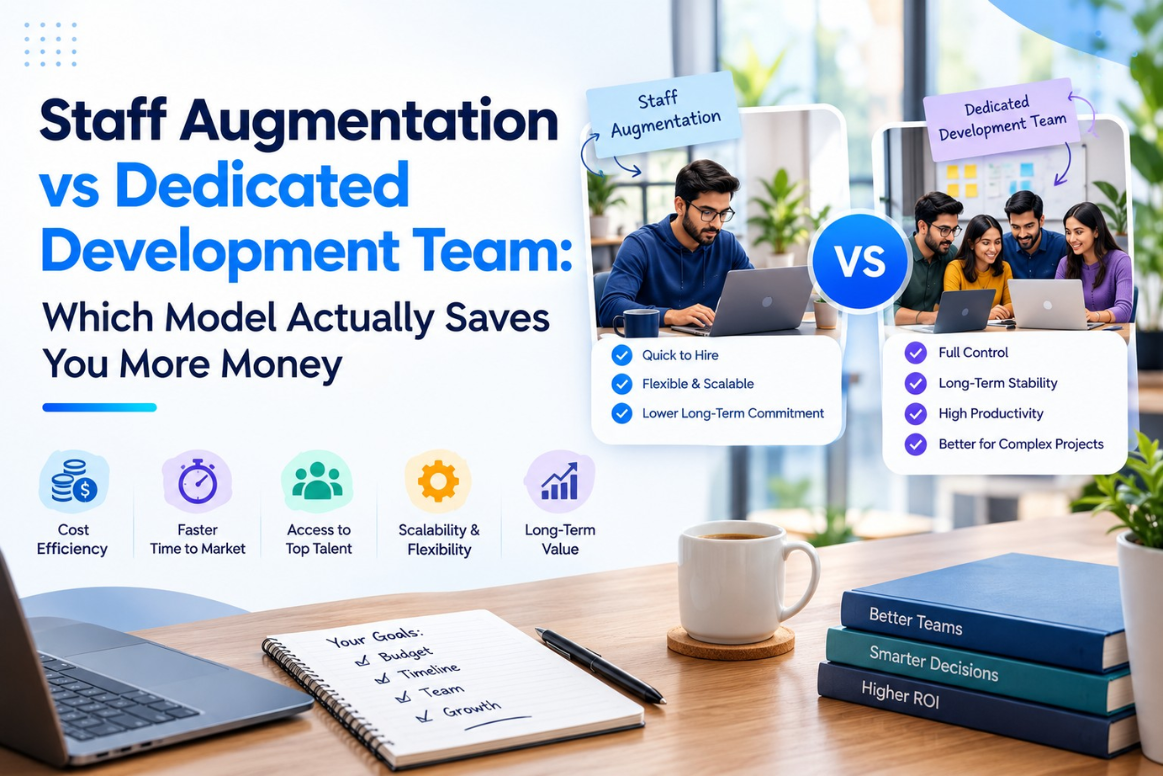
Staff Augmentation vs Dedicated Development Team: Which Model Actually Saves You More Money?
Posted By
naxtre
Published Date
01-10-2026
Quick
Answer
Staff augmentation embeds individual engineers into
your existing team under your direct management, starting from around $3,000 to
$9,000 per engineer per month. A dedicated development team delivers a
complete, self-managed pod with its own lead, QA, and project manager,
typically running $15,000 to $28,000 per month for a team of five. Staff
augmentation costs less upfront. Dedicated teams become more cost-effective
after approximately nine months.
Every company that has
considered hiring offshore developers has hit the same wall. Two salespeople
from two different agencies, each telling you their model is the smart choice.
One is pitching staff augmentation. The other is pitching a dedicated team. And
both of them are right, for different companies, at different stages.
The honest answer is that staff
augmentation vs dedicated development team is not a debate with one
universal winner. It is a question with one right answer for your specific
situation, and the wrong choice at the wrong stage consistently costs more than
either model's headline price suggests.
This guide uses real 2026 cost
data to walk through both models clearly, compare them on the dimensions that
actually matter, and help you make the call that fits your stage, your team,
and your timeline. Naxtre provides both models across our dedicated development team and software development outsourcing services, so
this comparison is built on what we see in practice, not theory.
Key Takeaways
•
Staff augmentation adds individual engineers to your
existing team at $3,000 to $9,000 per engineer per month. You manage them
directly.
•
A dedicated development team delivers a complete pod
with its own internal structure, lead, and QA at $15,000 to $28,000 per month
for five people.
•
Staff augmentation costs less in the first three to
six months. Dedicated teams become more cost-effective after approximately
nine months (Analytics Insight, 2026).
•
The primary decision variable is engineering
leadership: if you have strong in-house technical management, augmentation
works. If you do not, a dedicated team is safer.
•
Staff augmentation suits short engagements and
specific skill gaps. Dedicated teams suit ongoing product development where
requirements will evolve.
•
Both models save 30 to 60% compared to building
an equivalent team in-house in the US or UK.
•
The model choice matters less than the quality of
the partner. A well-run dedicated team consistently outperforms a poorly
managed augmented arrangement regardless of the cost structure.
What Each Model Actually Means
Before comparing them, it helps
to be precise about what each model actually involves, because both terms get
used loosely.
What is staff augmentation?
Staff augmentation means you
hire one or more engineers from an external provider and bring them directly
into your existing team. They work your hours, attend your standups, follow
your processes, and report to your technical lead or engineering manager. The
provider handles employment, payroll, and benefits. You handle day-to-day
management, direction, and quality review.
The word augmentation is
accurate: you are adding capacity to something that already exists. The model
assumes you have engineering leadership in place who can onboard, direct, and
review external contributors.
What is a dedicated development team?
A dedicated development team is
a complete, pre-formed unit: developers, QA engineers, a UI/UX designer if
needed, and a project manager, all working exclusively on your product. The
team has its own internal structure and coordination. Your role is to provide
product direction and decisions. The provider handles everything else: team
management, process, code reviews, sprint planning, and delivery.
The key distinction is that a
dedicated team runs itself. You are not managing individual engineers. You are
working with a team that manages itself internally while you focus on what to
build, not how to manage the people building it.
Side by Side: 10 Dimensions That Actually Matter
|
Dimension |
Staff
Augmentation |
Dedicated
Development Team |
|
Who
manages the engineers |
You manage
directly |
Provider PM
manages internally |
|
Onboarding
time |
1 to 2 weeks |
2 to 4 weeks |
|
Engagement
length |
1 to 6 months
typical |
12 plus
months typical |
|
Team
structure |
Individual
roles added |
Full pod:
devs, QA, PM, lead |
|
Cost per
engineer/month |
$3,000 to
$9,000 |
$4,000 to
$8,000 (within team rate) |
|
Cost for
5-person setup |
$15,000 to
$45,000 |
$15,000 to
$28,000 all-in |
|
Management
overhead on you |
High |
Low |
|
Knowledge
retention |
Medium
(individual-dependent) |
High
(team-level) |
|
Best
engagement length |
Under 9
months |
Over 9 months |
|
Requires
in-house tech lead |
Yes |
No |
Source: Shift Asia 2026 comparison data and Analytics Insight offshore team benchmarks .
The Real Cost Comparison in 2026
The headline rates tell part of
the story. The full cost picture tells a different one.
Staff augmentation costs
IT staff augmentation rates in
2026 range from $25 to $200 plus per hour depending on seniority, region, and
specialisation (Zdaas, 2026). For India-based senior
developers, the practical monthly range is $3,000 to $6,000 per engineer. That
looks attractive on paper. But it excludes your management time.
The hidden cost of augmentation
is the engineering leadership required to make it work. A senior engineer
managing three augmented developers is spending 20 to 30% of their time on
coordination, code review, and unblocking. At US or UK engineering salaries,
that time cost routinely adds $3,000 to $5,000 per month to the effective
total.
Dedicated team costs
A dedicated development team of
five from a reputable India-based partner typically runs $15,000 to $28,000 per
month all-in. That includes the engineers, QA, a project manager, and internal
team coordination. The management overhead on your side drops to two to three
hours of product alignment per week.
At first glance, a five-person
augmented setup at $5,000 per engineer looks cheaper than a $22,000 dedicated
team. The augmented setup is $25,000. The dedicated team is $22,000. But the
augmented setup assumes you have a full-time engineering manager absorbing the
coordination overhead. Most early-stage companies do not.
The nine-month rule
Financial data identifies a
clear break-even point. Staff augmentation costs less in the initial phase.
Dedicated teams become more cost-effective after nine months, once knowledge
retention, reduced onboarding cycles, and lower management overhead compound
(Analytics Insight, 2026).
If your engagement is under six
months and tightly scoped, augmentation is likely cheaper. If you are building
a product that will evolve over 12 plus months, the dedicated team model
consistently wins on total cost of delivery.
When Staff Augmentation Is the Right Answer
Staff augmentation works best
when four things are true at the same time.
•
You have strong in-house engineering leadership.
Someone needs to onboard, direct, and review augmented engineers. Without a
capable tech lead managing them directly, augmentation becomes expensive
contracting with no one steering.
•
The scope is defined and relatively stable.
Augmentation works well when the work is well-specified. When requirements are
evolving rapidly, the coordination overhead of managing individual contributors
becomes a liability.
•
You need a specific skill for a specific period.
A React Native specialist for a four-month sprint. A DevOps engineer to set up
a CI/CD pipeline. A data engineer to build a pipeline for a defined project.
These are the scenarios augmentation was built for.
•
You want to move in one to two weeks.
Augmentation has a faster onboarding window than a dedicated team build. If
speed of deployment is the constraint, augmentation wins.
When a Dedicated Development Team Is the Right Answer
The dedicated team model becomes
the clear choice when the inverse is true.
•
You do not have in-house engineering leadership.
If you are a non-technical founder, or if your CTO is already stretched, a
dedicated team brings its own project manager and technical lead. You direct
product decisions. They handle engineering execution.
•
Your product will evolve over 12 or more months.
Ongoing product development with changing requirements is where dedicated teams
consistently outperform augmentation. The team builds institutional knowledge
about your product, your users, and your architecture over time. That knowledge
compounds. Augmented contractors who rotate out take it with them.
•
Knowledge retention matters to you. One of the
most underestimated costs of staff augmentation is what walks out the door when
a contractor ends their engagement. A dedicated team builds shared knowledge at
the team level, not at the individual level.
•
You want predictable monthly costs. Dedicated
teams price on monthly retainers, which makes budgeting straightforward.
Augmentation rates per engineer create variable costs that are harder to
forecast as scope shifts.
A Third Option Worth Knowing: The Hybrid Model
The most effective approach in
2026 is often neither pure model. A hybrid works like this: a small in-house
core, typically a CTO or senior engineer who owns architecture and product
direction, paired with a dedicated offshore team that handles feature development,
QA, and sprint execution.
This captures the cost advantage
of offshore delivery, the management efficiency of the dedicated team model,
and the technical ownership of having senior in-house leadership. It is the
structure that most of Naxtre's long-term clients settle on after their first
year of working together.
The progression most companies
follow naturally looks like this. Pre-seed to seed: staff augmentation fills
specific gaps while the product is being validated. Series A: a dedicated team
takes over core product development as the roadmap stabilises. Series B and
beyond: the dedicated team scales, and in-house senior engineering is hired to
own architecture while the offshore team handles execution volume.
How Naxtre Approaches Both Models
Naxtre provides both models, and
we are direct with clients about which one fits their situation before any
contract is signed.
Our dedicated development team service assembles a
pre-vetted squad built around your specific stack, domain, and product goals,
typically within two weeks. The team includes a project manager, senior
developers, and QA engineers. You own the product decisions. We handle
everything else.
Our staff augmentation model
embeds individual engineers directly into your existing team. We match on
stack, seniority, and domain experience. You manage them directly, with the
same transparency you would expect from an in-house hire.
The difference between a Naxtre
engagement and a generic outsourcing arrangement is that we do not hand you
engineers and disappear. Our dedicated teams operate with direct Slack access,
sprint reviews, and milestone-based reporting. Every engagement includes a
dedicated PM as the primary accountability point between your product team and
ours.
If you want to hire dedicated developers or explore which model fits your
project stage, the discovery call is the right starting point. It is free,
specific to your situation, and there is no sales pitch attached to it.
The Bottom Line
Staff augmentation vs dedicated
development team is not a question of which model is better. It is a question
of which model fits your engineering leadership, your timeline, and your
product stage.
If you have a strong in-house
technical lead, a defined scope, and a sub-six-month engagement, augmentation
is cheaper and faster to start. If you are building a product that will evolve
over 12 plus months, lack in-house engineering management, or need predictable
costs and strong knowledge retention, the dedicated team model wins on total
cost of delivery.
When in doubt, the nine-month
rule is the clearest guide: under nine months, augmentation. Over nine months,
dedicated team.
Talk to the Naxtre team at www.naxtre.com
and we will give you a straight answer on which model fits your specific
situation.
Frequently Asked Questions
What is the difference between staff augmentation and a dedicated
development team?
Staff augmentation adds
individual engineers directly into your existing team under your direct
management. You are responsible for their direction, code review, and
day-to-day workflow. A dedicated development team is a complete, self-managed
unit with its own project manager, technical lead, and internal coordination.
You provide product direction. The team handles engineering execution
internally. The core difference is who manages the work: augmentation puts that
responsibility on you, a dedicated team takes it off you.
Which is cheaper, staff augmentation or a dedicated development team?
It depends on the engagement
length. Staff augmentation typically costs less in the first three to six
months because you are paying only for engineers without the team structure
overhead. Dedicated teams become more cost-effective after approximately nine
months, once knowledge retention, reduced onboarding cycles, and lower
management overhead compound. For a five-person setup in India, staff
augmentation runs $15,000 to $45,000 per month depending on seniority. A
dedicated team of five runs $15,000 to $28,000 all-in, including PM and QA.
When should I choose staff augmentation over a dedicated team?
Staff augmentation is the right
model when you have strong in-house engineering leadership who can manage
external contributors directly, when the scope is well-defined and relatively
stable, when you need a specific skill for a specific period of one to six
months, and when you need to move in one to two weeks. It works best as a
capacity extension for teams that already have functioning processes, not as a
replacement for engineering structure you do not yet have.
When should I choose a dedicated development team?
A dedicated development team is
the right model when you lack in-house engineering management and need the team
to run itself, when you are building a product that will evolve over 12 or more
months, when knowledge retention matters because your product has accumulated
technical context that should not walk out the door with rotating contractors,
and when you want predictable monthly costs rather than variable per-engineer
rates. It is also the right model when you are a non-technical founder who
needs to stay focused on product decisions rather than managing engineers.
How long does it take to onboard a dedicated development team?
With a reputable partner, a
dedicated development team can typically be assembled, scoped, and fully
onboarded within two to four weeks. This includes the discovery call, tech
stack matching, team assembly, and the first sprint kickoff. Staff augmentation
has a slightly faster window of one to two weeks because it involves placing
individual engineers rather than building a team structure. Both models are
significantly faster than the 60 to 90-day hiring timeline for equivalent
in-house talent in the US or UK.
What does a dedicated development team from Naxtre cost?
Naxtre's dedicated development
team pricing depends on team composition, seniority level, and the specific
technologies involved. As a reference point, a mid-to-senior team of four to
five engineers with QA and a project manager typically runs $12,000 to $22,000
per month. This is 60 to 75% lower than an equivalent team in the UK or US. The
discovery call is the fastest way to get an accurate estimate for your specific
requirements. Visit naxtre.com to start the conversation.
Can I switch from staff augmentation to a dedicated team later?
Yes, and many companies do
exactly this. A common progression is starting with staff augmentation during
the validation phase when the product scope is exploratory and the engagement
is short, then transitioning to a dedicated team model once the product has
found its market and the roadmap stabilises for the long term. Naxtre supports
both models and can manage this transition, ensuring knowledge transfer and
continuity between the augmented engagement and the dedicated team phase.
Let's Talk
About Your Idea!