- Home
- ServicesCrafted for Growth
Our development solutions are designed to transform your vision into a thriving success story.
- TechnologiesTech Solutions
We leverage cutting-edge technology to drive efficiency, scalability, and excellence in every project we undertake.
- Contact Us
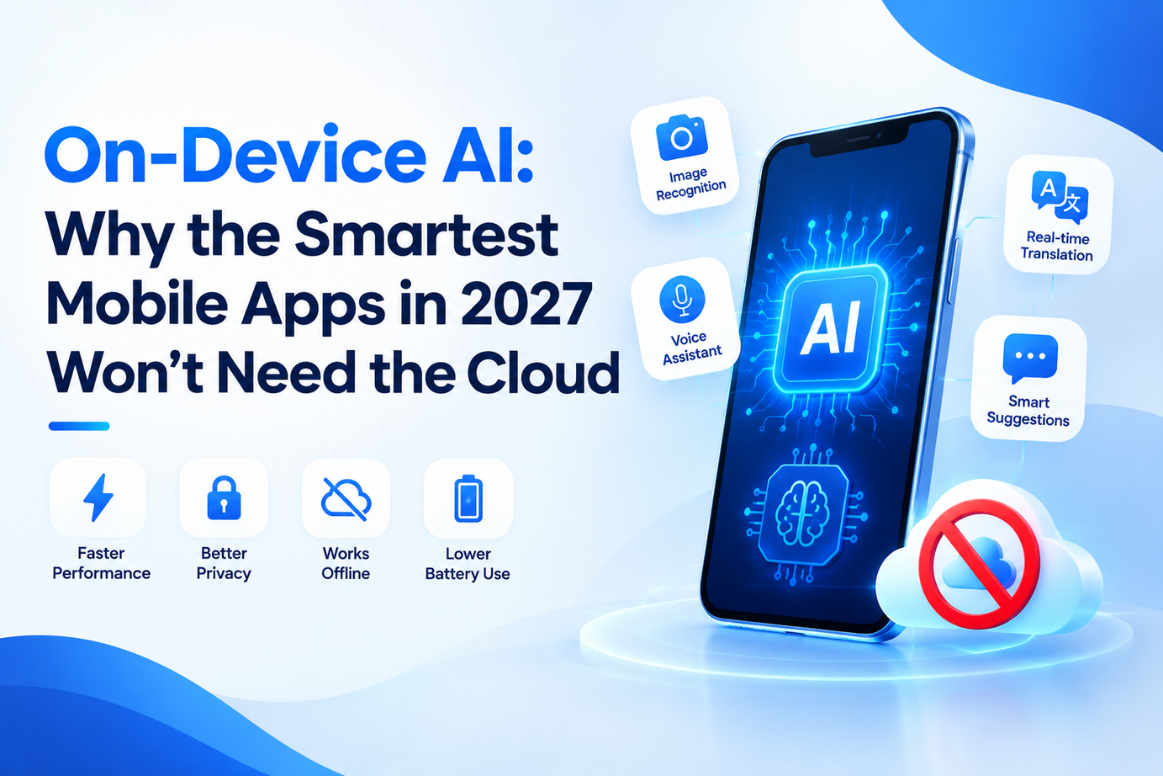
On-Device AI: Why the Smartest Mobile Apps in 2027 Won't Need the Cloud
Posted By
naxtre
Published Date
25-09-2026
Quick Answer
On-device AI runs machine learning models directly on a smartphone or tablet, without sending data to a cloud server. It delivers responses in under 50 milliseconds, works with no internet connection, and keeps sensitive user data entirely on the device. By 2027, more than 50% of all AI workloads are expected to run at the edge, not in the cloud.
Every time your app sends data to the cloud to run an AI feature, three things happen. It takes longer than it should. It depends on a connection the user might not have. And it sends personal data somewhere that is not the user's device.
In 2026, that model is changing. Fast. Apple Intelligence on iOS 18.4 runs writing tools, image generation, and a more capable Siri entirely on-device. Google's Gemini Nano processes real-time call screening and summarisation locally on Pixel 9 and Samsung Galaxy S25 without a single round-trip to a data centre. The chips are ready. The frameworks are mature. And user expectations have shifted.
The global mobile app development market is projected to surpass $614 billion by 2026. And the apps that will win the next three years are the ones being built with on-device AI at the core, not bolted on later as a cloud feature.
This is what on-device AI actually means, why it matters for your product, and what it takes to build it right.
Key Takeaways
• On-device AI processes data locally, with latency under 50ms vs 200 to 500ms for cloud round-trips.
• By 2027, over 50% of AI workloads will run at the edge, not in the cloud (Gitnux, May 2026).
• 78% of users refuse to use cloud AI features that process sensitive data remotely. 91% would pay more for on-device processing (F22 Labs, 2026).
• Apps with AI personalisation see 62% higher engagement and up to 80% higher conversion on in-app purchases (Moonstack, April 2026).
• The hardware crossed the threshold in 2025: Apple A17 Pro and A18 chips deliver 35 plus TOPS of neural engine performance. Qualcomm Snapdragon 8 Elite matches it.
• Core ML, TensorFlow Lite, and Gemini Nano via AICore are the three dominant frameworks for on-device inference in 2026.
• On-device AI is not just faster, it enables products that work offline, protect privacy by design, and reduce long-term cloud infrastructure costs.
What On-Device AI Actually Means
The term gets used loosely, so it is worth being precise about it.
Cloud AI means your app sends a request to a remote server, the server runs the model, and sends the result back to the device. The model lives in the cloud. Your data travels to it, gets processed, and the output comes back. For most of the last decade, this was the only viable way to run anything sophisticated in a mobile app.
On-device AI means the model runs on the phone or tablet itself. The data never leaves the device. The inference happens on dedicated hardware, typically a neural processing unit (NPU) built into the chip, and the result is available in milliseconds. No network required.
What Changes | Cloud AI | On-Device AI |
Where processing happens | Remote server | On the device |
Response latency | 200 to 500ms | Under 50ms |
Works offline | No | Yes |
User data leaves device | Yes | No |
Scales with user base | Costs increase | Flat marginal cost |
Battery impact | Lower (offloads compute) | Optimised by NPU chips |
Best for | Heavy, complex models | Real-time, privacy-sensitive features |
The tradeoff used to be significant. Smaller models meant less capable AI. But the hardware story changed in 2025. The Apple A17 Pro and A18 chips deliver over 35 TOPS (tera operations per second) of neural engine performance. Qualcomm's Snapdragon 8 Elite, which powers most 2026 flagship Android devices, hits comparable numbers. You can now run genuinely capable models on a phone that fit in someone's pocket.
Why 2026 Is the Inflection Point
Apple Intelligence changed what developers can expect from iOS
Apple's rollout of Apple Intelligence across iOS 18.4 moved on-device AI from experiment to standard. Writing tools, image generation via Image Playground, and the more capable Siri all run on a hybrid model: lightweight on-device inference for most tasks, with Private Cloud Compute as a fallback for the heaviest workloads only. For the first time, developers building on iOS have first-class on-device AI infrastructure to build against, not a workaround.
Gemini Nano made on-device AI a standard Android feature
Google integrated Gemini Nano into Android's ML Kit via the AICore system service. Developers can call it through a clean API without bundling a model into the app at all. The model is maintained by the OS, updated in the background, and handles real-time call screening, live translation, and summarisation entirely locally. It reacts in under 50 milliseconds for supported tasks.
User expectations shifted, not just hardware
The privacy dimension is now a product decision, not just a compliance one. Research from F22 Labs in 2026 found that 78% of users refuse cloud AI features that process their sensitive data remotely. More strikingly, 91% said they would pay more for an app that keeps their data on-device. That is not a niche privacy audience. That is most of your users.
Edge computing reduces app response times by 73% while eliminating connectivity-related user complaints entirely. That is the kind of number that changes a product roadmap (Dotcom Infoway, 2026).
Where On-Device AI Is Winning Right Now
These are not hypothetical use cases. They are in production in 2026.
Real-time language translation
Google's on-device ML Kit Translation API handles 58 languages locally. For apps serving Indian markets specifically, on-device inference handles Hindi, Tamil, Bengali, and other regional languages with zero latency and no connectivity requirement. Travel apps, customer service tools, and healthcare applications are shipping this today.
Health and fitness monitoring
Wearable health apps that monitor heart rate variability, sleep quality, and stress indicators now run their detection models on-device. Sensitive health data stays on the device. Models update via federated learning without centralising patient data. Apps using AI-triggered, context-aware health notifications see 3x higher open rates vs schedule-based push notifications (Panalinks, March 2026).
Smart photography and visual features
Every modern smartphone camera is now an on-device AI product. Real-time HDR, portrait mode, night mode, and object recognition all run entirely on the NPU. For app developers, this means computer vision features that used to require a cloud API call now run in under 30 milliseconds, enabling AR overlays, document scanning, and visual search that actually feel instant.
Voice and conversational interfaces
Wake word detection, local voice commands, and on-device speech-to-text are now table stakes for any app with a voice layer. Google's AI Edge Eloquent, based on the Gemma model, performs speech-to-text dictation directly on iPhones without cloud processing. Users in areas with poor connectivity, which includes significant portions of Naxtre's core markets across India and the Middle East, rely on this.
Fraud detection and fintech security
Processing transaction data locally means sensitive financial behaviour never reaches an external server. On-device fraud detection models can flag anomalous patterns in real time, at the moment of transaction, without the latency cost of a cloud call. For fintech apps operating under RBI or FCA data residency rules, on-device processing is increasingly not optional.
How On-Device AI Apps Are Built Differently
This is the part most overview articles skip. Building for on-device AI requires different architectural decisions at the start of the project, not retrofitting later.
Model selection and optimisation
Cloud AI lets you run any model size because server resources are elastic. On-device AI requires models that fit on a mobile chip with constraints on memory, battery, and processing budget. That means choosing between Apple's Core ML, Google's TensorFlow Lite, or PyTorch Mobile, and then applying quantisation, pruning, and knowledge distillation to reduce model size without destroying accuracy. A model that works beautifully in a cloud environment may need a redesigned architecture for on-device deployment.
Framework decisions shape everything
The three dominant frameworks in 2026 are Core ML for iOS-native apps, TensorFlow Lite for Android and cross-platform, and Gemini Nano via AICore for apps targeting Android 14 and above. Each has different capabilities, model support, and integration complexity. The framework choice is an architecture decision, not a tooling preference.
Federated learning for model improvement
One genuine challenge with on-device AI is improving models over time without centralising user data. Federated learning solves this: models are updated locally on each device using that device's data, and only the model weight updates, not the raw data, are shared back to improve the global model. Implementing this correctly requires infrastructure planning from the start of the project, not after launch.
Offline-first architecture
On-device AI naturally pairs with offline-first app design. If the model runs locally, the rest of the app should too. That means rethinking data sync, local storage, and state management from the ground up. For apps in our AI and ML development services practice, we treat offline capability as a core requirement, not an edge case to handle later.
What This Means for Founders and Product Teams Right Now
If you are starting a new mobile product in late 2026, the question is not whether to use AI. It is whether to run it on the device or in the cloud, and for which features each makes sense.
Not every AI feature belongs on-device. Complex generative tasks, large language model responses, and computationally intensive model inference still belong in the cloud for most products. The right architecture in 2026 is usually hybrid: lightweight, latency-sensitive, and privacy-critical features run on-device, while heavier computation falls back to cloud when connectivity allows.
But the default assumption has flipped. A year ago, cloud was the default and on-device was the edge case. Now on-device is the starting point for any feature where speed, privacy, or offline reliability matters.
• If your app handles health, finance, or legal data, on-device AI is rapidly becoming a compliance expectation, not just a product differentiator.
• If your core market includes India, Southeast Asia, or the Middle East, offline-capable AI features are a retention advantage because connectivity is genuinely inconsistent for a significant portion of your users.
• If your AI feature requires real-time response, under 100ms is the threshold where users perceive a feature as instant. Cloud latency of 200 to 500ms consistently falls below that bar.
How Naxtre Builds for On-Device AI
Our AI and ML development team works across the full on-device AI stack: model selection and optimisation, Core ML and TensorFlow Lite integration, federated learning infrastructure, and offline-first architecture design.
We have built mobile applications for clients in IoT (Oakter, Tessol, Sabre), healthcare, logistics, and enterprise analytics where on-device processing was a hard requirement. In each case, the architecture decisions were made at the start of the project, not retrofitted afterward.
If you are evaluating on-device AI for an existing app or designing a new product from scratch, we can help you work out which features belong on-device, which framework fits your stack, and what the build timeline and cost actually look like. The discovery call is free and specific to your project. Speak to our dedicated development team at naxtre.com to start the conversation.
The Bottom Line
On-device AI is not a niche architectural choice for privacy-obsessed apps. It is the direction the entire mobile industry is moving. By 2027, more than half of all AI workloads will run at the edge. The hardware is already there. The frameworks are mature. The user expectation for instant, private, offline-capable AI is already established by Apple and Google.
The apps being designed today with on-device AI at the core will have a structural advantage over apps that try to retrofit it later. That advantage compounds as user expectations continue to rise.
Talk to the Naxtre mobile team at www.naxtre.com and we will give you a straight answer on what on-device AI looks like for your specific product.
Frequently Asked Questions
What is on-device AI in mobile apps?
On-device AI means machine learning models run directly on the smartphone or tablet hardware, without sending data to a remote cloud server. The inference happens locally, typically on a dedicated neural processing unit built into the chip. The result is responses in under 50 milliseconds, full functionality with no internet connection, and sensitive user data that never leaves the device. In 2026, Apple Intelligence and Google's Gemini Nano have made on-device AI a standard feature on flagship devices rather than a niche capability.
What is the difference between on-device AI and cloud AI?
Cloud AI sends your data to a remote server, runs the model there, and returns the result. It enables large, complex models but introduces 200 to 500ms of latency, requires an internet connection, and moves user data off the device. On-device AI runs the model locally, delivering responses under 50ms with no connectivity requirement and no data leaving the device. The practical tradeoff is model size and complexity: on-device models must fit within the memory and processing constraints of mobile hardware, which has improved dramatically with the Apple A17 Pro, A18, and Qualcomm Snapdragon 8 Elite chips.
Why do users prefer on-device AI over cloud AI?
The evidence is direct: 78% of users refuse to use cloud AI features that process their sensitive data remotely, and 91% say they would pay more for an app that keeps their data on-device (F22 Labs, 2026). Speed is the second driver: users perceive features as instant when response time is under 100ms. Cloud round-trips at 200 to 500ms consistently fall below that threshold. Offline reliability is the third: apps that work without connectivity retain users in environments where cloud-dependent features would fail.
Which frameworks are used for on-device AI in 2026?
The three dominant frameworks are Apple Core ML for iOS-native development, Google TensorFlow Lite for Android and cross-platform apps, and Gemini Nano via the Android AICore system service for apps targeting Android 14 and above. PyTorch Mobile is also used, particularly for teams with existing PyTorch model expertise. Each framework has different model support, API design, and integration complexity. The choice depends on your target platform, the type of model you are deploying, and whether you need cross-platform support.
What kinds of apps benefit most from on-device AI?
Apps in healthcare and fitness (where data privacy is non-negotiable), fintech (where transaction data must stay on-device for compliance), real-time communication (where latency determines whether a feature feels usable), photography and computer vision (where 30ms matters for AR and scanning), and any app serving markets with inconsistent connectivity, including India, Southeast Asia, and the Middle East. Apps using context-aware AI features driven by on-device models see 62% higher engagement and up to 80% higher conversion on in-app purchases compared to non-AI equivalents (Moonstack, April 2026).
How much does it cost to build an on-device AI mobile app?
On-device AI adds complexity at the architecture and model optimisation layer, which typically adds 15 to 30% to the initial build timeline compared to a cloud-AI equivalent. However, the ongoing cost advantage is significant: cloud AI inference costs scale with your user base. On-device inference has a flat marginal cost per additional user. For apps expecting meaningful scale, the total cost of ownership often favours on-device within 12 to 18 months of launch. Our team at Naxtre can give you a project-specific estimate during a free discovery call.
Can Naxtre build on-device AI mobile apps?
Yes. Naxtre's AI and ML development practice covers the full on-device AI stack: model selection and optimisation, Core ML and TensorFlow Lite integration, federated learning infrastructure, and offline-first architecture. We have built on-device AI features into mobile products for clients across IoT, healthcare, logistics, and enterprise analytics. Visit naxtre.com to start the conversation.
Let's Talk
About Your Idea!