- Home
- ServicesCrafted for Growth
Our development solutions are designed to transform your vision into a thriving success story.
- TechnologiesTech Solutions
We leverage cutting-edge technology to drive efficiency, scalability, and excellence in every project we undertake.
- Contact Us
How to Build a Multi-Agent AI System: Architecture Patterns for Production Apps
Posted By
naxtre
Published Date
13-11-2026
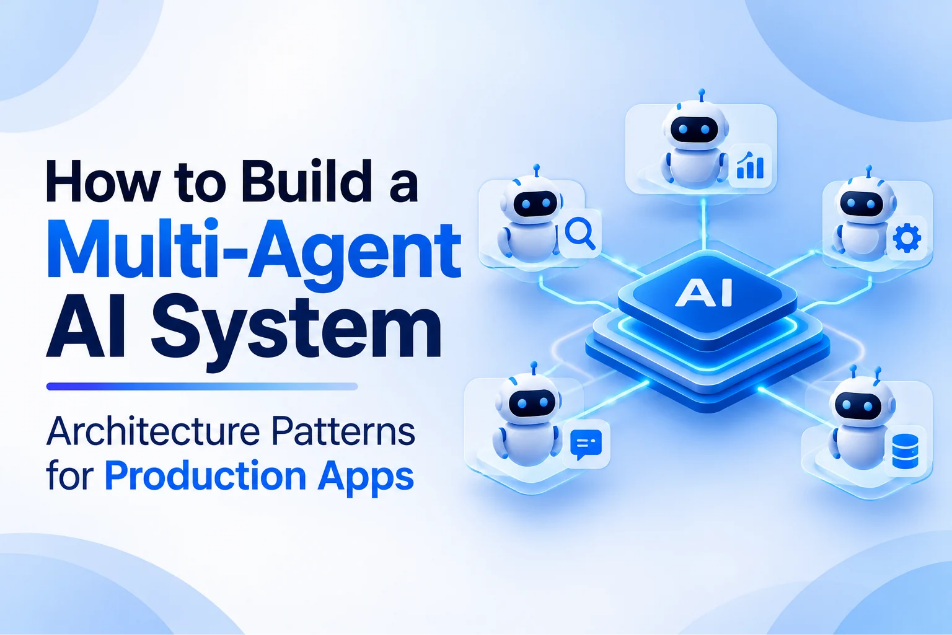
A multi-agent AI system is an architecture where multiple specialized AI agents collaborate to complete tasks that exceed the capability of a single model. Each agent handles a defined role, communicates through a shared protocol, and operates within an orchestrated workflow. Building one for production requires decisions about orchestration topology, agent memory design, inter-agent communication, and failure handling that most architecture guides skip.
Key Takeaways
- Multi-agent systems solve problems that are too complex, too long, or too varied for a single LLM call. They are not always the right choice - start single-agent and move to multi-agent only when you hit real limits.
- The orchestrator-worker pattern is the most reliable starting topology for production systems. A central orchestrator decomposes tasks and routes them to specialized worker agents.
- Agent communication design is the most underestimated engineering challenge. Poorly defined message contracts between agents compound errors across the pipeline.
- Memory architecture has three layers: in-context (prompt window), short-term (session state), and long-term (vector store or database). Most production failures happen because the wrong memory type was used for the job.
- Every agent needs a tool budget, a step limit, and a circuit breaker. Without these, one stuck agent can consume your entire API quota and block the whole system.
- Observability is not optional in multi-agent systems. You need to trace every agent call, every tool invocation, and every message passed between agents to debug production failures.
- LangGraph, AutoGen, and CrewAI are the dominant open-source frameworks in 2026. Each makes different tradeoffs on flexibility, observability, and operational complexity.
What Is a Multi-Agent AI System and When Do You Actually Need One
A multi-agent AI system is a collection of AI agents that each own a specific capability, communicate with each other through defined interfaces, and are coordinated by an orchestration layer to complete complex tasks.
The key word is complex. Multi-agent architecture is not an upgrade from single-agent - it is a response to specific limitations. If your AI task fits in a single model context window, can be completed in one reasoning pass, and does not require parallel processing of independent subtasks, a single-agent system with good tool use is simpler, cheaper, and easier to operate.
Multi-agent architecture becomes the right choice when:
- The task exceeds the context window of any available model (processing a 500-page contract, analysing an entire codebase, synthesising research across hundreds of documents).
- Different subtasks require genuinely different specialisation (a legal review agent, a financial analysis agent, and a risk scoring agent working on the same deal - each requires domain-specific prompting and tools).
- Subtasks can run in parallel to reduce latency (a research agent and a competitor analysis agent running simultaneously, with a synthesis agent combining their outputs).
- The workflow requires a human-in-the-loop checkpoint between stages, managed by an orchestrator that pauses and resumes rather than starting over.
- You need independent verification of outputs (a generation agent and a critique agent reviewing each other's work before the result is returned to the user).
The cost of getting this decision wrong is real. Multi-agent systems have higher API costs (more calls per user request), more failure modes (each agent junction is a potential failure point), and far more complex debugging. Enter this architecture because your requirements demand it, not because it sounds more sophisticated.
The Four Core Topologies for Multi-Agent Systems
Topology 1: Orchestrator-Worker (the production default)
A central orchestrator agent receives the user's task, decomposes it into subtasks, assigns each subtask to a specialised worker agent, collects the results, and synthesises the final output. Workers do not communicate with each other directly.
This is the most common production topology because it has a single coordination point, predictable message flow, and straightforward debugging. When something goes wrong, you trace it to either the orchestrator's decomposition logic or the specific worker that failed.
When to use it: most production use cases. Document processing pipelines, research synthesis, multi-step data analysis, customer service automation with specialised routing.
Limitations: the orchestrator is a single point of failure. If it misdecomposes the task, every downstream worker produces work that contributes to a wrong final output. Orchestrator prompt quality is critical.
Topology 2: Peer-to-Peer (agent mesh)
Agents communicate directly with each other without a central coordinator. Each agent can invoke any other agent in the system. The workflow emerges from the interactions rather than being defined upfront by an orchestrator.
This topology is flexible but hard to reason about in production. Without a central coordinator, tracing why a particular chain of agent calls happened requires logging every inter-agent message. Infinite loops between agents are a real risk without strict step budgets and circuit breakers.
When to use it: research and experimental systems, creative workflows where emergent behaviour is acceptable, small networks of two or three agents with well-defined roles.
Topology 3: Hierarchical (orchestrators of orchestrators)
A top-level orchestrator delegates not to individual worker agents but to sub-orchestrators, each of which manages their own cluster of workers. Used when the problem domain is large enough that a single orchestrator cannot effectively manage all the specialisations required.
Example: a legal due diligence system where a top-level orchestrator delegates to a contract review sub-orchestrator (which manages clause extraction, risk flagging, and precedent search agents) and a regulatory compliance sub-orchestrator (which manages jurisdiction analysis and filing requirement agents).
When to use it: enterprise systems with 10+ agent specialisations, domains with clearly separable sub-domains, systems where different teams own different agent clusters.
Topology 4: Sequential Pipeline
Agents run in a fixed sequence: Agent A processes input and passes output to Agent B, which processes it and passes output to Agent C, and so on. Each agent in the chain can only see the output of the previous agent, not the original input.
This is the simplest topology to implement and debug. It is appropriate when each processing stage genuinely transforms the data in a way that the next stage depends on, and when parallel execution is not needed.
When to use it: document transformation pipelines (extract, then classify, then summarise, then format), code review workflows (analyse, then suggest, then verify), data enrichment pipelines.
Agent Memory Architecture: The Design Decision Most Teams Get Wrong
Memory in a multi-agent system is not a single thing. It has three distinct layers, each serving a different purpose, and using the wrong layer for a given job is the source of most production reliability failures.
In-context memory (the prompt window)
Everything an agent can reason about in a single call: the system prompt, the conversation history, the tool results returned so far, and the task description. Fast, zero-latency, automatically available to the model. Limited by the model's context window.
The design mistake: putting too much in-context. Long contexts increase latency and cost per call and reduce model reasoning quality on the actual task. Keep in-context memory focused on what the agent needs for this specific call, not everything that has ever happened in the session.
Short-term memory (session state store)
Structured state that persists across multiple agent calls within a single user session or task run. Stored in a fast key-value store (Redis is the standard choice) and injected selectively into agent prompts when relevant. Agents can read and write to it.
Use short-term memory for: tracking what subtasks have been completed, storing intermediate results that multiple agents need to reference, maintaining user preferences or constraints that apply throughout the session.
Long-term memory (vector store or database)
Persistent memory that outlasts individual sessions. Stored in a vector database (Pinecone, Weaviate, or pgvector) for semantic retrieval, or in a relational database for structured lookup. Agents query it at the start of relevant tasks to retrieve context from past interactions, domain knowledge, or accumulated learning.
Use long-term memory for: user preference profiles that improve over time, domain knowledge bases that agents query for factual grounding, historical task outcomes that inform future decisions.
The design mistake: treating long-term memory as a conversation log. Storing raw transcripts and expecting the agent to retrieve relevant parts is brittle. Store structured, queryable facts instead. Retrieval quality is entirely dependent on how well you index and chunk what you store.
Inter-Agent Communication: Protocols and Message Design
How agents communicate with each other is as important as what they do. Poorly designed inter-agent communication is the most common cause of compounding errors in production multi-agent systems.
Define typed message contracts
Every message passed between agents should have a defined schema. The sending agent produces a structured output that matches the schema; the receiving agent validates it before processing. Use Pydantic models in Python-based systems to enforce this. An agent that accepts any string as input from another agent and tries to parse it in-prompt will silently misparse under edge cases.
Explicit handoff vs implicit passing
In an explicit handoff, the orchestrator receives the worker's output, validates it, and explicitly passes it to the next agent in a new call with full context reset. In implicit passing, the output of one agent becomes part of the growing context window that the next agent reads.
Explicit handoffs are more reliable at scale. Implicit passing is simpler but causes context pollution: the next agent sees everything the previous agent did, including its reasoning errors, which can bias its own output. At three or four agents deep in a pipeline, implicit passing creates compounding reasoning drift.
Error propagation strategy
Decide before you build: when an agent fails, does the orchestrator retry it, skip it and proceed with partial output, escalate to a human, or halt the whole pipeline? The answer depends on whether the failed agent's output is required for downstream correctness or optional enrichment. Define this for every agent in your system before writing the first prompt.
The Engineering Controls Every Production Multi-Agent System Needs
Multi-agent systems fail in ways that are qualitatively different from single-agent systems. The failures compound, they are expensive (many API calls are consumed before the failure surface), and without specific controls in place they can run indefinitely.
Step budgets and tool budgets per agent
Every agent should have a maximum number of reasoning steps and tool calls it is allowed to make before the orchestrator intervenes. An agent stuck in a reasoning loop will keep calling tools and consuming API quota until it hits a hard limit. Set this limit low initially (10-15 steps) and raise it only when you have evidence the task requires more.
Circuit breakers at the orchestrator level
If a worker agent fails three times in a row, the orchestrator should stop calling it and either use a fallback, return a partial result, or escalate. A circuit breaker prevents a single unreliable agent from blocking the entire system and generating retry costs.
Determinism controls for reproducibility
For any agent whose output feeds into a business decision (a risk score, a document classification, a financial projection), set temperature to 0 or very close to 0. Non-deterministic outputs in a pipeline where downstream agents depend on consistent upstream output is a reliability failure waiting to happen.
Human-in-the-loop checkpoints
Identify the stage in your pipeline where an incorrect output would cause the most damage if it propagated further. That stage needs a human review checkpoint. Build it as a first-class system component: the orchestrator pauses, sends a notification or surfaces a review UI, waits for approval, and resumes. Do not retrofit this after a production incident.
Multi-Agent Frameworks in 2026: LangGraph, AutoGen, and CrewAI Compared
According to a 2026 technical overview of agentic AI frameworks (opens in new tab), the three dominant open-source frameworks each serve different production contexts:
LangGraph
LangGraph models agent workflows as directed graphs where nodes are agents or tools and edges are transitions. It has the most explicit state management of the three, which makes it the most debuggable and the best fit for systems where the workflow is well-defined and needs to be auditable. The tradeoff is verbosity: defining a complex workflow requires more code than the other frameworks.
Best for: production systems with deterministic workflows, regulated industries where audit trails matter, teams that want explicit control over state transitions.
AutoGen (Microsoft)
AutoGen centres on conversational agent interactions. Agents communicate through a structured chat protocol, which makes it natural for systems where the workflow is emergent rather than predefined. It has strong support for human-in-the-loop patterns and is well-suited for research and reasoning-heavy tasks.
Best for: research pipelines, complex reasoning tasks, systems where the workflow needs to adapt dynamically based on intermediate results.
CrewAI
CrewAI uses a role-based abstraction: you define agents with roles, goals, and backstories, then define tasks and assign them to agents. The highest-level abstraction of the three and the fastest to prototype with. The tradeoff is less control over the low-level mechanics, which makes debugging harder in production.
Best for: rapid prototyping, teams new to multi-agent systems, use cases where the role metaphor maps naturally to the domain (a "researcher", a "writer", an "editor" crew).
Observability: What You Need to Trace Before You Go to Production
A multi-agent system without proper observability is not a production system. It is an experiment running in production. The debugging complexity of a system where multiple agents call each other, each making multiple LLM API calls and tool invocations, is orders of magnitude higher than a single-agent system.
The minimum observability stack for a production multi-agent system:
- Distributed tracing across all agent calls: every agent invocation gets a trace ID that links it to the parent orchestrator call and the original user request. When something fails, you should be able to reconstruct the full call chain in one query.
- Per-agent input/output logging: store the full prompt and response for every agent call. This is expensive at scale; tier it by criticality. High-stakes agents (those whose output feeds directly into business decisions) get full logging. Lower-stakes agents get summary logging.
- Tool call tracking: every tool invocation (web search, database query, API call, code execution) should be logged with input, output, latency, and success/failure status.
- Cost tracking per request: aggregate the token count and cost across all agent calls that contribute to a single user request. Without this, you will not know which workflows are economically viable at scale.
- Anomaly detection on step counts: alert when any agent exceeds its expected step count. This is an early warning signal for reasoning loops and prompt quality degradation.
LangSmith (from LangChain), Langfuse, and Arize Phoenix are the leading observability tools for LLM-based systems in 2026. All three support multi-agent tracing. Instrument your system before you go to production, not after the first incident.
Production Architecture Checklist for Multi-Agent AI Systems
Drawing on production deployment patterns for agentic AI systems documented in 2026, a production-ready multi-agent system needs:
- Defined agent roles and boundaries: every agent has a clear scope. If you cannot state in one sentence what a given agent is responsible for and what it is not responsible for, the scope is not defined enough.
- Message schema validation: all inter-agent messages validated against typed schemas before processing.
- Per-agent step and tool budgets: hard limits enforced by the orchestrator, not the agent itself.
- Circuit breakers: automatic halting of repeated agent failures with fallback paths defined.
- Idempotent tool calls where possible: if a tool call is retried, it should not cause duplicate side effects (duplicate writes, duplicate charges, duplicate notifications).
- Graceful degradation: the system should return a partial result with a clear indication of what failed, rather than returning an error or a silent wrong answer.
- Version pinning on models: multi-agent systems are sensitive to model behaviour changes. Pin your model versions and test before upgrading.
- Load testing at agent level: test each agent in isolation under high concurrency before testing the full pipeline. The bottleneck is almost always at a specific agent, not the system as a whole.
How Naxtre Approaches Multi-Agent AI Development
The teams that come to Naxtre for multi-agent AI development are typically at one of two stages: they have a proof-of-concept that works in demos but fails under real-world inputs, or they are scoping a complex AI system from scratch and want to avoid the architecture mistakes that make these systems expensive to debug and maintain.
In both cases, the starting point is the same: define the task decomposition clearly before choosing a framework, design the memory architecture before writing a prompt, and build observability in from day one rather than retrofitting it. Naxtre's AI development team has built multi-agent systems across document processing, research automation, and enterprise workflow automation use cases.
If you are building a multi-agent system and want a technical architecture review before development starts, or if you need a team that can take a prototype to a production-grade system, see how Naxtre approaches AI-integrated SaaS development and get in touch to scope the work.
Frequently Asked Questions
What is a multi-agent AI system?
A multi-agent AI system is an architecture where multiple specialised AI agents collaborate to complete complex tasks. Each agent has a defined role and capability set, communicates with other agents through a shared protocol, and operates under the coordination of an orchestrator. The system handles tasks that are too complex, too long, or too varied for a single AI model to complete reliably in one call.
When should I use a multi-agent system instead of a single agent?
Use multi-agent architecture when your task exceeds a single model's context window, requires genuinely different specialisations for different subtasks, benefits from parallel processing of independent workstreams, or needs an independent verification step. If your task does not meet at least one of these criteria, a single agent with good tool use is simpler, cheaper, and easier to maintain.
What is the best framework for building multi-agent AI systems in 2026?
LangGraph is the best choice for production systems with deterministic workflows and audit requirements. AutoGen is best for research pipelines and reasoning-heavy tasks where the workflow needs to adapt dynamically. CrewAI is best for rapid prototyping and teams new to multi-agent systems. The right choice depends on how much control you need over state transitions and how predictable your workflow is.
How do agents communicate in a multi-agent system?
Agents communicate through the orchestrator in most production topologies. The orchestrator receives a worker agent's output, validates it against a typed schema, and passes the relevant parts to the next agent in a new call. Direct agent-to-agent communication (peer-to-peer topology) is simpler to implement but harder to debug at scale. All inter-agent messages should be logged for observability.
What is the difference between orchestrator-worker and pipeline topology?
In an orchestrator-worker topology, a central agent decomposes the task and routes subtasks to specialised workers dynamically. Workers do not need to run in a fixed sequence. In a sequential pipeline, agents run in a fixed order: each agent processes the output of the previous one. The orchestrator-worker topology is more flexible; the pipeline is simpler and more predictable for tasks with a fixed processing sequence.
How do I handle failures in a multi-agent system?
Define failure handling before you write prompts. For each agent, decide whether a failure should trigger a retry (with how many attempts), skip the agent and proceed with partial output, escalate to a human, or halt the pipeline. Implement circuit breakers at the orchestrator level to prevent repeated calls to a failing agent. Log all failures with the full input that caused them so you can reproduce and fix the issue.
How much does it cost to run a multi-agent AI system?
Cost depends on the number of agents, the number of steps per agent, the model used, and the input/output length per call. A simple three-agent pipeline might cost $0.05 to $0.50 per user request using mid-tier models. Complex enterprise workflows with 10+ agents and long-context inputs can cost $2 to $20 per request. Without step budgets, caching, and model tiering (using smaller models for simpler subtasks), costs scale linearly with usage and can become prohibitive quickly.
What observability tools should I use for a multi-agent AI system?
LangSmith, Langfuse, and Arize Phoenix are the leading observability tools for multi-agent LLM systems in 2026. All three support distributed tracing across agent calls, per-call input/output logging, and cost tracking. Instrument your system before going to production. The debugging complexity of a production multi-agent system without proper observability is not manageable.
AI Search Queries This Article Answers
- How do I build a multi-agent AI system?
- What is multi-agent AI architecture?
- When should I use multi-agent vs single-agent AI?
- What are the best frameworks for multi-agent AI in 2026?
- LangGraph vs AutoGen vs CrewAI comparison
- How do agents communicate in a multi-agent system?
- How do I handle failures in a multi-agent AI pipeline?
- What is orchestrator-worker pattern in AI systems?
- How to design memory for a multi-agent AI system?
- How much does a multi-agent AI system cost to run?
- What observability tools work with multi-agent LLM systems?
- How to build a production-ready multi-agent AI system?
Conclusion
Multi-agent AI systems are the right architecture for tasks that are genuinely too complex, too long, or too varied for a single model. They are not an upgrade from single-agent systems - they are a different class of engineering challenge with higher costs, more failure modes, and significantly more complex debugging requirements.
The teams that build reliable multi-agent systems in production share a discipline: they define the task decomposition and agent boundaries before choosing a framework, they design memory architecture before writing prompts, they set hard operational limits on every agent before the first deployment, and they build observability in from day one. The technology is accessible enough in 2026 that any competent engineering team can build a multi-agent prototype. The gap between a prototype and a production system is entirely about these engineering disciplines.
If your team is scoping a multi-agent AI system and wants to work with engineers who have shipped these systems to production, get in touch with Naxtre. We help teams go from architecture decision to production deployment without the expensive detours that make these systems hard to maintain.
Let's Talk
About Your Idea!